
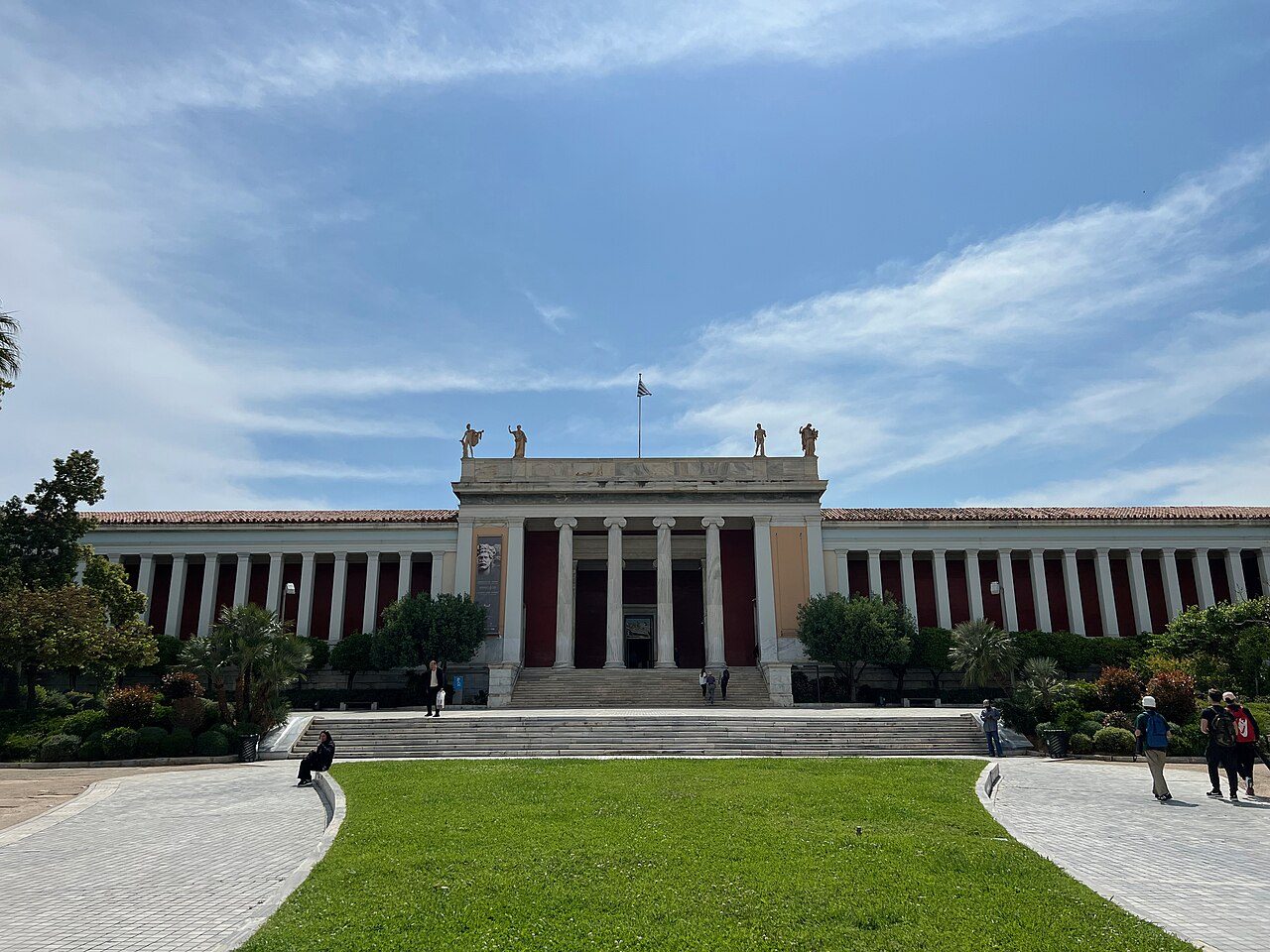
National Archaeological Museum
Fronted by a stately Ionic portico designed by architects Ludwig Lange, Panagis Kalkos, and Ernst Ziller, the monumental neoclassical facade completed in 1889 conceals the definitive treasury of ancient Hellas. Stepping off the sun-drenched pavement of Patission Street into the museum’s cool, cavernous galleries immediately suspends modern Athens in favor of antiquity. Across dozens of interconnected exhibition halls, natural daylight filters onto polished marble surfaces spanning seven millennia, tracing Greece’s artistic evolution from enigmatic Cycladic figurines to dramatic Hellenistic bronzes. In the central Mycenaean hall, the beaten-gold funerary Mask of Agamemnon gleams under low-lit glass, its hammered, stylized features evoking Heinrich Schliemann’s sensational 1876 excavations at Mycenae. Further inward stands the heroic, fifth-century BCE Artemision Bronze—arrested in perpetual motion, muscles taut as Zeus or Poseidon prepares to hurl a weapon—whose empty eye sockets project an uncanny, commanding presence into the room. Nearby, visitors lean closely over the corroded green fragments of the Antikythera Mechanism, marveling at the astonishingly complex bronze gear trains that functioned as humanity’s earliest astronomical computer, grounding the museum's artistic grandeur in profound ancient science.
More in Athens
Photo credits (5)
- Srishti Sethi, CC BY-SA 4.0, via Wikimedia Commons
- Giles Laurent, CC BY-SA 4.0, via Wikimedia Commons
- Giles Laurent, CC BY-SA 4.0, via Wikimedia Commons
- JFKennedy at English Wikipedia, Public domain, via Wikimedia Commons
- Giles Laurent, CC BY-SA 4.0, via Wikimedia Commons