
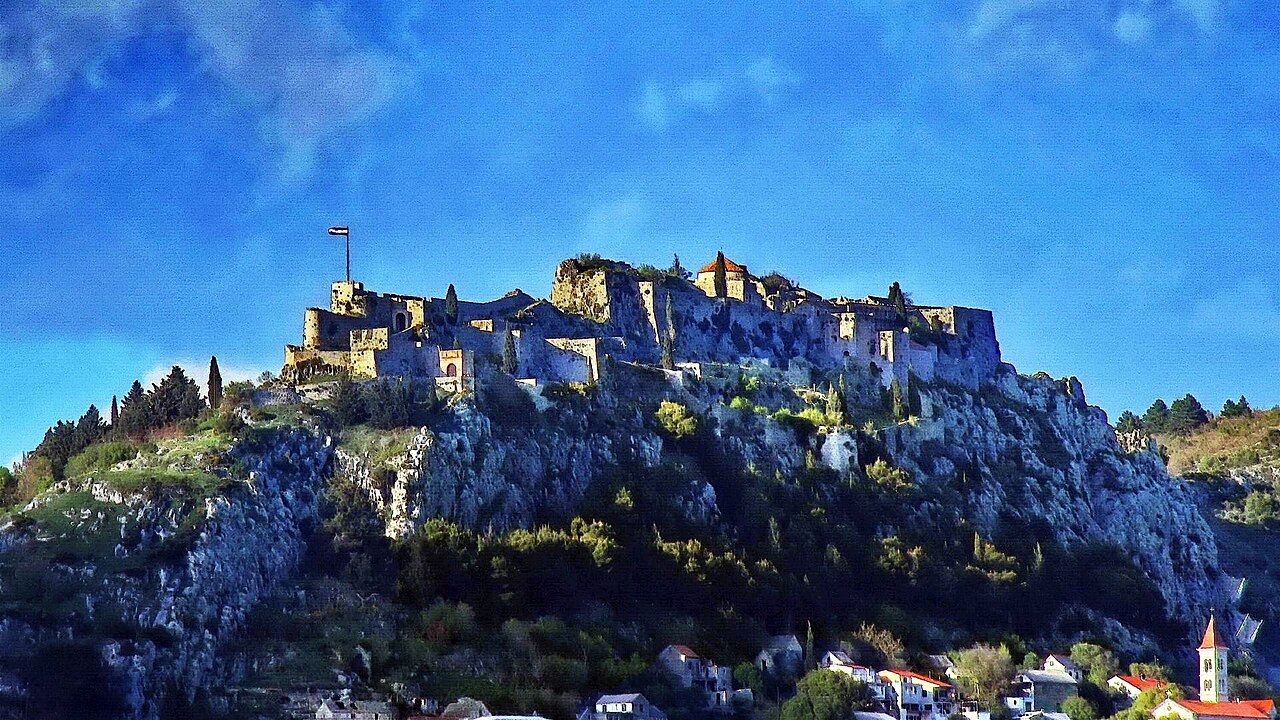
Klis Fortress
Straddling a razor-thin limestone ridge between the Mosor and Kozjak massifs, Klis Fortress has dictated access to the Dalmatian coast since the Illyrian Dalmatae first fortified the pass. Its most legendary era unfolded during the early 16th century under Captain Petar Kružić, who led the famed Uskok guerrillas in a desperate, decades-long defense against relentless Ottoman sieges until the redoubt finally fell in 1537. Subsequent Venetian modifications transformed the site into an elongated, three-tiered defensive complex carved directly out of the living bedrock. Within the central enclosure stands the Church of Saint Vitus, a rare architectural palimpsest that preserves the squinches and domed silhouette of the 16th-century Ottoman mosque built during the Turkish occupation. Ascending the weathered, switchback stone ramps, travelers encounter an uncompromising military aerie largely untouched by modern embellishment. The fierce, dry *bura* wind frequently buffets the outer bastions, carrying the scent of wild sage and rosemary rooted in the limestone mortar. Peering through narrow musket embrasures and over sheer vertical drops, visitors stand in the very footprints of Kružić’s archers. From the uppermost terrace, the fortress commands an unbroken vista: the entire Split basin stretches out below, its terracotta roofs dissolving into the deep azure waters of the Adriatic Sea and the distant, sun-bleached spine of Brač Island.
More in Split
Photo credits (2)
- Ivan T., CC BY 3.0, via Wikimedia Commons
- DIREKTOR, CC BY-SA 3.0, via Wikimedia Commons