
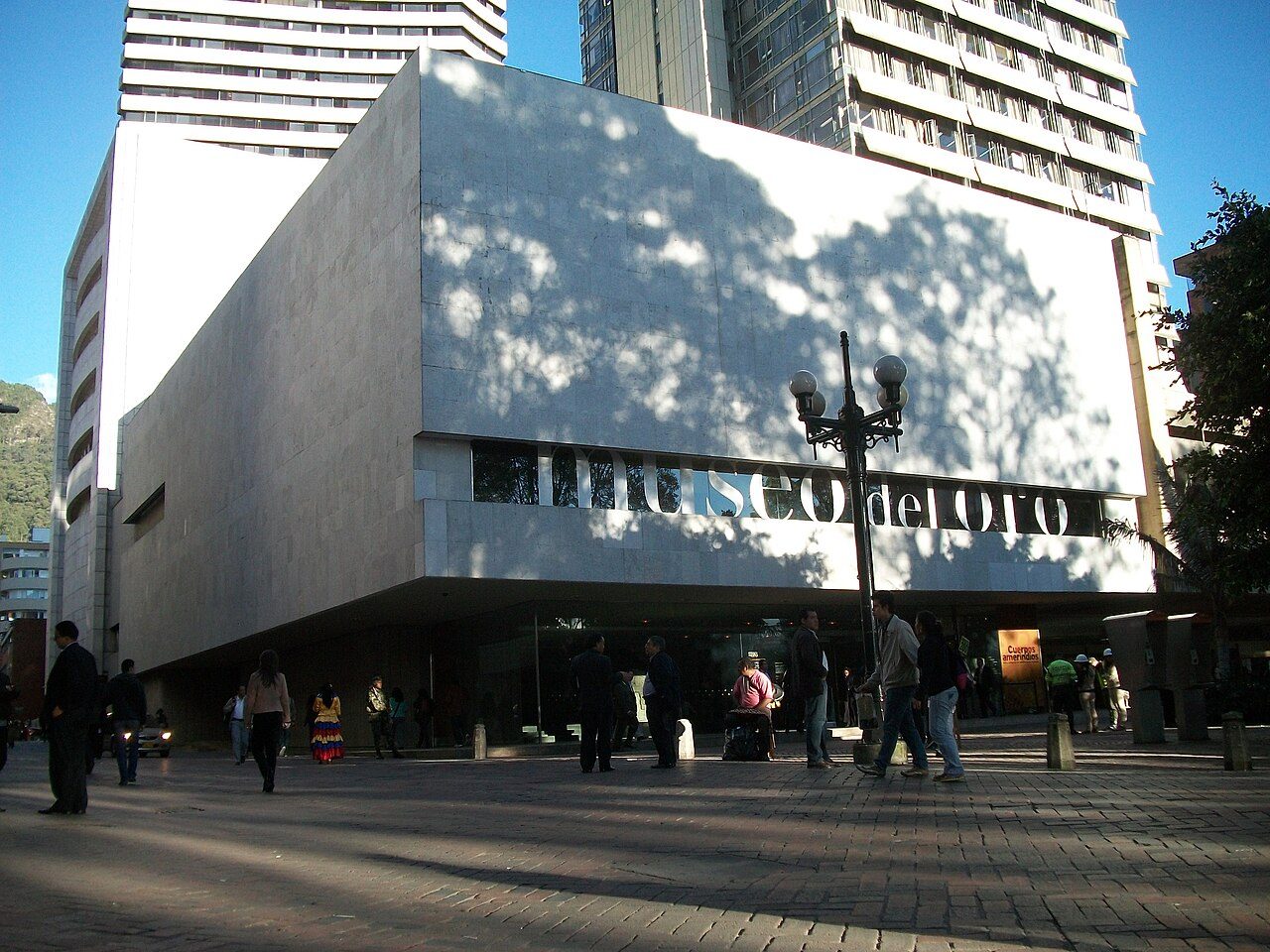
Gold Museum
Rising beside Parque Santander, the Museo del Oro safeguards the gilded legacy of Colombia’s pre-Columbian civilizations, spanning the Calima, Zenú, and Muisca cultures. Established in 1939 when the Banco de la República purchased the bulbous, ceremonial *Poporo Quimbaya*, the collection now safeguards over 34,000 gold artifacts housed behind a pale, marble-clad modernist envelope designed by architect Germán Samper Gnecco. Among its labyrinth of curated masterworks rests the intricate *Balsa Muisca* (Muisca Raft), a lost-wax cast alloy vessel dating between 600 and 1600 CE. Depicting a chieftain draped in golden ornaments on Lake Guatavita, this singular artifact preserves the tangible reality behind the mythical Spanish quest for El Dorado. Visitors drift past suspended avian masks, hammered pectorals, and filigree nose ornaments, eventually stepping into the museum’s dramatic culmination: the *Salón de la Ofrenda* (Offering Room). Inside this pitch-black, circular vault, the heavy pneumatic door glides shut, isolating observers in utter darkness as hypnotic indigenous flute recordings and ritual chanting softly resonate. Suddenly, concentric halos of light wash down translucent display cases, revealing thousands of golden votives hovering in mid-air around the perimeter. Bathed in the warm, metallic glow of sacred offerings, visitors confront an ancient metallurgy conceived not for commercial currency, but as an alchemical conduit to capture the energy of the sun.
More in Bogota
Photo credits (4)
- Felipe Restrepo Acosta, CC BY-SA 3.0, via Wikimedia Commons
- Felipe Restrepo Acosta, CC BY-SA 4.0, via Wikimedia Commons
- Felipe Ortega Grijalba, CC BY-SA 4.0, via Wikimedia Commons
- Bernard Gagnon, CC BY-SA 4.0, via Wikimedia Commons