
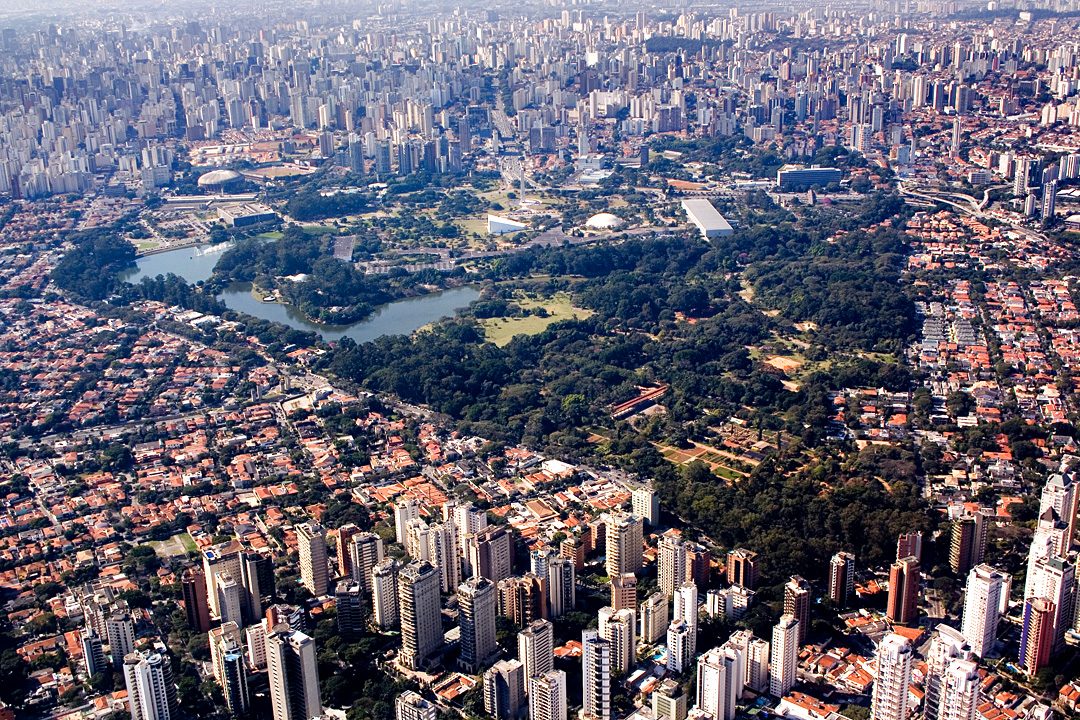
Ibirapuera Park
Inaugurated in 1954 to commemorate São Paulo’s quadricentennial, Ibirapuera Park stands as a defining monument of Brazilian high modernism. The sprawl of subtropical greenery represents a masterstroke collaboration between landscape visionary Roberto Burle Marx and architect Oscar Niemeyer. Niemeyer’s bold signature forms punctuate the verdant canopy: the stark white hemispherical dome of the Oca exhibition space rises like an extraterrestrial shell, while the trapezoidal Ibirapuera Auditorium commands attention with its blazing crimson canopy—the *labareda*—projecting dramatically over the entrance. Linking these cultural landmarks, including the Bienal Pavilion and the Museu Afro Brasil, is the iconic *Marquise*, an undulating ribbon of reinforced concrete balanced effortlessly atop slender pilotis. Stepping beneath the sheltered expanse of the Marquise, visitors enter a kinetic theater of Paulistano life, where skateboarders and rollerbladers carve fluid arcs across smooth concrete against an eclectic soundtrack of portable speakers. Drifting away from the architectural core, quiet promenades flanked by towering tipuana and purple-flowered jacaranda trees wind toward the central lake. Here, the thrum of South America’s largest metropolis softens into the rustle of bamboo and the calls of southern lapwings. Leaning over the wooden pedestrian footbridges, you look across dancing fountain jets to see Niemeyer’s gleaming white curves reflected on the water’s surface, juxtaposed starkly against São Paulo’s serrated wall of distant skyscrapers.
More in Sao Paulo
Photo credits (3)
- Fernando Stankuns, CC BY-SA 4.0, via Wikimedia Commons
- Rodrigo Tetsuo Argenton, CC BY-SA 4.0, via Wikimedia Commons
- ProtoplasmaKid, CC BY-SA 4.0, via Wikimedia Commons