
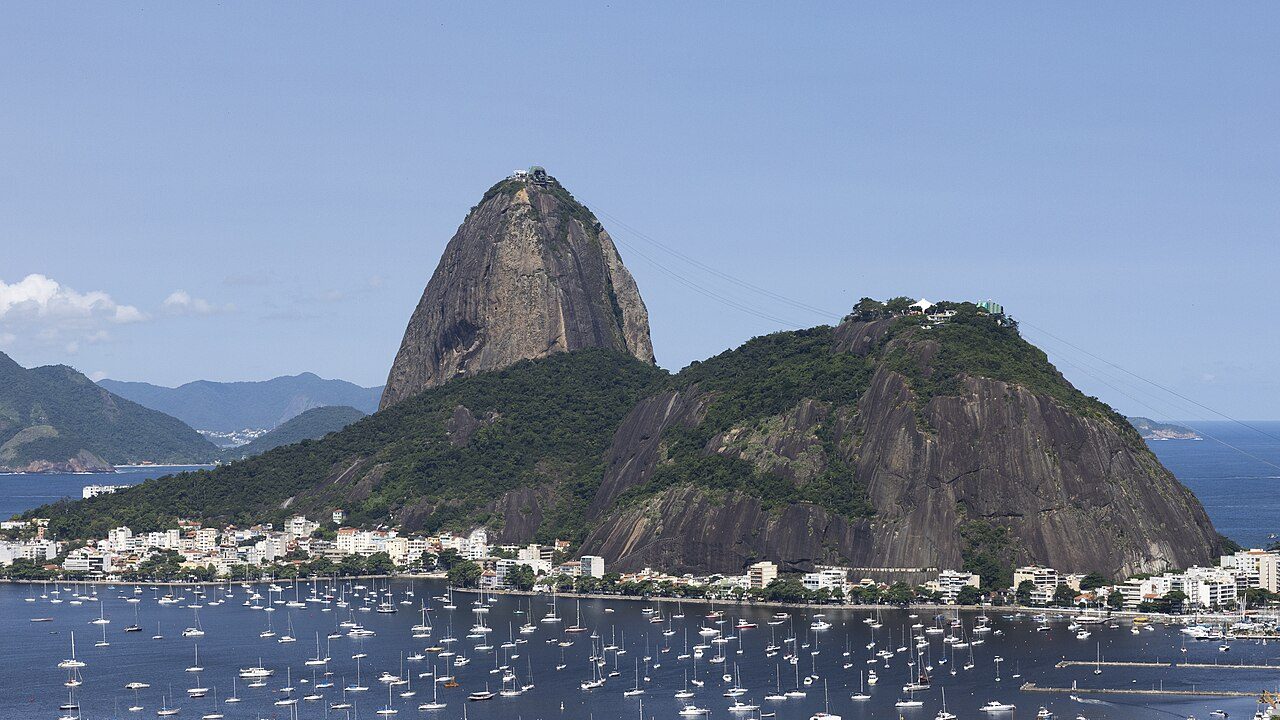
Sugarloaf Mountain
Rising 396 meters sheer above the mouth of Guanabara Bay, this pre-Cambrian monolithic inselberg owes its moniker to the 16th-century conical clay molds used by Portuguese merchants to steam and refine sugarcane for Atlantic transit. Beneath its shadow in 1565, conquistador Estácio de Sá established the fortified outpost that became Rio de Janeiro. While British climber Henrietta Carstairs first conquered its vertical gneiss faces in 1817, Brazilian engineer Augusto Ferreira Ramos transformed the landmark in 1912 by launching the *Bondinho*, the world’s third aerial cable car system. Today, aerodynamic, floor-to-ceiling glass trams glide on steel cables, vaulting passengers first to the plateau of Morro da Urca before making the final dizzying leap across the void to the summit’s weathered quartz cap. Stepping onto the open-air wooden summit boardwalks, travelers are met by crisp Atlantic breezes carrying the damp, vegetal fragrance of the surrounding Mata Atlântica canopy. Small black-tufted marmosets rustle through wild bromeliads clinging to the sheer rock face, while frigatebirds ride the thermals overhead. The viewpoint unfolds an arresting 360-degree topographical tapestry: the golden crescent of Copacabana Beach, the yacht-studded inlet of Botafogo, and the distant silhouette of Christ the Redeemer crowning Mount Corcovado. At dusk, the raw stone catches a burnished bronze glow as Rio de Janeiro’s city lights ignite across the water below.
More in Rio de Janeiro



Photo credits (5)
- Arne Müseler, CC BY-SA 3.0 de, via Wikimedia Commons
- Joalpe, CC BY-SA 4.0, via Wikimedia Commons
- Eduardo P, CC BY-SA 3.0, via Wikimedia Commons
- Arne Müseler, CC BY-SA 3.0 de, via Wikimedia Commons
- Marcos Cunha, CC BY-SA 3.0, via Wikimedia Commons