

Christ the Redeemer
Conceived in 1920 to mark Brazil’s centennial of independence, this colossal Art Deco monument was engineered by Heitor da Silva Costa and sculpted by French-Polish master Paul Landowski, with Romanian artist Gheorghe Leonida fashioning its serene, stylized visage. Officially inaugurated atop the 710-meter granite peak of Mount Corcovado in October 1931, the 30-meter reinforced concrete figure spans 28 meters from fingertip to fingertip, resting upon an eight-meter pedestal that houses the Chapel of Our Lady of Aparecida. At arm's length, the monolithic gray structure reveals exquisite surface detail: an intricate tessellation of over six million pale-green, triangular soapstone tiles, chosen for their weather resistance and hand-pasted onto mesh sheets before installation. Stepping onto the crowning observation terrace, visitors are greeted by buffeting Atlantic winds and the imposing shadow of the outstretched arms towering overhead. Far below, the Tijuca Forest gives way to the sweeping topography of Rio de Janeiro, presenting an uninterrupted panorama of Guanabara Bay, the iconic dome of Sugarloaf Mountain, the blue expanse of the Rodrigo de Freitas Lagoon, and the arc of Copacabana’s sands. As low-hanging sea mists race across the summit, the colossal figure alternates between disappearing into ethereal white fog and suddenly reemerging against the brilliant blue sky, creating a dizzying, suspended sensation high above the urban sprawl.
More in Rio de Janeiro

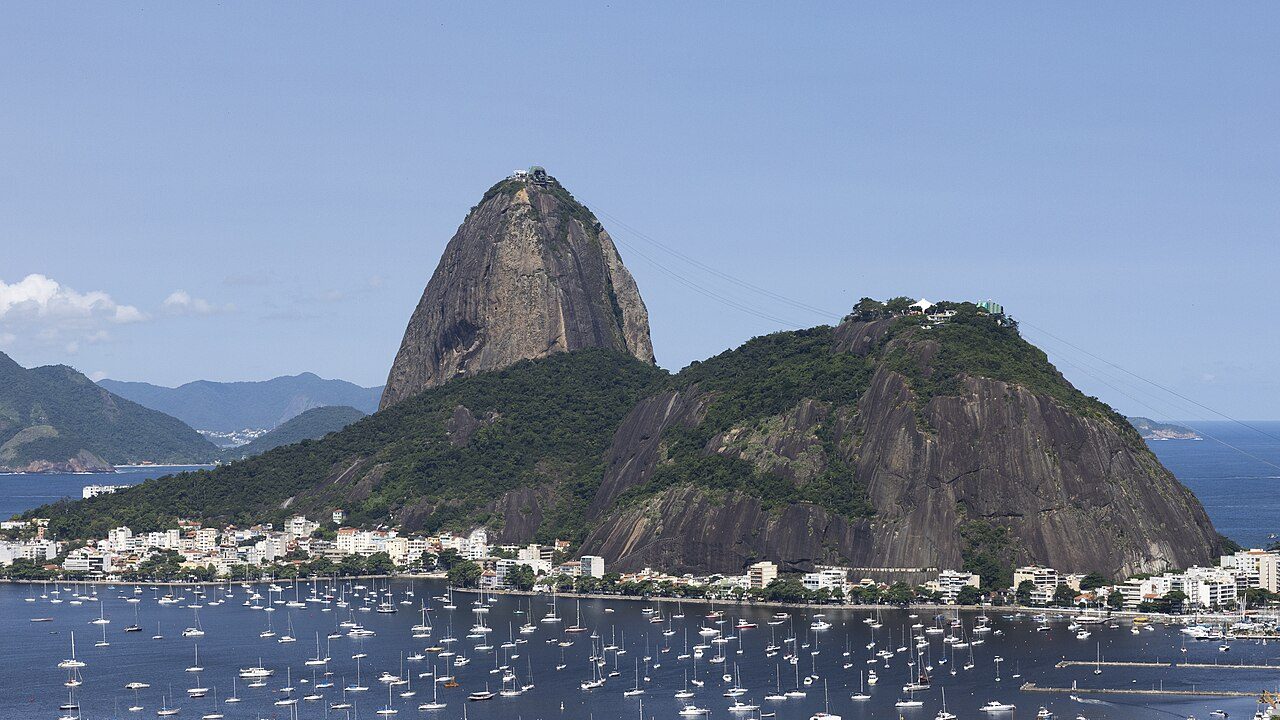

Photo credits (5)
- Joalpe, CC BY-SA 4.0, via Wikimedia Commons
- Arne Müseler, CC BY-SA 3.0 de, via Wikimedia Commons
- Eduardo P, CC BY-SA 3.0, via Wikimedia Commons
- Arne Müseler, CC BY-SA 3.0 de, via Wikimedia Commons
- Marcos Cunha, CC BY-SA 3.0, via Wikimedia Commons