
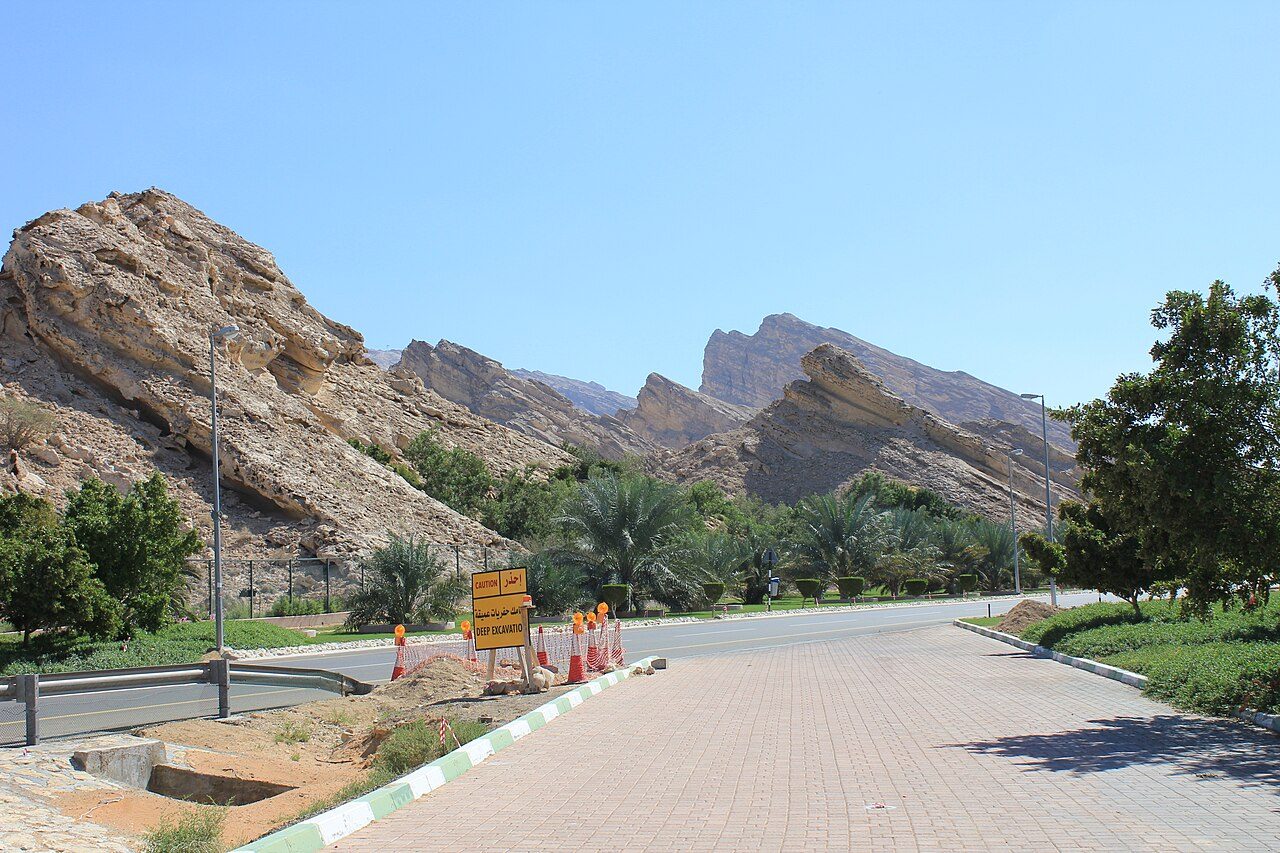
Jebel Hafeet
Rising 1,249 meters above the desert floor, this craggy spine of fractured Tertiary limestone safeguards some of Arabia’s oldest human antiquities. Clustered along its eastern foothills stand the UNESCO-inscribed beehive tombs of the Hafit period (3200–2700 BCE), dome-shaped Bronze Age sepulchers assembled from dry-stacked, uncemented fieldstones that once sheltered Mesopotamian ceramic imports and copper daggers. In the 1980s, the late Sheikh Zayed bin Sultan Al Nahyan oversaw the construction of the mountain’s world-renowned ascent: a three-lane highway of twenty-one sweeping hairpin turns engineered into the sheer, stratified rock face. Ascending the precipitous switchbacks, travelers feel the desert swelter yield to brisk, high-altitude gales that whistle through deep ravines and exposed marine fossil beds. At the rocky crest, the landscape drops dramatically, revealing the emerald date palm groves of the Al Ain oasis contrasting sharply with the amber ripples of the vast Rub' al Khali (Empty Quarter) stretching beyond the Omani border. As twilight descends, the setting sun washes the eroded limestone crags in burnished ochre and deep violet, while the sodium-vapor lamps along the serpentine road ignite like a ribbon of amber embers cutting through prehistoric stillness.
More in Al Ain
Photo credits (3)
- Xiaotong Gao, CC BY-SA 3.0, via Wikimedia Commons
- Kaulike2b, CC BY-SA 4.0, via Wikimedia Commons
- Slywire, CC BY-SA 4.0, via Wikimedia Commons