
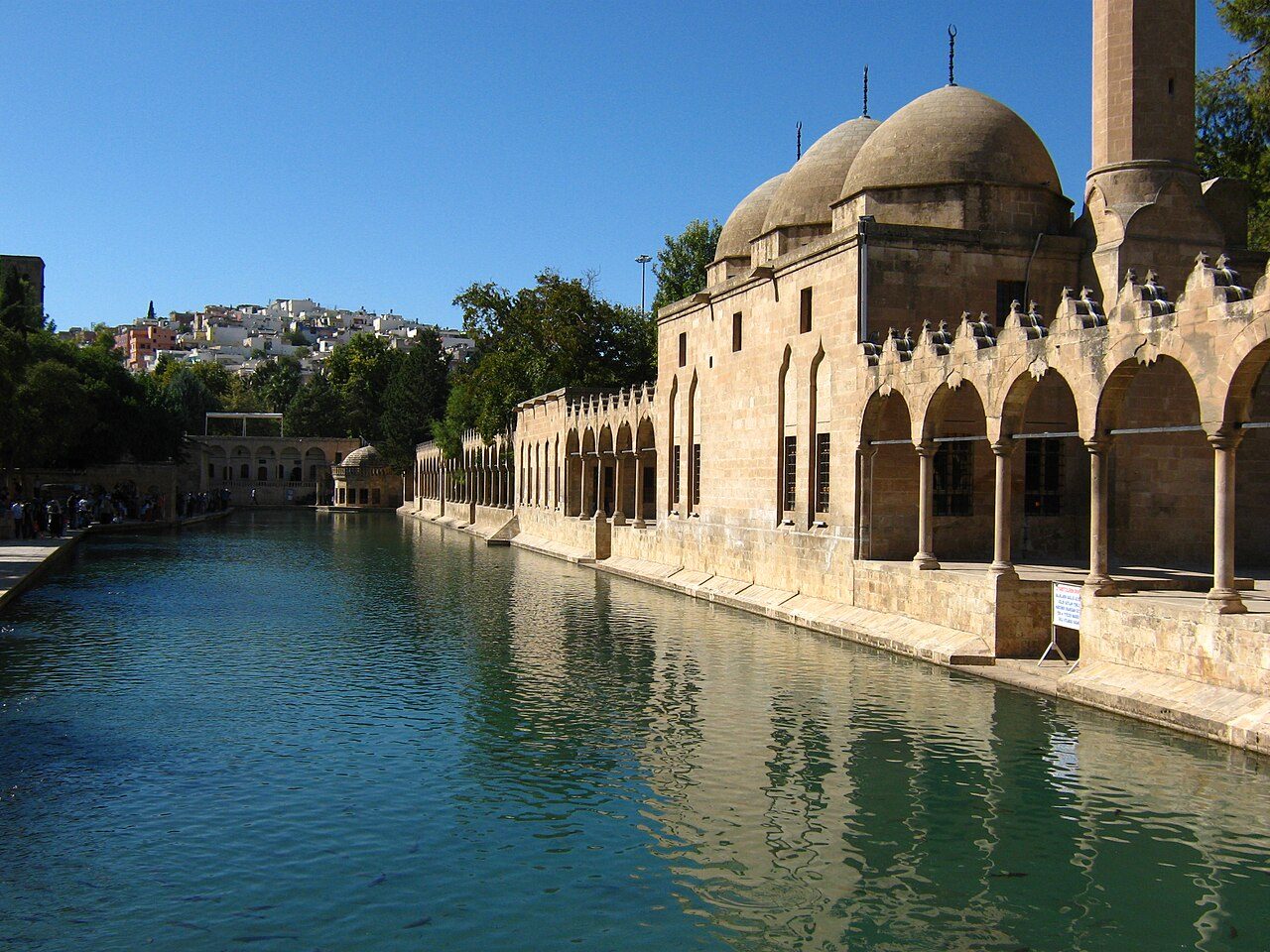
Balikligol
According to sacred Abrahamic tradition, the tyrant King Nimrod cast the Prophet Abraham into a raging pyre from the craggy citadel above, only for the inferno to miraculously transmute into cool spring water and the burning embers into swimming carp. Today, this legend anchors Balıklıgöl, an elongated rectangular basin framed by the warm, honey-toned Urfa limestone of surrounding medieval sanctuaries. Along the northern perimeter stretches the 1716 Rizvaniye Mosque, distinguished by its Ottoman portico of pointed arches and serene open-air madrasa, while the southwest bank features the 1211 Ayyubid-founded Halil-ür Rahman Mosque, whose square-shafted, former Byzantine watchtower minaret casts sharp shadows across the reflective surface. Standing along the stone balustrades beneath weeping willows, visitors encounter thousands of sacred, dark-scaled carp that churn the emerald-green water into silver ripples whenever pilgrims scatter pellets of feed. A light humidity hangs in the courtyard, carrying the faint scent of stone dust, crushed laurel, and frankincense wafting from nearby courtyards. As the call to prayer echoes off the limestone arcades and the dramatic twin Corinthian columns perched on the cliffs overhead, the ambient murmurs drop into shared reverence, immersing travelers in a living tableau of ancient theology and Levantine architecture.
More in Sanliurfa
Photo credits (3)
- Anadolu, CC BY-SA 3.0, via Wikimedia Commons
- Teomancimit, CC BY-SA 3.0, via Wikimedia Commons
- Zhengan, CC BY-SA 4.0, via Wikimedia Commons