
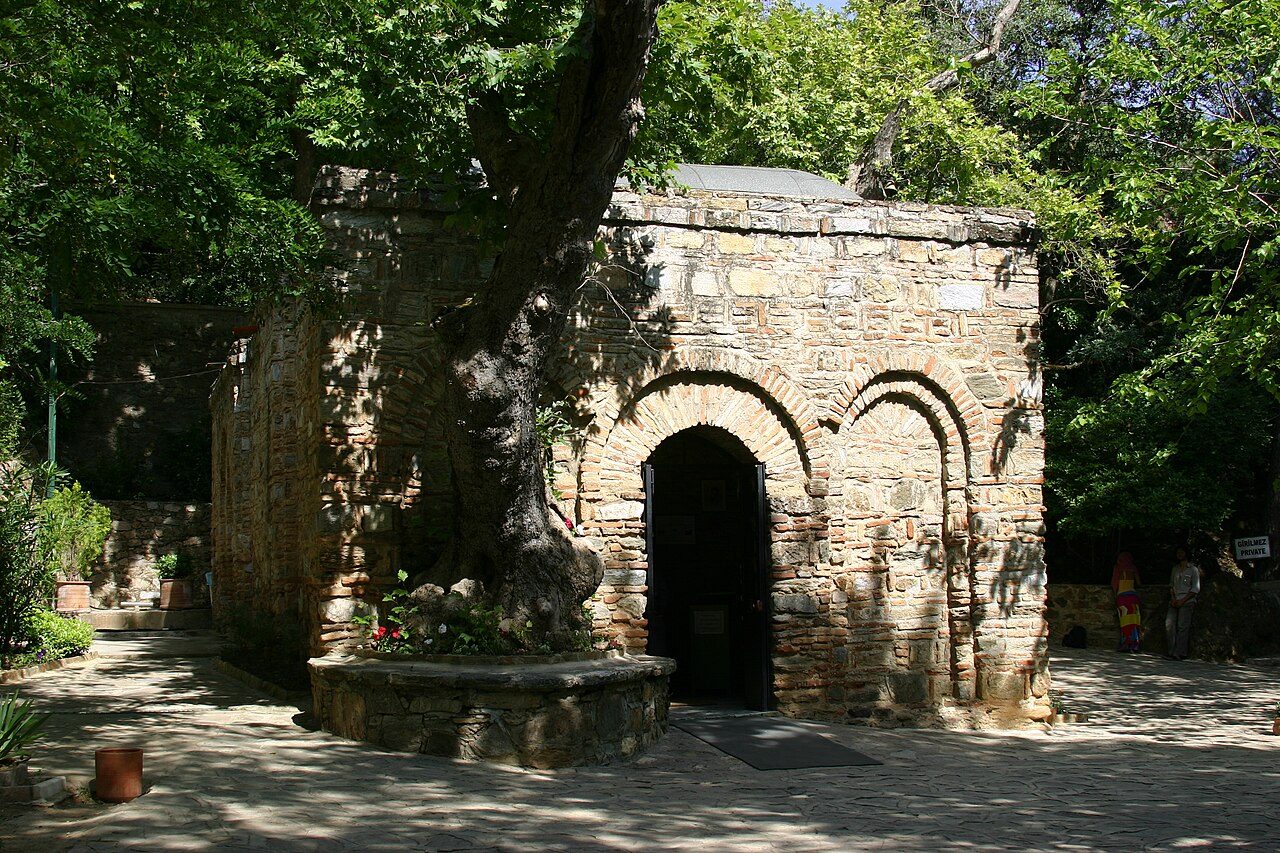
House of the Virgin Mary
Perched within the pine-cloaked ridge of Mount Koressos (Bülbüldağı), this modest sanctuary emerged from obscurity in 1891 when Lazarist priests retraced the detailed visions of bedridden German mystic Anne Catherine Emmerich. Early Christian tradition holds that the Apostle John brought the Virgin Mary here to escape Jerusalem’s persecutions, sheltering her in these wooded hills until her Assumption. Constructed of weathered reddish-grey fieldstone, the current cruciform chapel dates to the sixth and seventh centuries, though its core rests upon first-century Roman foundations. Its exterior is disarmingly austere, defined by thick masonry, a low-slung dome, and a recessed archway that opens directly into antiquity. Stepping through the threshold, the dry Aegean heat yields to a cool, shadowed quiet scented with frankincense and melting beeswax. Inside the dimmed nave, daylight filters toward a solitary apse where a delicate bronze statue of Mary stands over an altar adorned with fresh-cut lilies and flickering votive tapers. Exiting into the mountain breeze, visitors descend toward three stone fountains fed by a sacred spring believed to hold healing virtues. Just beyond stands the iconic Wishing Wall, where the sensory journey culminates before a staggering, woven tapestry of hundreds of thousands of knotted white cloths and paper slips, each bearing an intimate prayer penned in languages from across the globe.
More in Selcuk
Photo credits (6)
- No machine-readable author provided. Mfryc assumed (based on copyright claims)., CC BY-SA 2.5, via Wikimedia Commons
- Benh LIEU SONG, CC BY-SA 3.0, via Wikimedia Commons
- Benh LIEU SONG, CC BY-SA 3.0, via Wikimedia Commons
- Arkiyolok, CC BY-SA 4.0, via Wikimedia Commons
- Bernard Gagnon, CC BY-SA 3.0, via Wikimedia Commons
- Ahmet Tuna Yesilyayl…, CC BY 3.0, via Wikimedia Commons