
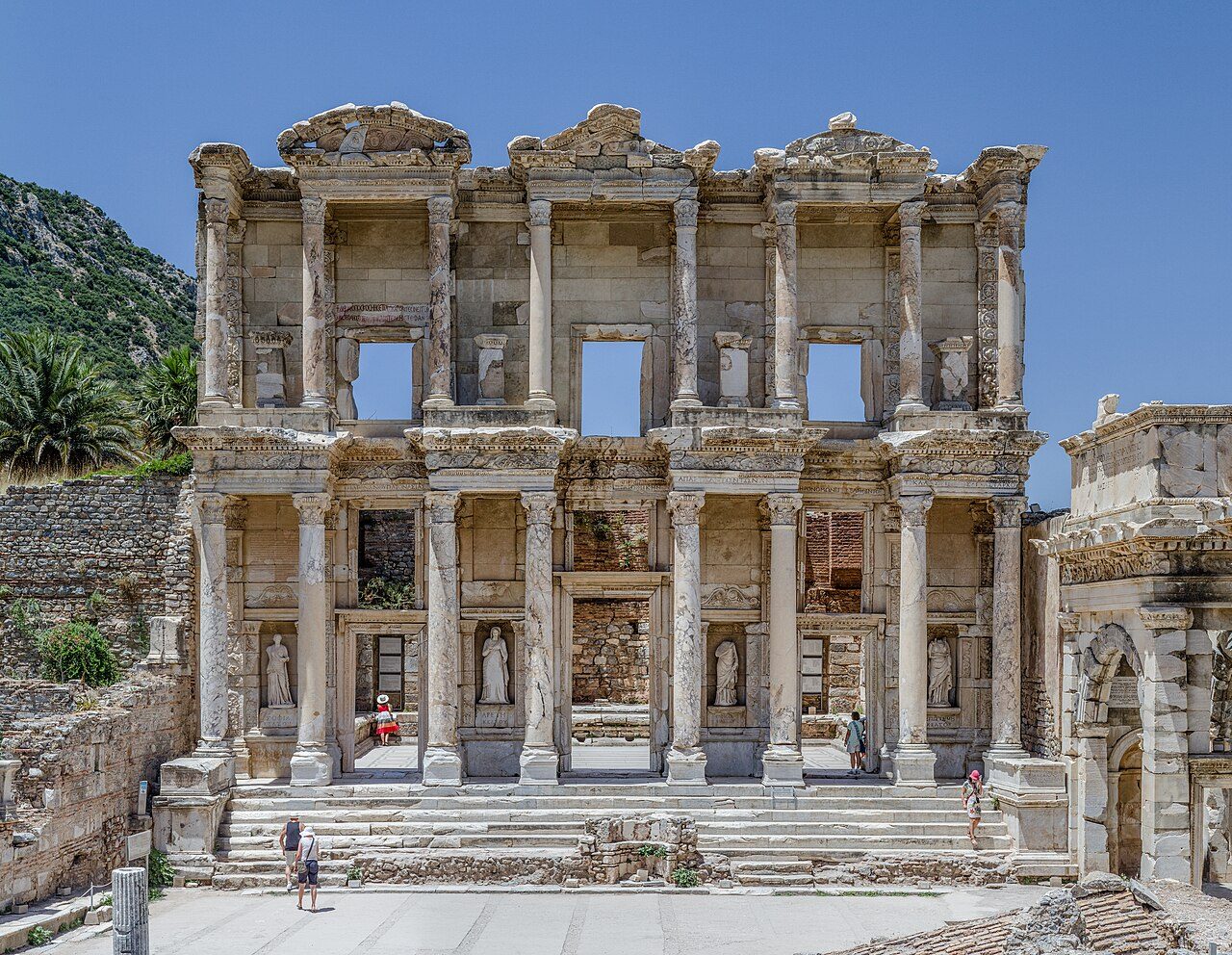
Library of Celsus
Commissioned in 114 AD by the Roman consul Gaius Julius Aquila to honor his late father, Tiberius Julius Celsus Polemaeanus, this monumental structure served dual purposes as a family mausoleum and a repository for 12,000 parchment scrolls. Reconstructed meticulously from tumbled rubble by Austrian archaeologists in the 1970s, the two-story marble façade stands as a masterwork of Roman imperial theatricality. Sixteen soaring Corinthian columns support alternating triangular and curved pediments, utilizing clever optical illusions—such as convex grading and wider central bays—to make the building appear broader and taller than its physical footprint. Stepping onto the sun-bleached flagstones at the foot of Curetes Street, you are dwarfed by the sheer verticality of honey-hued marble glowing against the Mediterranean sky. In the lower level's recessed wall niches stand detailed replicas of the four personified civic virtues: Sophia (Wisdom), Arete (Valor), Ennoia (Intelligence), and Episteme (Knowledge). Passing through the triple entrance into the open-air reading hall, the cool breeze carries the scent of wild thyme from the surrounding hills into the rectangular interior, where brick niches that once housed wooden bookcases encircle the sunken, vaulted crypt containing Celsus’s original lead-lined sarcophagus.
More in Selcuk
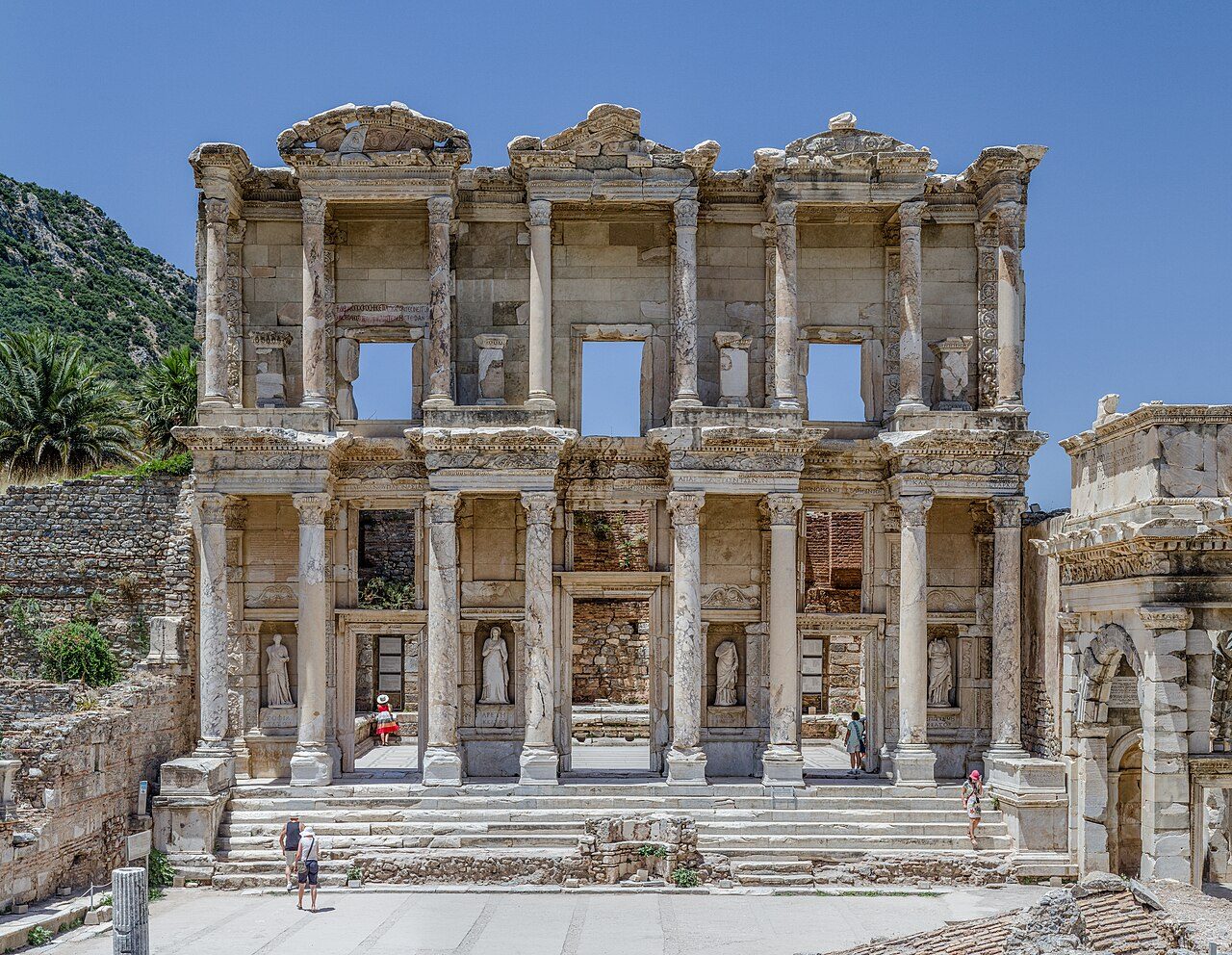
Photo credits (6)
- Benh LIEU SONG, CC BY-SA 3.0, via Wikimedia Commons
- Benh LIEU SONG, CC BY-SA 3.0, via Wikimedia Commons
- No machine-readable author provided. Mfryc assumed (based on copyright claims)., CC BY-SA 2.5, via Wikimedia Commons
- Arkiyolok, CC BY-SA 4.0, via Wikimedia Commons
- Bernard Gagnon, CC BY-SA 3.0, via Wikimedia Commons
- Ahmet Tuna Yesilyayl…, CC BY 3.0, via Wikimedia Commons