
Ephesus
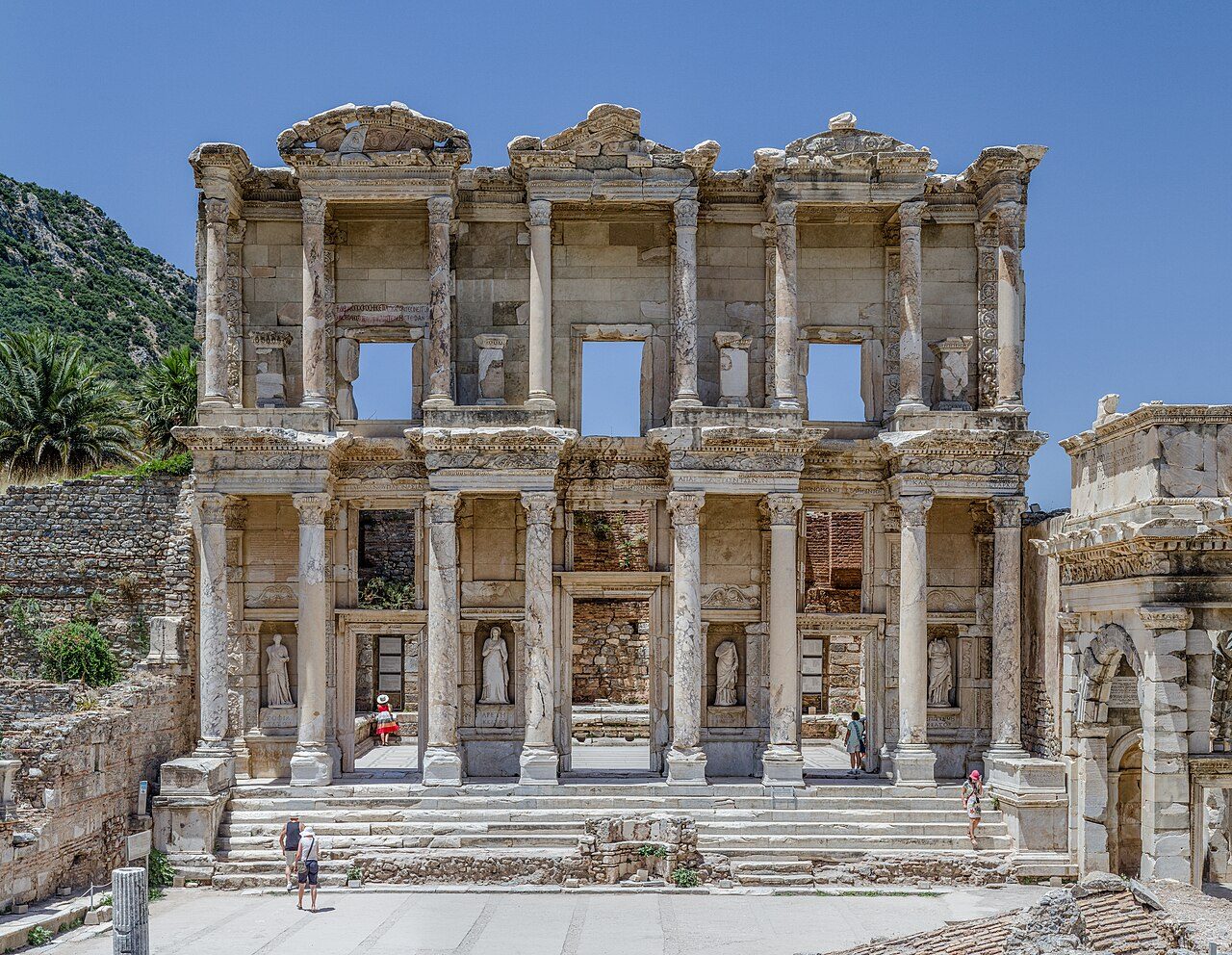
Beneath the scrub-covered slopes of Mount Pion, Ephesus sprawls as the crown jewel of Roman Asia, where first-century CE civic grandeur still commands the landscape. Walking down the sun-bleached marble slabs of Curetes Street, visitors trace ancient chariot ruts worn deep into the stone, passing the intricate relief carvings of Trajan’s Fountain and the Corinthian peristyle of Hadrian’s Temple. The visual crescendo arrives at the Library of Celsus, commissioned around 114 CE by consul Tiberius Julius Aquila. Its towering, two-tiered facade of honey-colored marble glows against the Aegean sky, framed by alternating curved and triangular pediments alongside four replica statues standing in shaded niches to embody Wisdom, Knowledge, Intelligence, and Virtue. Beyond the library, the marble-paved Arcadian Way leads toward the Great Theatre, a colossal semicircular auditorium carved directly into the bedrock that once held 25,000 spectators. Here, the acoustic engineering still carries spoken words to the topmost rim, where the apostle Paul famously incited the fury of the Artemis silversmiths around 55 CE. Within the sheltered slopes of the Terrace Houses, visitors tread elevated glass walkways directly above the private living quarters of Ephesus’s elite, looking down on polychromatic geometric mosaics, preserved hypocaust heating channels, and vivid wall frescoes depicting muses and philosophers. Under the fierce Aegean sun, the scent of wild thyme mingles with radiating heat from the limestone, conjuring the daily pulse of an imperial metropolis.
More in Selcuk
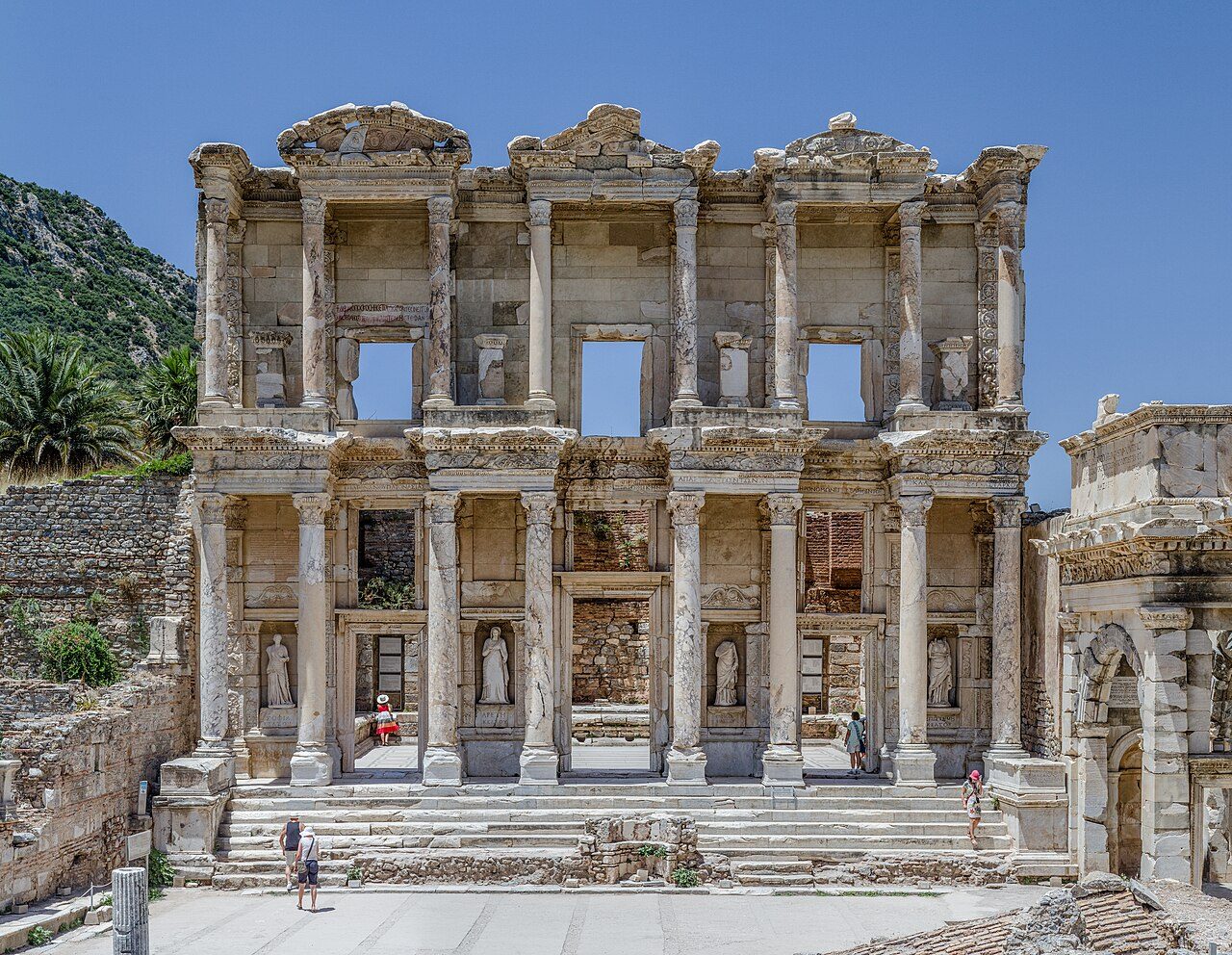
Photo credits (6)
- Benh LIEU SONG, CC BY-SA 3.0, via Wikimedia Commons
- Benh LIEU SONG, CC BY-SA 3.0, via Wikimedia Commons
- No machine-readable author provided. Mfryc assumed (based on copyright claims)., CC BY-SA 2.5, via Wikimedia Commons
- Arkiyolok, CC BY-SA 4.0, via Wikimedia Commons
- Bernard Gagnon, CC BY-SA 3.0, via Wikimedia Commons
- Ahmet Tuna Yesilyayl…, CC BY 3.0, via Wikimedia Commons