
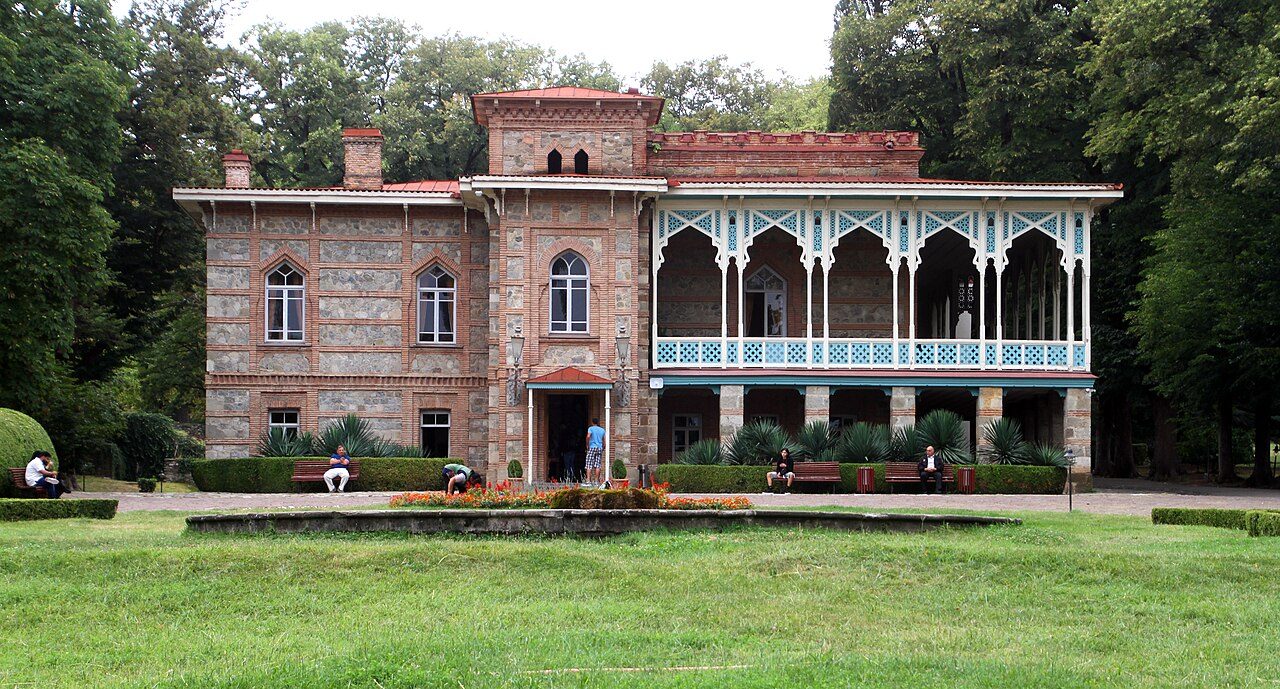
Tsinandali Estate
Cradle of Georgian romanticism and modern viticulture, the Tsinandali Estate was the 19th-century salon of poet-prince Alexander Chavchavadze. In 1841, Chavchavadze wed ancestral clay-vessel methods to European barrel aging inside these walls, bottling Georgia’s first Western-style vintages. The two-story manor seamlessly fuses Italianate neoclassicism with indigenous Kakhetian architecture, distinguished by expansive fretwork verandas and delicate wooden lace *shushabandi* (latticed galleries) overlooking the Alazani Valley. Inside, polished parquet leads through grand parlors appointed with St. Petersburg grand pianos, velvet upholstery, and heirloom silver, echoing an aristocratic golden age that was violently interrupted in 1854 when Dagestani forces loyal to Imam Shamil raided the estate and captured the prince’s family. Outside, the traveler wanders through an 18-hectare English-style landscape park laid out in the 1880s by Prussian botanist Arnold Regel. Beneath towering Japanese ginkgos, Lebanese cedars, and fragrant boxwood tunnels, the warm Kakhetian air gives way to subterranean chill as you descend stone steps into the historic winery and oenotheque. Within these brick-vaulted vaults rest more than 16,500 cobwebbed bottles, including a legendary 1814 Polish Honey and Chavchavadze’s pioneering 1841 Saperavi. Standing in the cellar's cool, damp gloom with the scent of aged oak hanging heavy, visitors touch the exact intersection where Georgian wine shed its medieval isolation to enter the global stage.
More in Telavi

Photo credits (3)
- Gerd Eichmann, CC BY-SA 4.0, via Wikimedia Commons
- Kakhi Kuloshvili, CC BY-SA 4.0, via Wikimedia Commons
- Draceane, CC BY-SA 4.0, via Wikimedia Commons