
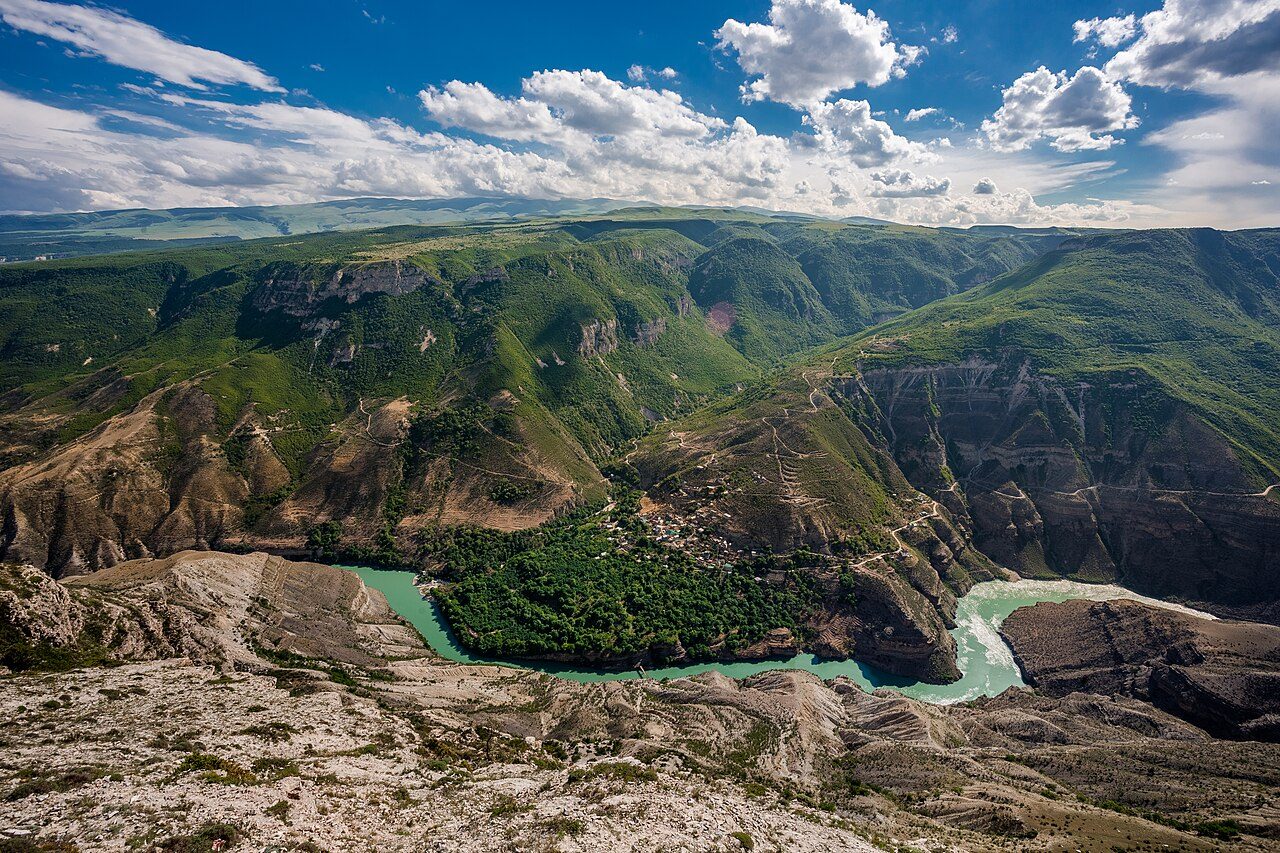
Sulak Canyon
Carved through the limestone spine of Dagestan, Sulak Canyon plunges to a staggering depth of 1,920 meters, slicing a chasm deeper than Arizona’s Grand Canyon. Beneath its jagged precipices winds the Sulak River, an intensely turquoise ribbon fed by glacial runoff. These chalky ramparts served as a brutal theater during the 19th-century Caucasian War, providing natural fortresses for Imam Shamil’s fighters and later inspiring Leo Tolstoy’s 1872 masterpiece, *The Prisoner of the Caucasus*. Human engineering dramatically altered the gorge in the 1970s with the construction of the Chirkey Hydroelectric Dam, whose towering 232-meter arched concrete wall impounds the river into a sweeping sapphire reservoir against barren, folded ridges. Standing on the windswept observation rims near the village of Dubki, travelers encounter a vertiginous drop where Eurasian griffon vultures circle on thermal updrafts hundreds of meters below eye level. The sheer terraced walls transition through shades of rust, ochre, and pale ash as shifting cloud shadows play across the gorge. At the canyon floor, accessible by rattling descents down steep mountain switchbacks, the vast silence gives way to the roar of twin-engine skiffs skimming across the water. Passengers navigate narrow bends hemmed in by weeping limestone cliffs, enveloped by cold mineral spray as subterranean springs burst directly from the rock face into the turquoise depths.
More in Makhachkala

Photo credits (4)
- Sobolev Alexander, CC BY-SA 4.0, via Wikimedia Commons
- Ksenia Romanenko, CC BY-SA 4.0, via Wikimedia Commons
- Vyacheslav Bukharov, CC BY-SA 4.0, via Wikimedia Commons
- Dinamik, CC BY-SA 4.0, via Wikimedia Commons