
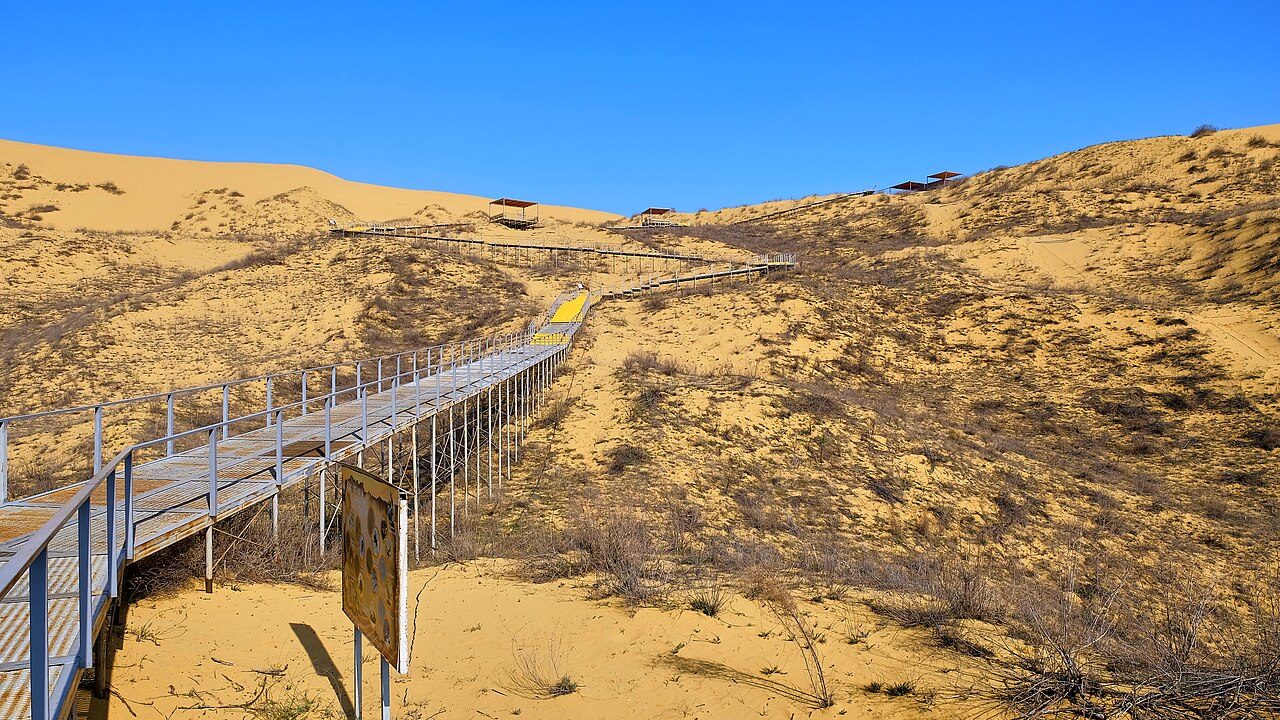
Sarykum Sand Dune
Rising incongruously against the jagged Caucasus foothills, the Sarykum Sand Dune is Eurasia’s largest isolated sand mountain, an ancient geological anomaly formed over hundreds of thousands of years by winds funneling alluvial deposits from the Narat-Tyube ridge. Its golden crests earned it the Kumyk name for "yellow sand," drawing the curiosity of 19th-century traveler Alexandre Dumas during his 1858 Caucasian journey. Decades later, Soviet cinema immortalized this landlocked desert in 1969, when director Vladimir Motyl filmed the iconic drama *White Sun of the Desert* on its slopes, utilizing Dagestan’s wind-carved contours as a stand-in for the Central Asian Karakum. Ascending the elevated boardwalk designed to preserve the fragile habitat, visitors encounter an abrupt thermal surge as radiant heat rises off ochre ridges reaching heights of up to 250 meters. The summit continuously shifts in the mountain gales, whipping fine quartz powder into transient ripples that shelter rare fauna, including spur-thighed tortoises and venomous blunt-nosed vipers. Standing along the narrow upper spine, the sensory contrast is dramatic: dry sand sifts warmly across the viewing platform, while directly below, the rushing Shura-Ozen River cuts through lush green valleys, offering a surreal panorama where arid Saharan conditions collide directly with alpine wilderness.
More in Makhachkala

Photo credits (3)
- Vyacheslav Bukharov, CC BY-SA 4.0, via Wikimedia Commons
- Ksenia Romanenko, CC BY-SA 4.0, via Wikimedia Commons
- Dinamik, CC BY-SA 4.0, via Wikimedia Commons