
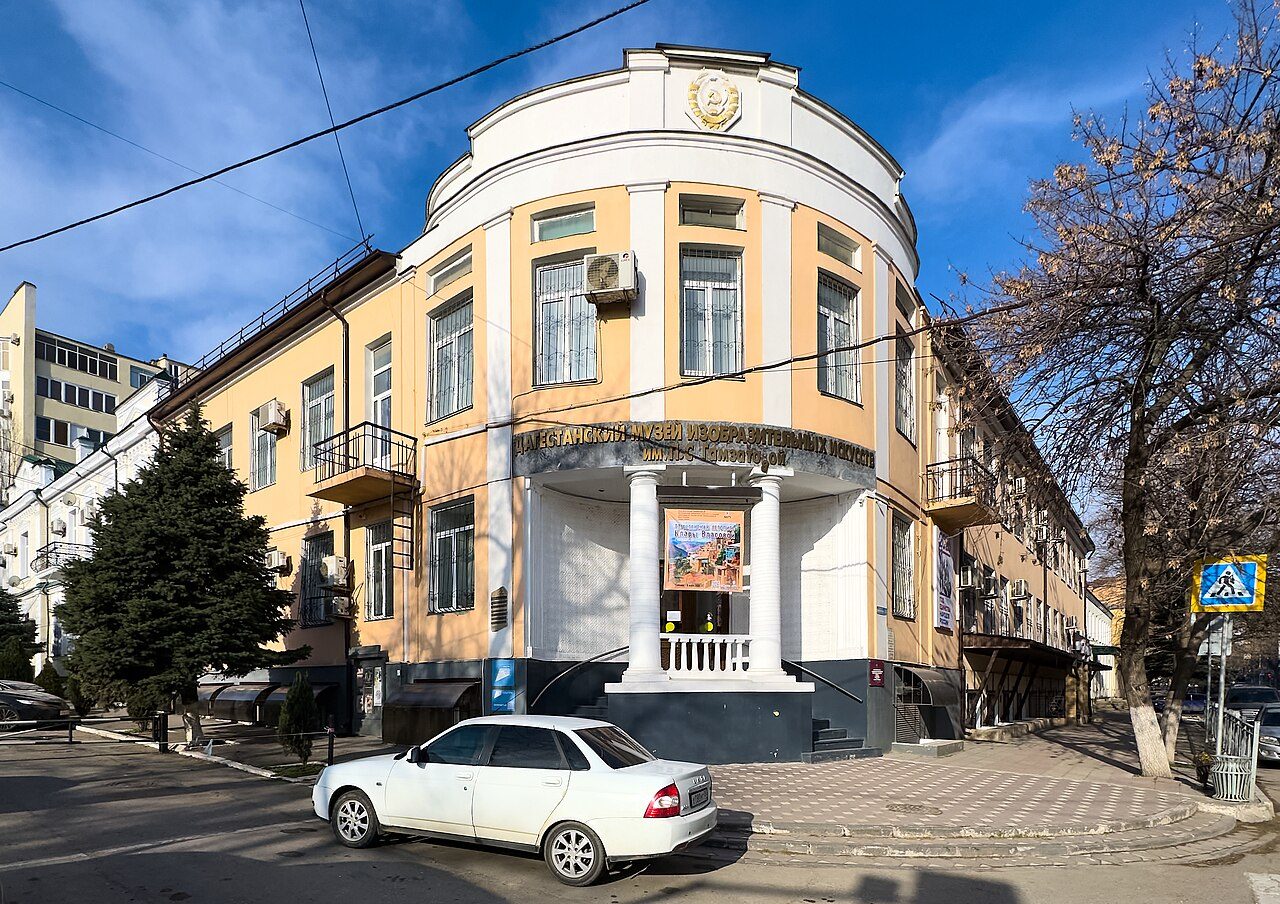
Dagestan Museum of Fine Arts
Established in 1958 and later named in honor of long-serving director Patimat Gamzatova, the museum occupies a sober, early-20th-century neoclassical edifice on Makhachkala’s leafy Gorky Street. Behind its restrained facade lie ten distinct exhibition rooms holding over fourteen thousand works, establishing the Northern Caucasus’s foremost visual chronicle. Visitors navigate polished salons hung with Russian imperial canvases—including maritime scenes by Ivan Aivazovsky and panoramic frontier studies by Franz Roubaud—alongside early-20th-century works by Dagestani trailblazers like Muetdin-Arabi Dzhemal, whose portraits translate the weathered dignity of highland elders against sheer vertical *auls*. The heart of the collection shifts into the tactile realm of Caucasian decorative arts. Visitors stand inches from sacred 17th- and 18th-century Kaitag embroideries, their talismanic silk-and-indigo solar disks once stitched onto hand-spun cotton to protect infants in cradles. Nearby vitrines capture the metallic gleam of Kubachi craftsmanship, from niello-engraved silver kindjal daggers to intricately embossed brass water jugs. Walking along the creaking parquet, the subtle scent of aged wool drifts from vegetal-dyed Tabasaran carpets and ink-dark Untsukul wood inlays, allowing travelers to encounter an aesthetic crucible shaped by Persian, Ottoman, and mountain-clan traditions.
More in Makhachkala

Photo credits (4)
- Vyacheslav Bukharov, CC BY-SA 4.0, via Wikimedia Commons
- Ksenia Romanenko, CC BY-SA 4.0, via Wikimedia Commons
- Vyacheslav Bukharov, CC BY-SA 4.0, via Wikimedia Commons
- Dinamik, CC BY-SA 4.0, via Wikimedia Commons