
 New added
Bangladesh
Anchored along the curving banks of the Buriganga River, Dhaka embodies the historical soul of Bangladesh, evolving from its 17th-century prominence as the Mughal provincial capital Jahangirnagar to the epicenter of the 1971 Liberation War. The capital’s complex architectural lineage spans centuries of dramatic transformation. In Old Dhaka, the 1678 Lalbagh Fort showcases red sandstone bastions and the octagonal mausoleum of Pari Bibi capped by a brass dome, while nearby stands Ahsan Manzil, an Indo-Saracenic palace reconstructed in 1872 by Nawab Abdul Ghani, defined by its bubble-shaped dome and sweeping grand staircase painted in saturated pink. A few miles north, the narrative shifts sharply into modernist monumentality at the Jatiya Sangsad Bhaban, designed by Louis Kahn and completed in 1982, where raw, layered concrete walls carved with colossal triangles and circles hover dramatically over an artificial moat. Navigating this dense urban landscape places travelers amid an unrelenting sensory rhythm punctuated by the melodic chiming of thousands of brass rickshaw bells, their carriage chassis emblazoned with vibrant folk art. The dense air carries the scent of river silt blended with smoking mustard oil and slow-cooked mutton *kacchi biryani* drifting from hidden alleyway cauldrons. Beneath the cavernous 117-foot-high ceiling of Kahn's parliamentary assembly hall, a sudden, cathedral-like quiet replaces the street chaos as shafts of pale daylight pierce monumental cutouts, casting sharp geometric shadows across bare concrete that capture the solemn resilience of a hard-won nation.
 Kawsar Milon
More in Dhaka
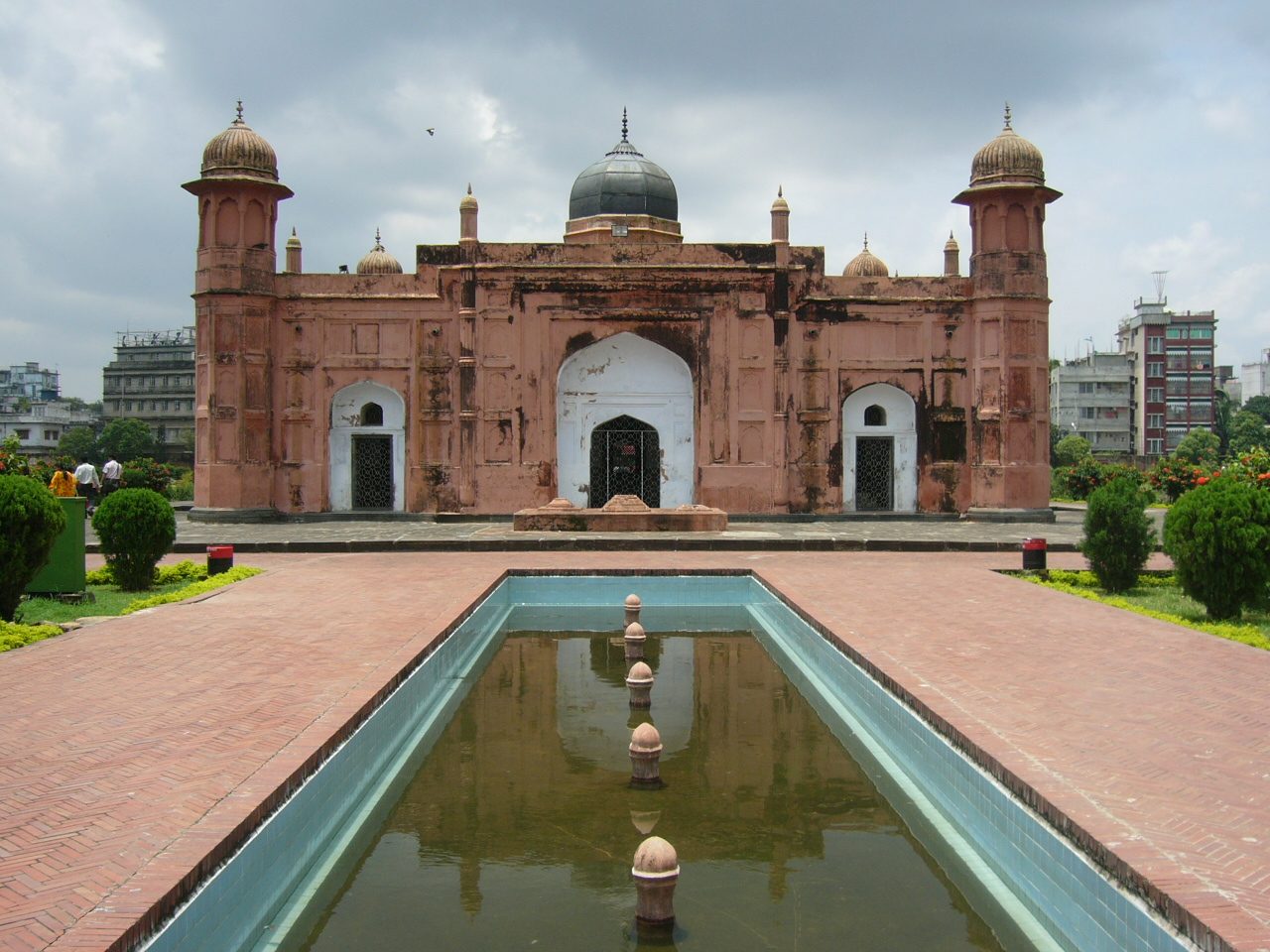
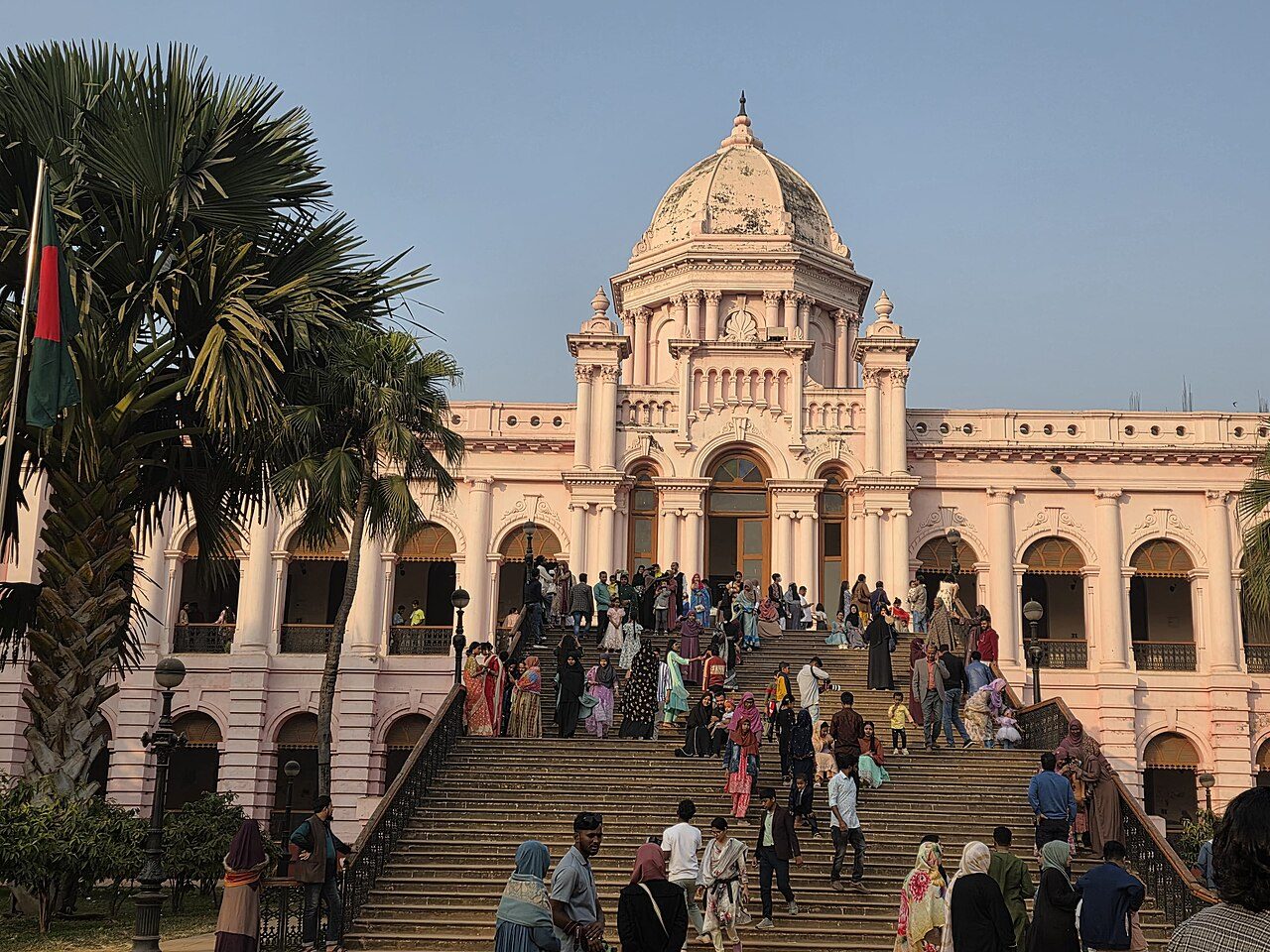
Photo credits (3)
- Alok Majumdar, CC BY-SA 4.0, via Wikimedia Commons
- No machine-readable author provided. Shmunmun assumed (based on copyright claims)., Public domain, via Wikimedia Commons
- Nafiz6167, CC BY-SA 4.0, via Wikimedia Commons