
 New added
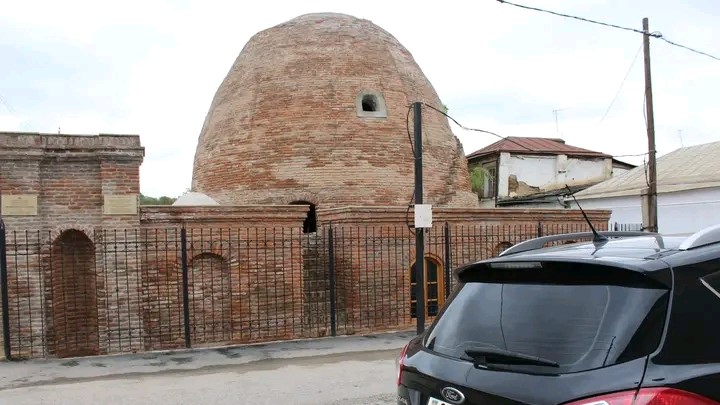
Chukhur Hamam
Built at the turn of the nineteenth century under the enduring architectural traditions of the Quba Khanate, Chukhur Hamam derives its name from the deep earthen hollow into which it was sunken to trap ambient subterranean warmth. Constructed entirely from locally fired red brick bound with a traditional mortar tempered by egg whites, the bathhouse earned international renown in 1858 when French novelist Alexandre Dumas bathed within its vaulted chambers during his journey across the Caucasus. Six interconnected chambers spread outward beneath an arresting cluster of hemispherical beehive cupolas, crowned by a dominant central dome originally engineered with rooftop vents to regulate moisture and exhaust wood smoke. Approaching the excavated perimeter, visitors encounter a striking landscape of weathered crimson masonry contrasting against Quba's surrounding greenery, dominated by the surreal, bubble-like profiles of the roofline. Stepping inside the quiet, preserved interior, the air feels noticeably cooler and subterranean, carrying the dry, mineral scent of aged lime plaster and fired clay. Gazing upward through the grand bathing hall, natural light spears through the geometric ocular apertures of the main rotunda, illuminating arched brick alcoves and the floor-level stone channels where roaring hypocaust heat once warmed generations of Silk Road travelers.
 Qarqar
More in Quba
Photo credits (4)
- Irada, CC BY-SA 3.0, via Wikimedia Commons
- David Uriarte, CC BY-SA 4.0, via Wikimedia Commons
- Asif Masimov, CC BY-SA 3.0, via Wikimedia Commons
- Gunel77, CC BY-SA 4.0, via Wikimedia Commons