Khinalyg
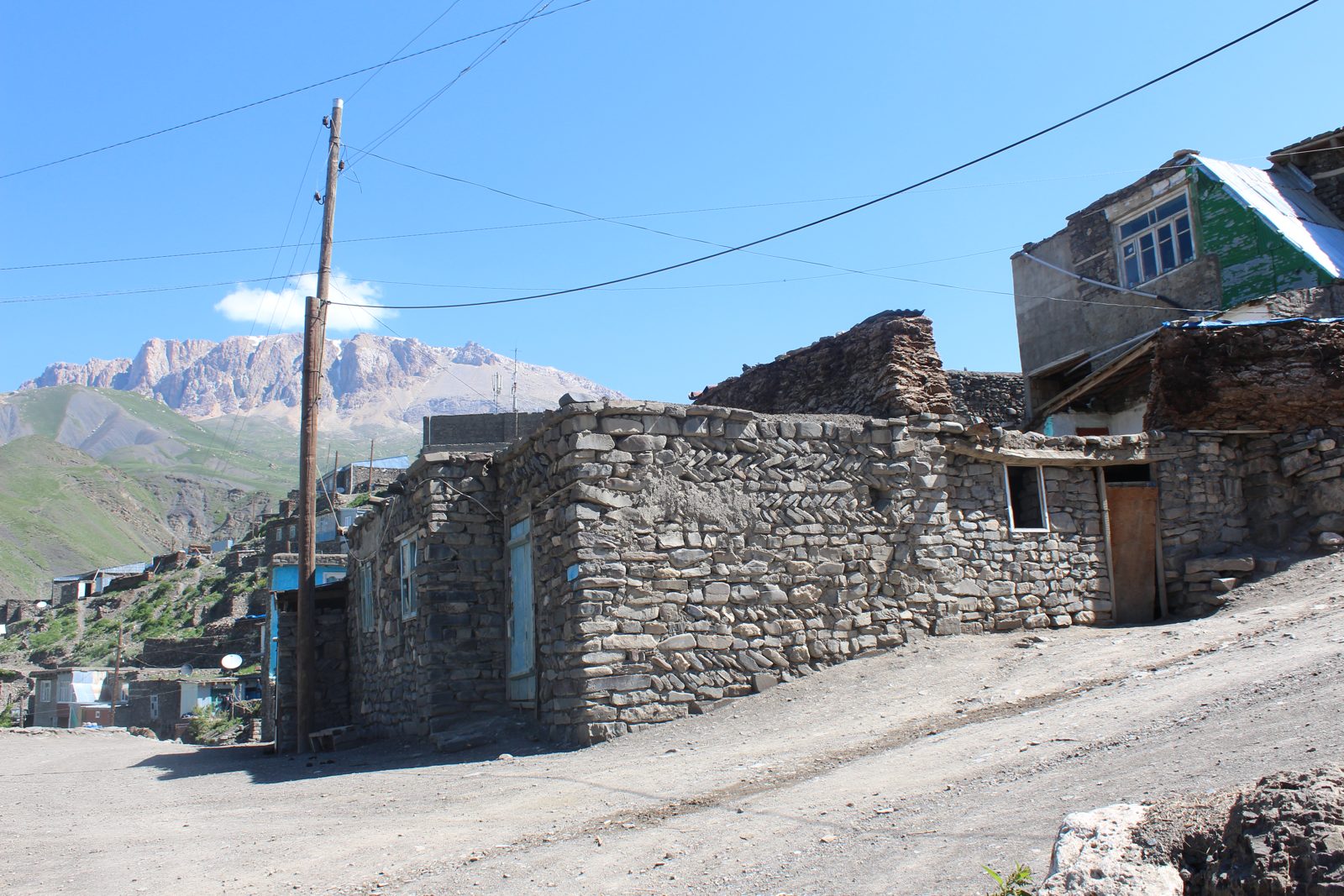
Perched at an elevation of 2,350 meters in the Greater Caucasus, Khinalyg claims an uninterrupted lineage spanning over five millennia, inhabited by an ethnic enclave tracing roots to antiquity and ancient Caucasian Albania. The village’s architecture clings vertically to a precipitous limestone spur, where roughly 380 homes built from river cobblestones and mortar form a dense, stepped amphitheater. Due to the extreme incline, the flat mud-and-straw roof of each lower dwelling serves as the front courtyard for the house stacked directly above it. Walls are patterned with neatly stacked cakes of *tezek*—sun-dried dung fuel—drying beside small timber-framed windows, while the 12th-century Pir Jomard mosque anchors the upper slopes, marking the community's medieval transition from indigenous fire-worship to Islam. Navigating the settlement entails scrambling up narrow, unpaved switchbacks buffeted by biting alpine gusts and the sharp, earthy tang of peat-fueled hearth smoke. Visitors walk directly over neighbors' rooftop courtyards, where woven crimson *kilim* rugs are laid out to dry alongside freshly sheared sheep’s wool. The auditory landscape is entirely distinct: villagers converse not in standard Turkic dialects, but in Ketsh, a critically endangered Northeast Caucasian language isolate spoken nowhere else on Earth. Standing at the village summit, travelers are greeted by an amphitheater of cloud-scraped ravines and the jagged crown of Mount Tufandag, suspended in an austere redoubt that feels thoroughly detached from modernity.
Open on map