
 New added
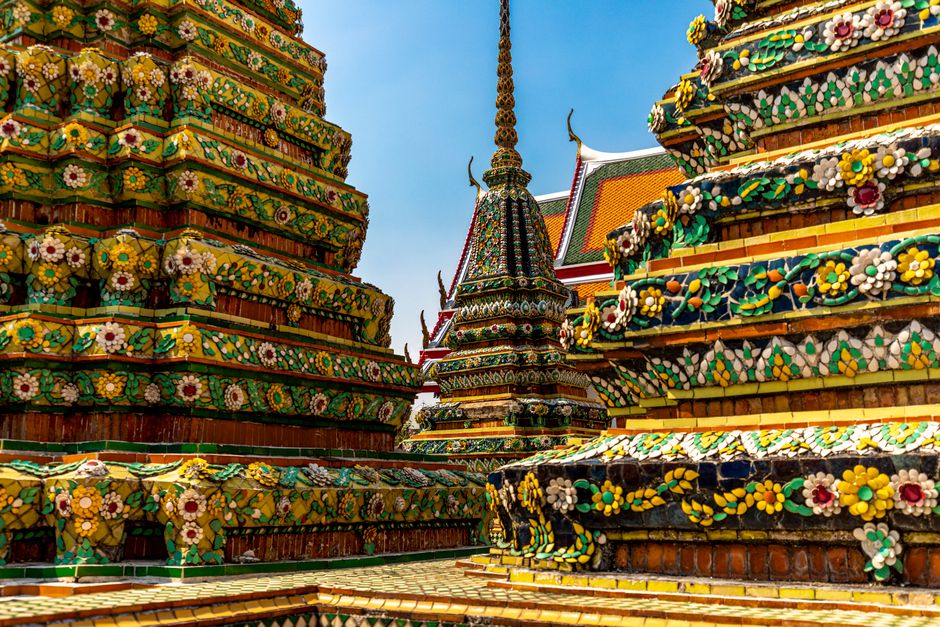
Wat Pho
Originally founded during the Ayutthaya kingdom, this sacred complex achieved its grandest form under the Chakri dynasty when King Rama I rebuilt the monastery in 1788, followed by a sweeping expansion under Rama III in 1832. Renowned as Thailand’s earliest public university, the temple codified traditional healing and Thai massage onto inscribed marble epigraphs set into the monastery walls. Its crowning structural wonder is the *Vihara* of the Reclining Buddha, sheltering a 46-meter-long, gold-leafed figure depicting the Buddha’s transition into parinirvana. The colossal soles of the figure’s feet stand five meters tall, masterfully inlaid with iridescent mother-of-pearl that details the 108 auspicious *lakshanas* (virtuous marks) of the enlightened one. Stepping past the threshold into the sunlit courtyards reveals a forested skyline of 91 stupas, anchored by four soaring 42-meter *Phra Maha Chedi* clad in intricate mosaics of Chinese glazed ceramics and floral porcelain. Weathered granite statues of bearded European sailors and mythical beasts—imported as ship ballast from Qing-dynasty trade routes—guard courtyards planted with sacred bodhi trees. Inside the dim sanctuary, visitors walk barefoot across cool stone as the air thickens with sweet sandalwood incense. The hushed atmosphere resonates with a hypnotic, rhythmic metallic ping: travelers dropping copper coins one by one into a line of 108 bronze alms bowls to earn merit and ensure good fortune.
More in Bangkok
Photo credits (3)
- Basile Morin, CC BY-SA 4.0, via Wikimedia Commons
- Don Ramey Logan, CC BY-SA 3.0, via Wikimedia Commons
- Ahoerstemeier, CC BY-SA 3.0, via Wikimedia Commons