
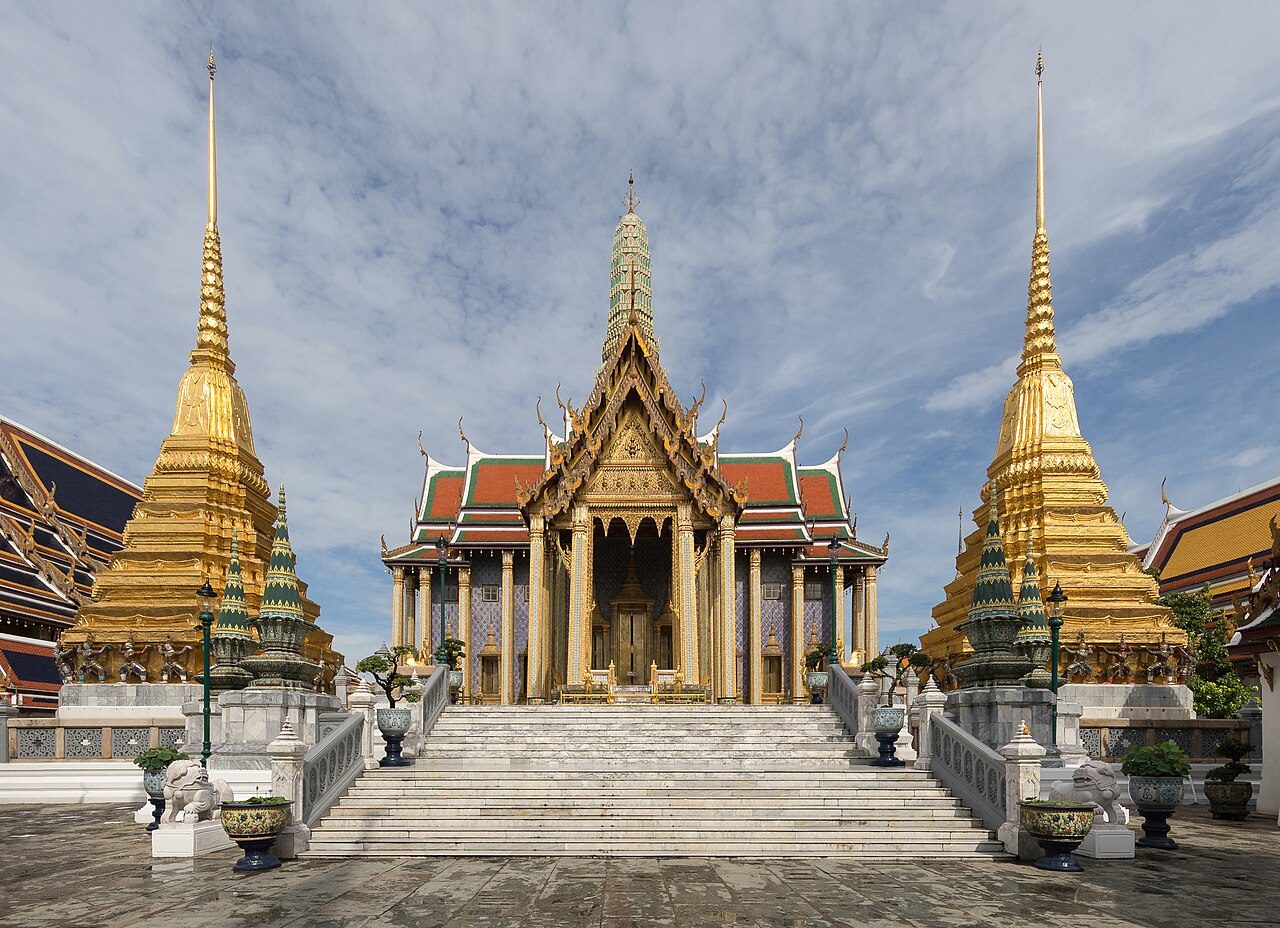
Wat Phra Kaew
Consecrated in 1782 when King Rama I established Bangkok as the royal capital, Wat Phra Kaew serves as the spiritual anchor of Thailand and the crowning masterpiece of Rattanakosin architecture. Uniquely constructed without living quarters for monks, the compound functions entirely as a sacred royal chapel adjacent to the Grand Palace. Twelve towering, five-meter-tall *yaksha* (mythological demon guardians) stand sentinel at the gateways, brandishing ceremonial clubs against evil spirits. Beyond them unfolds a sensory labyrinth of iridescent glass mosaics, sweeping multi-tiered roofs clad in glazed green and orange tiles, and the soaring, gold-leaf-sheathed spire of Phra Si Rattana Chedi, erected by King Rama IV to enshrine holy relics of the Buddha. Slipping off your shoes to step across the marble threshold of the central *ubosot* (ordination hall), the tropical glare gives way to the scent of burning joss sticks and lotus blossoms. Painted along the surrounding cloister, over two kilometers of intricate frescoes illustrate the entire epic of the *Ramakien*. Inside the sanctuary, visitor gazes rise toward the diminutive, 66-centimeter image carved from flawless green jadeite—the Emerald Buddha. Perched high atop a gilded, multi-tiered wooden pedestal under a nine-tiered umbrella, the figure radiates quiet majesty, cloaked in seasonal vestments of pure gold that are meticulously changed three times each year by the reigning monarch himself.
More in Bangkok
Photo credits (3)
- Basile Morin, CC BY-SA 4.0, via Wikimedia Commons
- Don Ramey Logan, CC BY-SA 3.0, via Wikimedia Commons
- Ahoerstemeier, CC BY-SA 3.0, via Wikimedia Commons