
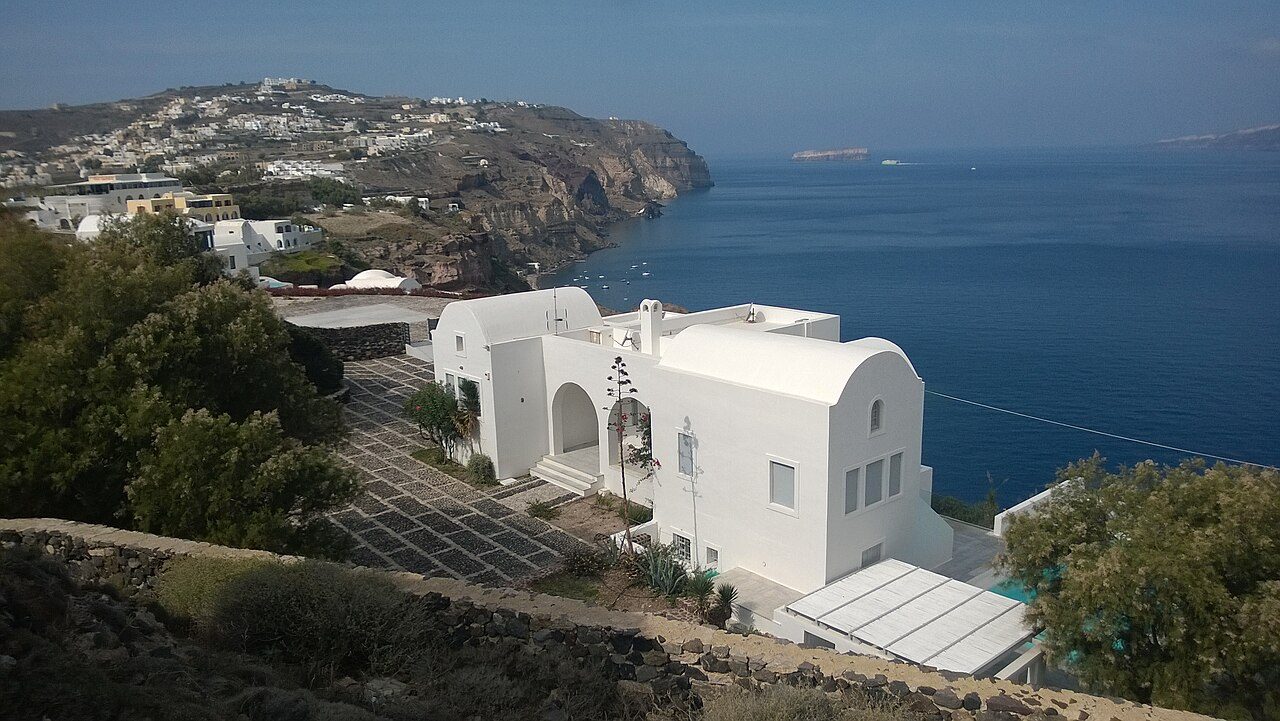
Akrotiri
Buried beneath meters of volcanic pumice during the catastrophic late-17th-century BCE Theran eruption, Akrotiri preserves one of the Aegean’s most sophisticated Bronze Age maritime societies. Unlike Roman Pompeii, the absence of human remains suggests the inhabitants evacuated with their valuables before the final blast, leaving behind a ghost city of remarkable urban design. Beneath a modern bioclimatic canopy, elevated timber walkways let travelers look directly down into excavated streets flanked by two- and three-story ashlar masonry residences. Clusters of towering terracotta *pithoi* (storage vessels) remain anchored in ancient pantries, while intricate clay drainage pipes embedded within stone walls reveal an astounding standard of Cycladic sanitary engineering. Walking above the dust-laden contours of Triangle Square, visitors encounter a haunting, palpable stillness. Cool air circulates through the shelter, carrying the dry, mineral scent of millennia-old volcanic ash and tufa. Peering through gaping stone window frames and preserved doorways, it is easy to visualize the domestic chambers in their prime, once lined with vivid mineral-pigment frescoes depicting swallows, blue monkeys, and boxing youths. With no modern sounds filtering into the covered enclosure, one feels less like an observer in a museum and more like a privileged explorer wandering through an aristocratic prehistoric neighborhood frozen mid-stride.
More in Santorini
Photo credits (4)
- Jan M, CC BY-SA 3.0, via Wikimedia Commons
- Holger Uwe Schmitt, CC BY-SA 4.0, via Wikimedia Commons
- Giles Laurent, CC BY-SA 4.0, via Wikimedia Commons
- Sidvics, CC BY-SA 4.0, via Wikimedia Commons