
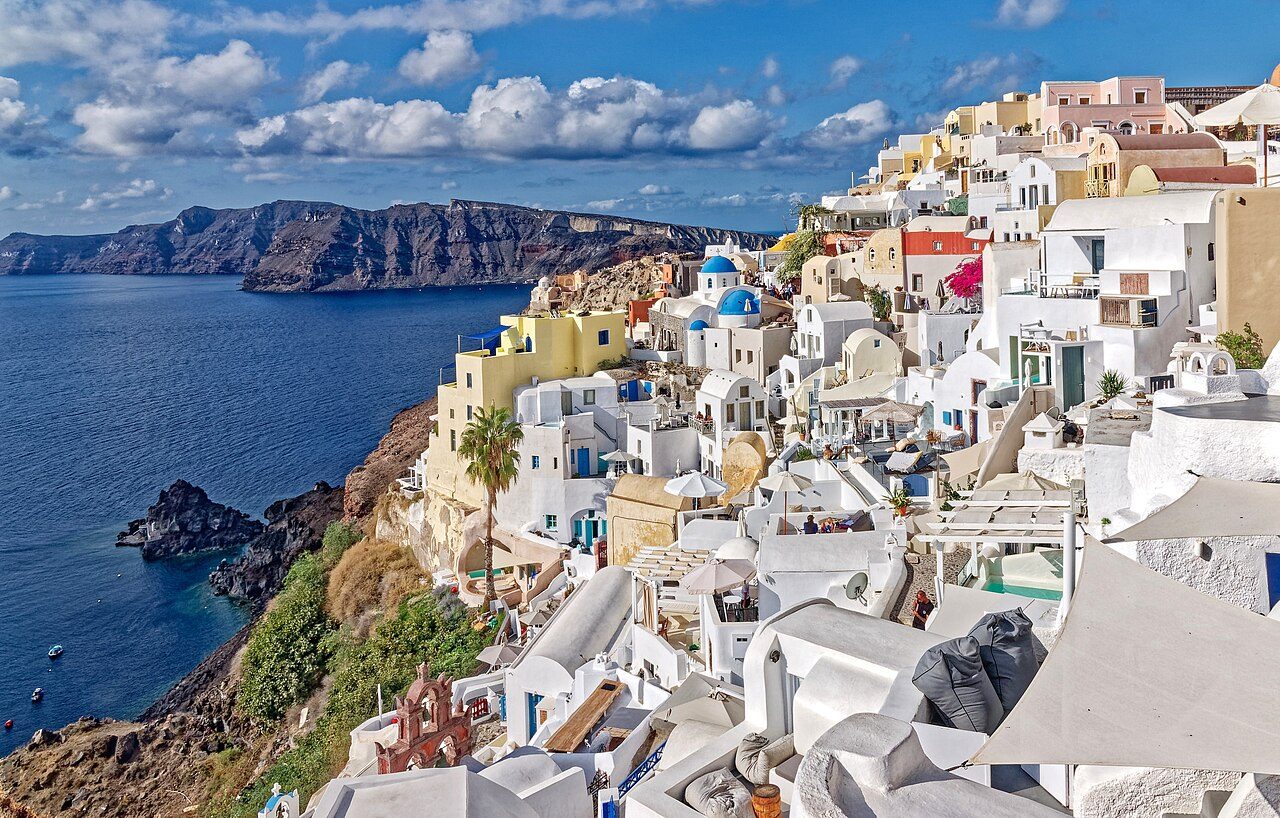
Oia Village
Perched atop Santorini’s volcanic caldera rim, Oia—historically known as Apano Meria—flourished between the late 18th and early 20th centuries as a formidable Aegean maritime powerhouse. Its vernacular architecture directly mirrors this seafaring social hierarchy: vaulted *yposkafa* (cave dwellings carved into porous volcanic tuff by deckhands) stand alongside the stately, two-story neoclassical *kapetanospita* (sea captains' mansions) constructed from local red basalt and limestone. At the village's westernmost precipice, the surviving brickwork of the 15th-century Venetian fortress of Agios Nikolaos recalls centuries of anti-corsair vigilance, its battlements having survived Ottoman raids before largely fracturing in the cataclysmic 7.7-magnitude earthquake of 1956. Today, traversing Oia’s polished marble pathways immerses you in a vivid interplay of gleaming whitewash, sun-baked ochres, and the deep cobalt of churches like Anastasi and Panagia Platsani. The brisk Aegean *meltemi* wind carries sea spray and thermal heat up the sheer, 150-meter volcanic cliff face, rattling the timber spars of sail-less clifftop windmills. Standing upon the cracked parapet of the Venetian *kastro*, you gaze out across the flooded caldera basin as the setting sun projects long, dramatic shadows against the multi-hued volcanic strata tumbling down to Ammoudi Bay.
More in Santorini
Photo credits (4)
- Holger Uwe Schmitt, CC BY-SA 4.0, via Wikimedia Commons
- Jan M, CC BY-SA 3.0, via Wikimedia Commons
- Giles Laurent, CC BY-SA 4.0, via Wikimedia Commons
- Sidvics, CC BY-SA 4.0, via Wikimedia Commons