 New added
Mathematical Bridge
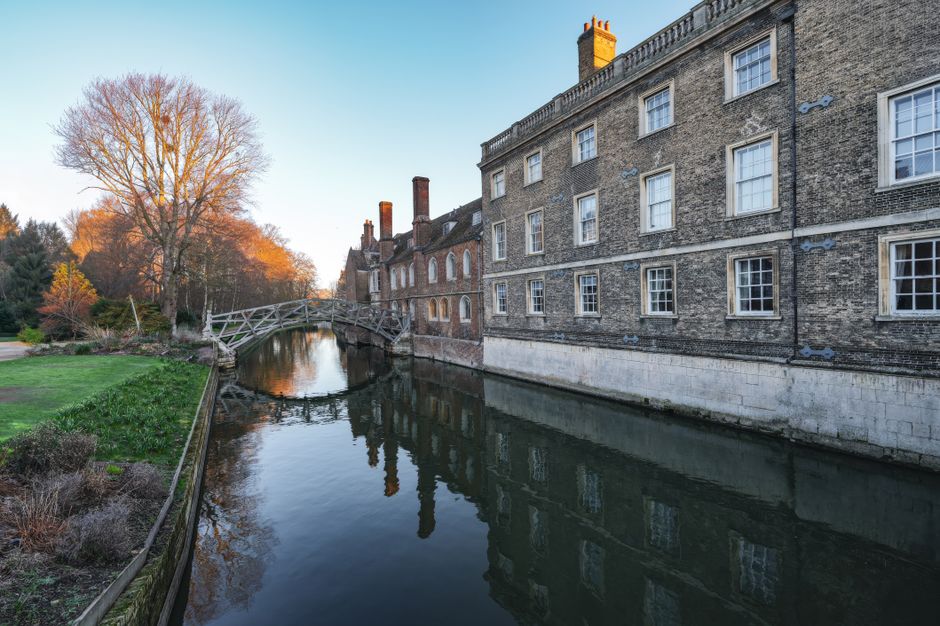
Spanning the languid River Cam to link the medieval quarters of Queens’ College with its riverside grounds, the Mathematical Bridge—officially the Wooden Bridge—embodies eighteenth-century Enlightenment ingenuity. Designed in 1749 by carpenter William Etheridge and erected by master builder James Essex the Younger, the structure is a masterclass in tangent and radial trussing. While persistent university lore erroneously credits Sir Isaac Newton with assembling the span without bolts—supposedly leaving baffled scholars unable to reassemble it without iron pins—the bridge has always relied on discreet iron fixings. Visually, it presents a striking geometric puzzle: a lattice of entirely straight English oak timbers mathematically arranged to describe a rigid, self-supporting curved arch that contrasts sharply with the weathered red Tudor brick of the college backdrop. Viewing the bridge from the adjacent Silver Street parapet, observers encounter quintessential Cambridge tranquility. Beneath the intricate timber belly, chauffeured and self-hire punts glide through green, mirrored waters, their passengers instinctively ducking as wooden poles scrape against the gravelly riverbed. Up close, the tactile gray patina of the timber bears centuries of damp river mist, while the geometric crisscross of beams perfectly frames weeping willows and the quiet courtyards beyond. Standing here, travelers sense an exquisite dialogue between austere engineering and pastoral romance, watching the afternoon sun cast sharp, rhythmic shadows of the bridge’s mathematical lattice across the flowing current.