
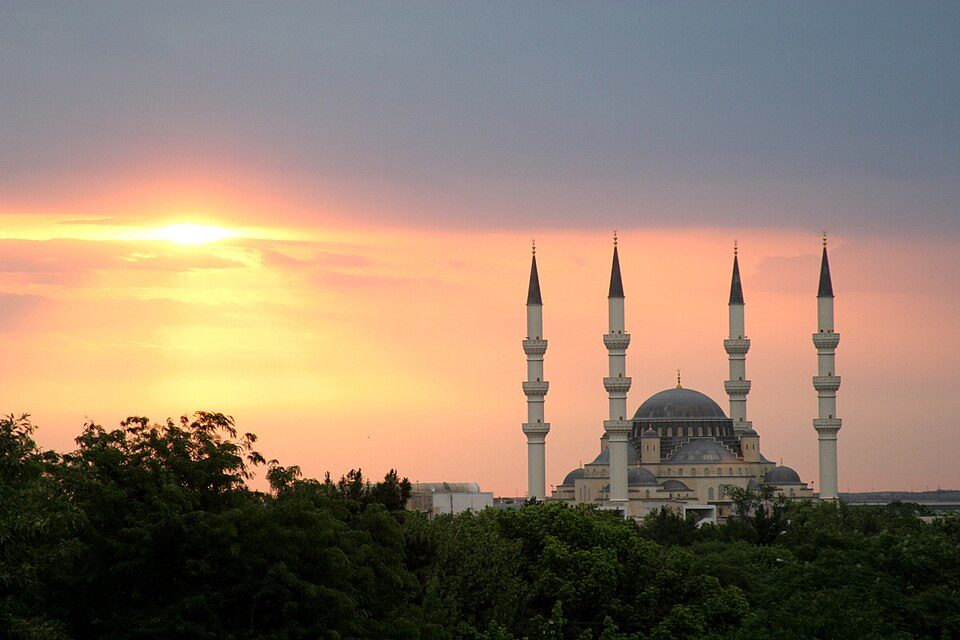
Ertugrul Gazi Mosque
Inaugurated in 1998 during Turkmenistan’s early post-Soviet transformation, the Ertugrul Gazi Mosque stands as a marble-clad monument to shared Turkic ancestry, gifted by the Turkish government and named for the 13th-century father of Osman I, founder of the Ottoman Empire. Modeled explicitly on Istanbul’s Blue Mosque, the complex bridges classic Ottoman imperial architecture with Ashgabat’s signature white-stone aesthetic. Four fluted, pencil-thin minarets soar to a height of nearly 63 meters, anchoring a cascading series of lead-sheathed domes and semi-domes. Before stepping inside, visitors traverse an open-air marble courtyard flanked by shaded porticoes, centered around a traditional octagonal ablution fountain where the echo of trickling water tempers the arid city heat. Passing through heavy carved-wood portals, travelers enter a vast, light-flooded prayer hall capable of holding 5,000 worshippers. The acoustics immediately hush ambient noise, softened beneath your feet by an immense, crimson-and-indigo hand-knotted Turkmen carpet. Tilting your head back reveals a central dome ringed by dozens of stained-glass windows, its interior painted with intricate gold-leaf calligraphy and floral arabesques that radiate outward like a celestial canopy. Handcrafted Iznik ceramic tiles wrap the *mihrab* and *minbar* in deep cobalt and turquoise glazes, while a monumental crystal chandelier hangs suspended in midair, bathing the sacred space in a warm, amber glow that feels worlds away from the sterile, sun-bleached avenues outside.
More in Ashgabat
Photo credits (4)
- Jim Fitzgerald
- Ekki3, CC BY-SA 4.0, via Wikimedia Commons
- Hans Birger Nilsen, CC BY-SA 2.0, via Wikimedia Commons
- Tinss