
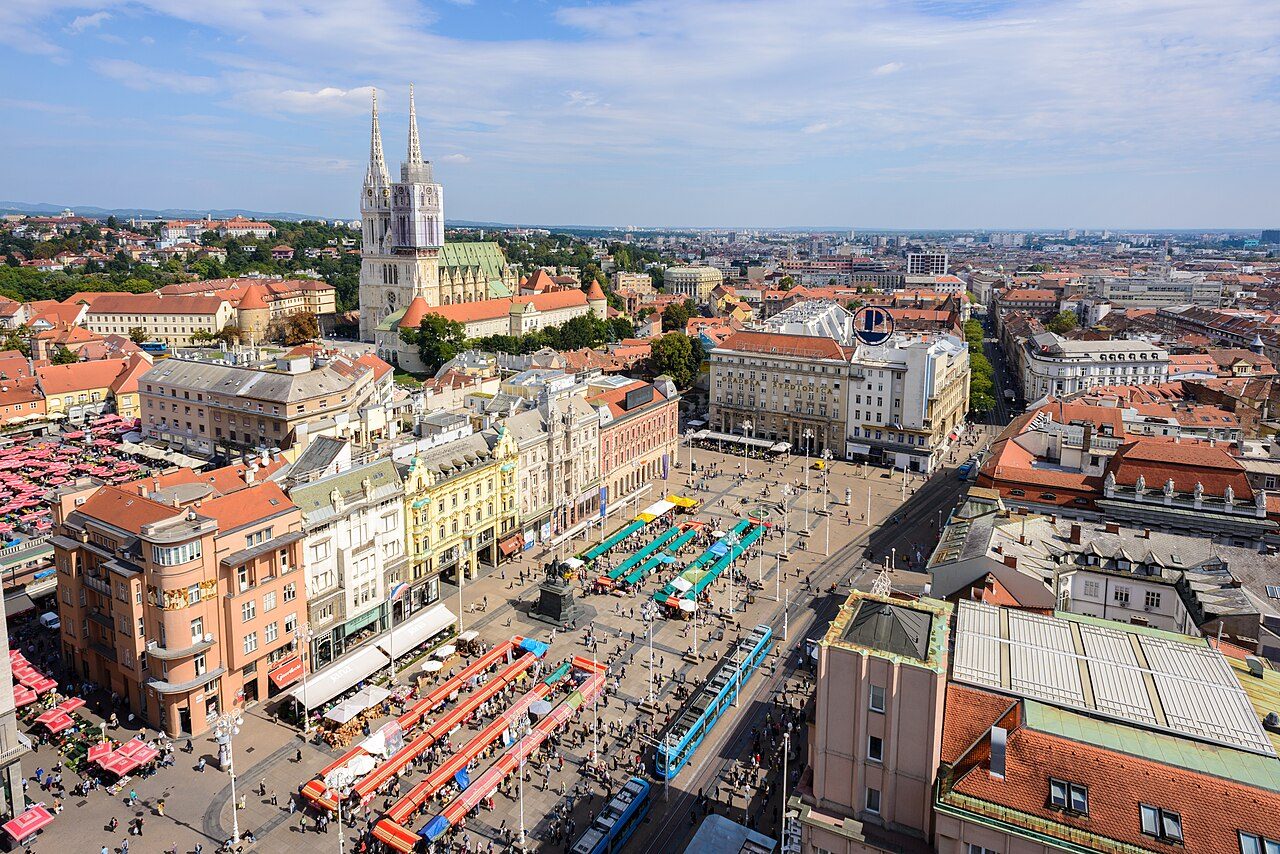
Ban Jelacic Square
At the intersection of Zagreb’s Upper and Lower Towns, the rhythmic clang of cobalt-blue trams signals arrival at the civic hub forged in the seventeenth century. Dominating the stone expanse stands Austrian sculptor Anton Dominik Fernkorn’s 1866 bronze equestrian monument to Ban Josip Jelačić, sword raised high. Stripped of its pedestal and hidden away in a museum basement by communist authorities in 1947, the statue was triumphantly reinstalled in October 1990, its orientation pivoted south toward the Adriatic rather than north toward Hungary. Framing this open pedestrian arena is an architectural timeline of pastel-hued facades, where ornate Austro-Hungarian Historicism and Austrian Secessionist motifs stand beside sharp interwar Modernism. Step onto the granite paving and you encounter locals congregating *pod satom* (beneath the tall public clock) amidst a constant swirl of commuters and street musicians. On the square's eastern fringe, the stone Manduševac fountain bubbles quietly, commemorating the ancient wellspring where a thirsty knight bade the maiden Manda to "scoop" (*zagrabiti*) water, immortalizing the city's namesake. Travelers feel the low hum of iron rails vibrating through the ground, catch the rich scent of espresso drifting from crowded cafe terraces along the perimeter, and watch afternoon light glance off centuries-old cornices into the coin-strewn waters of the legendary spring.
More in Zagreb
Photo credits (4)
- Nick Savchenko from Kiev, Ukraine, CC BY-SA 2.0, via Wikimedia Commons
- Jorge Franganillo, CC BY 2.0, via Wikimedia Commons
- VitVit, CC BY-SA 4.0, via Wikimedia Commons
- Robert Nyman, CC BY 2.0, via Wikimedia Commons