
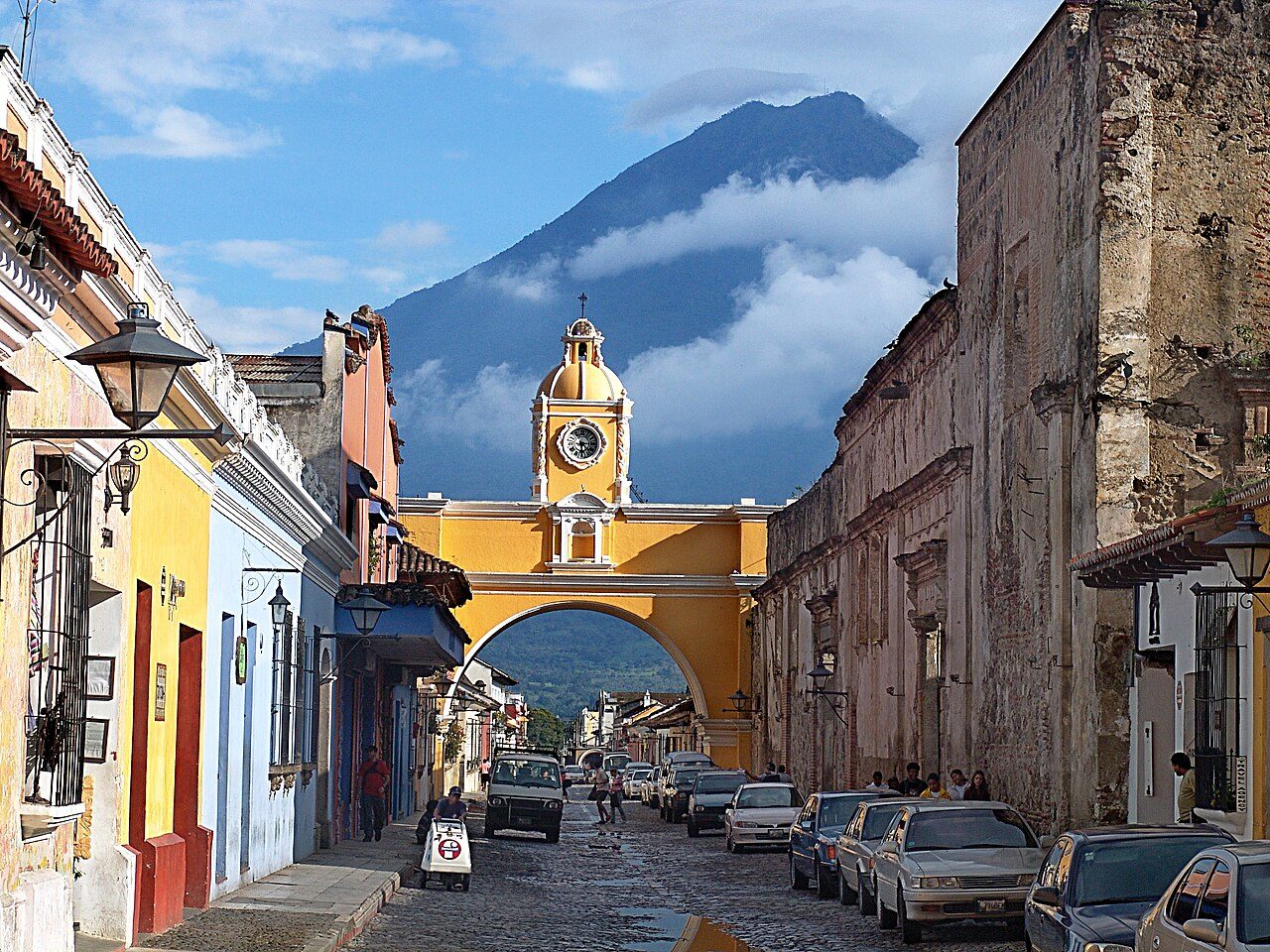
Santa Catalina Arch
Commissioned in 1693, this iconic saffron-yellow passageway was conceived as a veil of modesty for the cloistered nuns of the Convent of Santa Catalina Virgen y Mártir. Bound by strict vows of perpetual seclusion, the sisters required a private overhead bridge to cross the thoroughfare between their convent and a newly acquired school annex without exposing themselves to the public gaze. While the cataclysmic Santa Marta earthquakes of 1773 leveled much of the colonial capital, the low, earthquake-resistant baroque span stubbornly endured. The turret crowning its center was added in the 1830s, introducing a neoclassical French clock that requires manual winding every three days. Standing on the worn basalt cobblestones of 5a Avenida Norte in the crisp highland dawn, travelers encounter Antigua’s defining vista: the arch's central barrel vault perfectly framing the emerald, cloud-wreathed cone of Volcán de Agua in the distance. Intricate white stucco filigree pops against the radiant yellow lime-wash, catching the morning light alongside hanging wrought-iron lanterns. Though the hollow interior corridor where nuns once glided unseen remains shuttered to foot traffic, standing beneath the thick volcanic-stone abutments evokes the palpable tension between cloistered Spanish devotion and the volatile, seismic landscape of the Panchoy Valley.
More in Antigua Guatemala
Photo credits (2)
- Unknown author, Public domain, via Wikimedia Commons
- USGS, Public domain, via Wikimedia Commons