
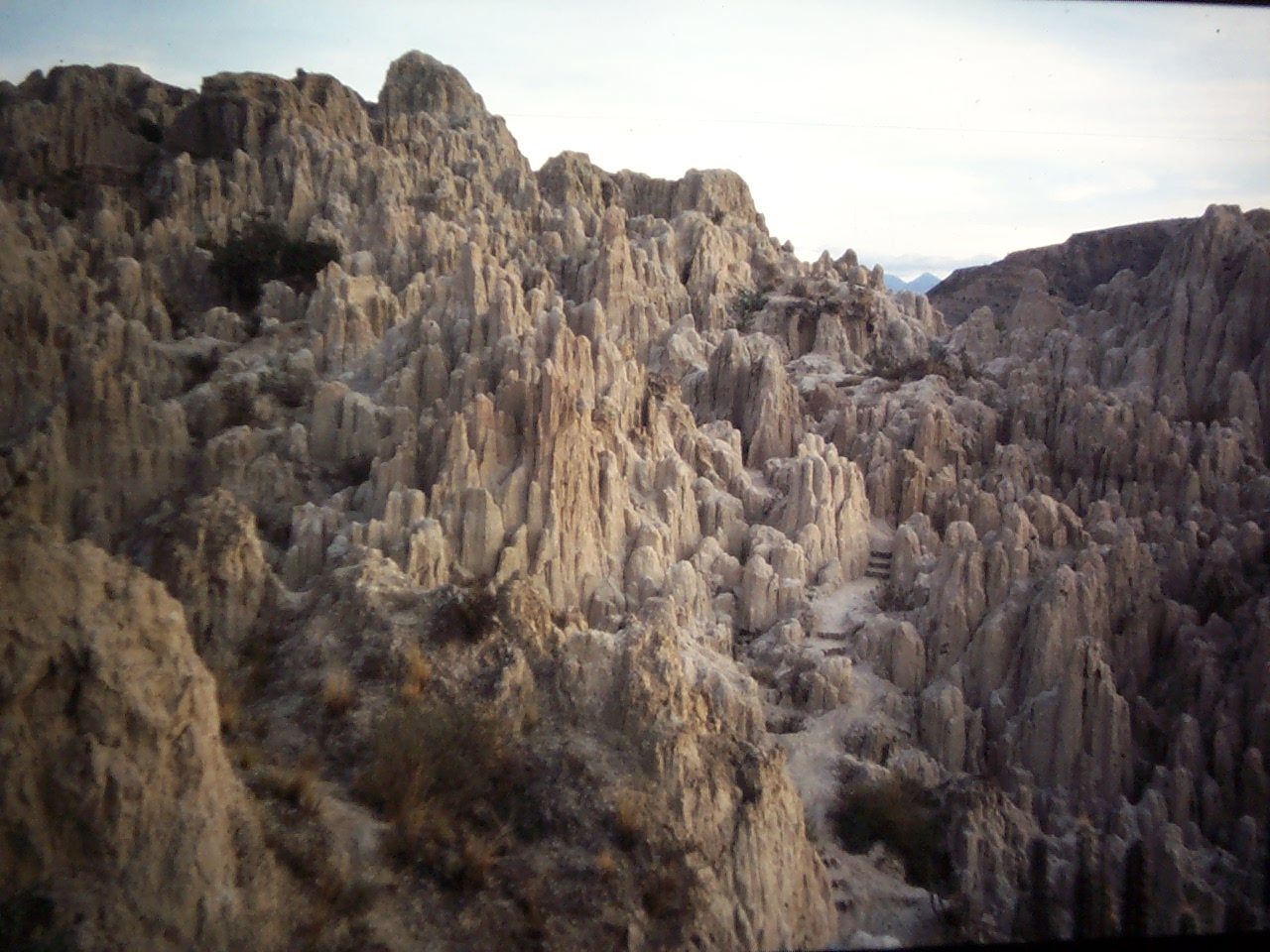
Valle de la Luna, La Paz
Carved into the clay canyons of Mallasa on the southern fringes of La Paz, Valle de la Luna stands as a dramatic testament to millennia of relentless Andean erosion. Torrential rains and fierce altiplano winds hollowed out a mountain of compacted clay and sandstone, sculpting an intricate labyrinth of monolithic spires, fluted needles, and cavernous crevices. Long regarded in indigenous folklore as a realm shaped by wind spirits, the terrain captured global imagination in 1969 when Apollo 11 astronaut Neil Armstrong visited Bolivia and famously remarked that the stark badlands mirrored the lunar surface he had recently traversed. The badlands display a striking palette of oxidized minerals, shifting across striated layers of chalky beige, pale ochre, deep rust-red, and faint violet. Winding along the Devil’s Point trail, travelers enter an eerily silent maze where the metropolitan roar of La Paz completely dissolves. Resilient San Pedro cacti thrust upward from sterile fissures, defying the bone-dry soil. The high-altitude sun cuts razor-sharp shadows across brittle pinnacles, while the thin Andean breeze hums like a flute through the eroded chimneys. Suspended wooden footbridges offer vantage points over the subterranean hollows, where the crunch of loose gravel underfoot anchors an otherwise unearthly scene. Standing among these petrified sentinels, visitors encounter a singular visual clash: prehistoric, pale clay hoodoos foregrounding the snow-capped apex of Mount Illimani resting against the piercing blue sky.
More in La Paz


Photo credits (4)
- Unknown author, CC BY-SA 3.0, via Wikimedia Commons
- JERRYE AND ROY KLOTZ MD, CC BY-SA 3.0, via Wikimedia Commons
- EEJCC, CC BY-SA 4.0, via Wikimedia Commons
- Keyan Alejandro, CC BY 4.0, via Wikimedia Commons