
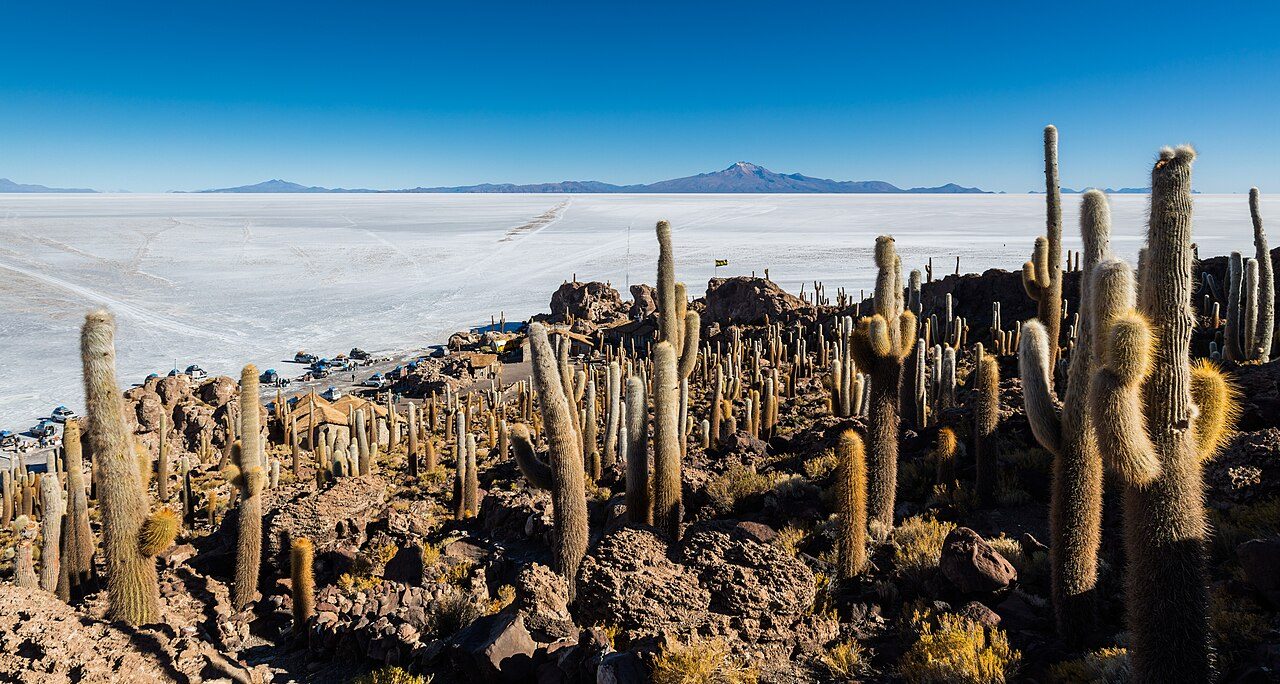
Incahuasi Island
Rising starkly from the blinding white expanse of the Salar de Uyuni, Incahuasi Island—Quechua for "Inca House"—is the fossilized crest of an ancient volcanic seamount. Submerged during the late Pleistocene epoch beneath the prehistoric Lake Minchin, the outcrop still bears intricate crusts of petrified coral and calcified stromatolite reefs. In the fifteenth century, the terrain provided a fortified resting outpost for Inca chasquis (messengers) navigating the treacherous Altiplano trade routes. Today, its jagged limestone slopes are dominated by a forest of thousands of colossal *Echinopsis atacamensis* cacti, ancient botanical sentinels reaching heights of over ten meters, with the oldest specimens having sprouted more than a millennium ago. Climbing the rough-hewn stone trail, visitors immediately contend with the biting, thin air at 3,650 meters above sea level, surrounded by the dry rustle of golden spines clashing in the Andean wind. The path threads through natural limestone archways and past fossil-encrusted sea caves before culminating at the island’s highest rocky knoll. From this windswept summit, the sensory impact is absolute: looking outward reveals an unbroken 360-degree panorama of hexagonal salt crusts stretching toward the distant, sacred silhouette of Tunupa Volcano, evoking the eerie, mesmerizing sensation of being marooned on a cactus-strewn atoll within an infinite, petrified sea.
More in Uyuni

Photo credits (2)
- Diego Delso, CC BY-SA 4.0, via Wikimedia Commons
- Luca Galuzzi ( Lucag ), edit by Trialsanderrors, CC BY-SA 2.5, via Wikimedia Commons