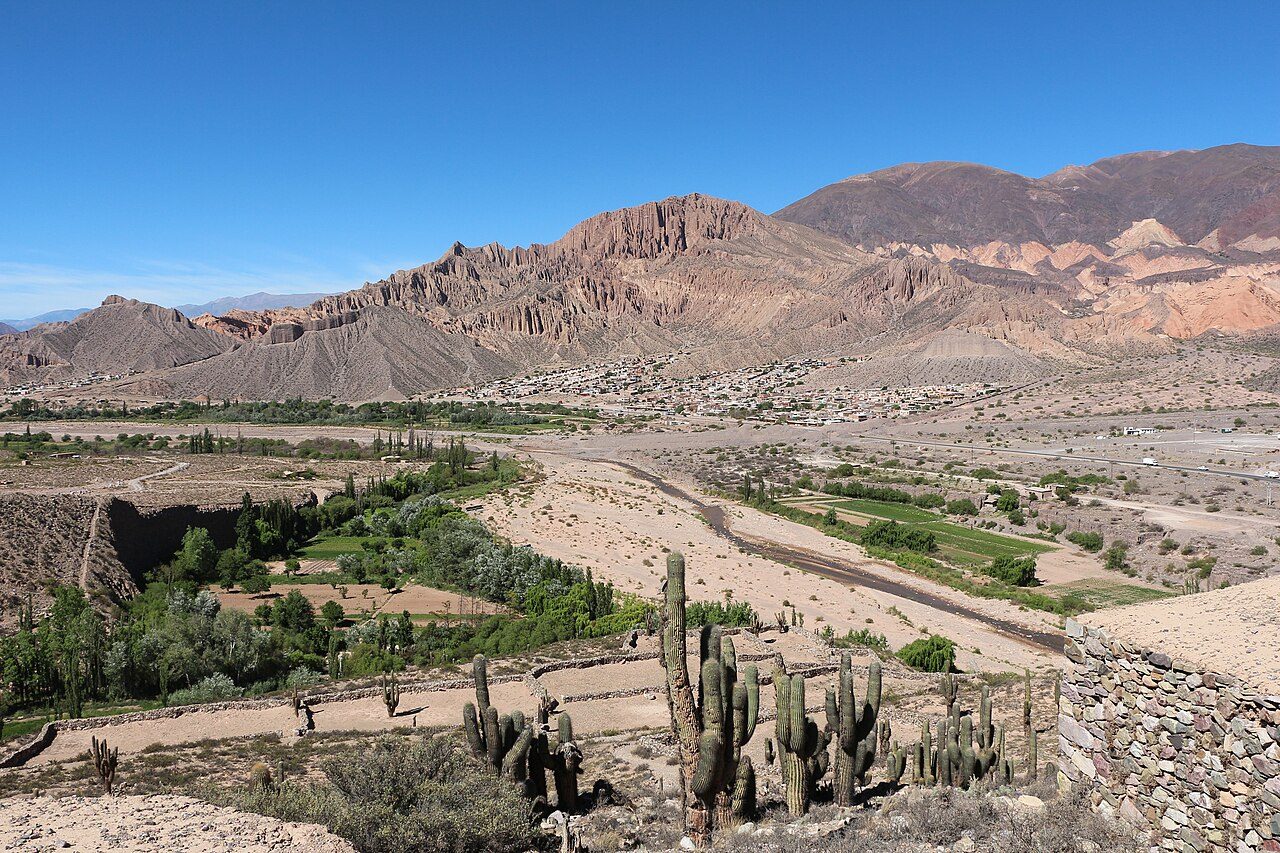
Hill of Seven Colors
Looming directly behind the 17th-century adobe chapel of Santa Rosa de Lima, the *Cerro de los Siete Colores* exposes over 500 million years of complex sedimentation and tectonic uplift. Designated as part of the UNESCO-protected Quebrada de Humahuaca, this monumental geologic formation chronicles Earth’s eras through distinct chromatic strata: deep purple and muted sea-green bands derived from Cambrian marine shales; chalky whites from Ordovician limestone; and blazing terracotta, ochre, and vermilion formed by Tertiary sandstones and iron-rich clay. Long before Spanish conquistadors laid out the village grid in 1594, the pre-Incan Omaguaca people regarded this mineral wall as a sacred landmark, anchoring their settlements in the sheltered microclimate at its base. Standing in the central plaza at dawn, travelers witness an arresting optical shift as the first rays of high-altitude sun ignite the pigments against a piercing cobalt sky. Walking the encircling *Paseo de los Colorados* trail, the crisp, thin Andean air carries the faint scent of woodsmoke and mountain thyme. Underfoot, the dry gorge crunches with loose shale and fine rust-colored dust, while giant cardón cacti stand sentinel against sheer vertical cliffs. In the midday quiet, the mountain sheds its morning luminescence and deepens into stark, saturated ripples of Earth’s ancient sea beds, towering over the sun-baked mud brick and cardón-wood roofs of Purmamarca below.