Purmamarca
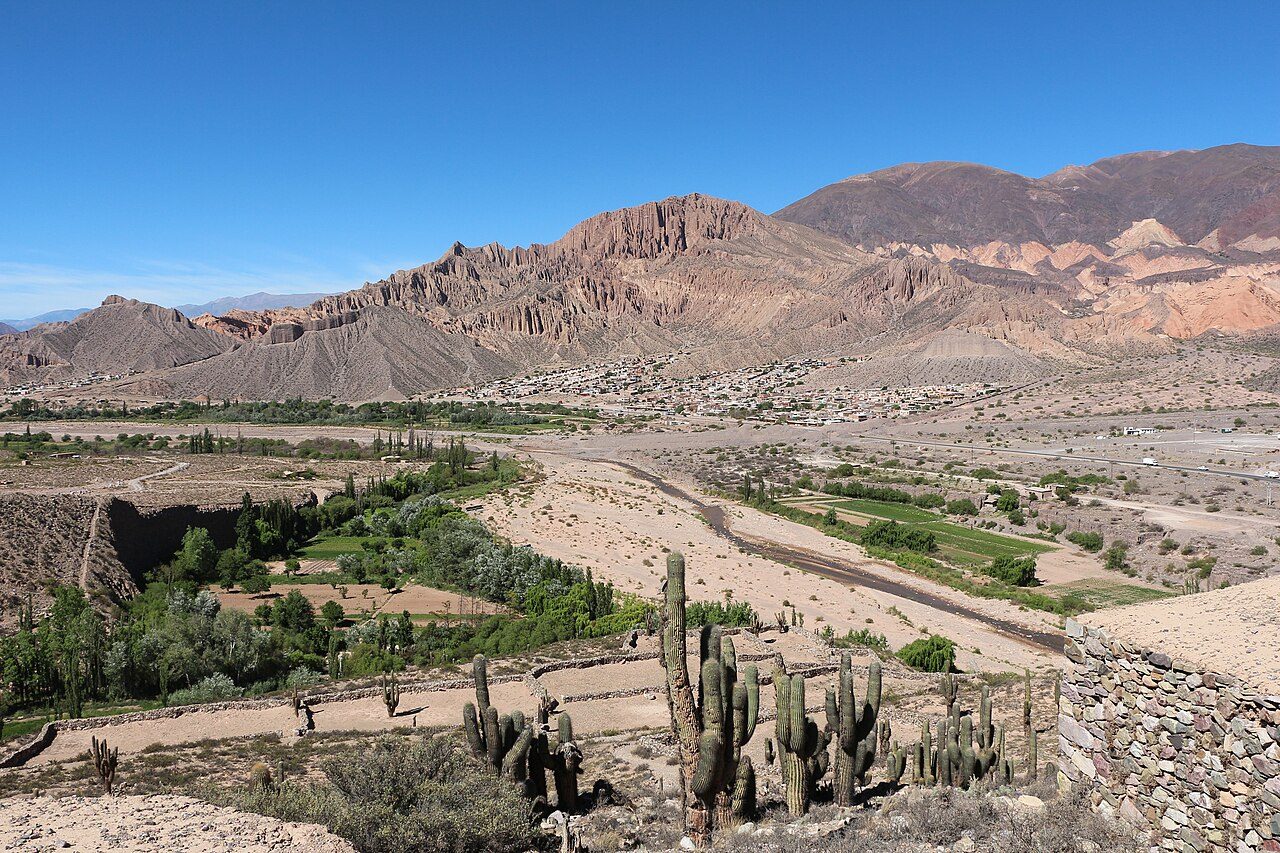
Purmamarca sits in a mountain cleft within Jujuy’s Quebrada de Humahuaca, pressed against the arid foothills of northwestern Argentina. Walking its quiet grid of packed-dirt streets means brushing past low, sun-baked adobe walls and simple clay courtyards. Overhead, the Cerro de los Siete Colores rises directly behind the village, displaying layered bands of ochre, green, and purple sediment shaped over hundreds of millions of years. The settlement has indigenous roots preceding the Spanish conquest, with colonial documents recording its formal Spanish layout around 1594. At the town center stands the Iglesia de Santa Rosa de Lima, built around 1648 with whitewashed mud-brick walls and a ceiling carved from cardón cactus wood. Beside the church spreads a five-hundred-year-old algarrobo tree. Just behind the perimeter, the three-kilometer Paseo de los Colorados trail threads through jagged red sandstone ravines, tracing dry riverbeds framed by giant columnar cacti. Daily life centers on Plaza 9 de Julio, where Kolla weavers arrange hand-spun llama wool blankets and dyed textiles directly on the ground. Local taverns serve hearty northern specialties like slow-cooked llama casserole, corn tamales, and humitas. Each August, villagers make offerings of tobacco, food, and chicha into shallow earth pits during the Pachamama festival. The entire village is easily covered on foot; walk the red-clay trails just after dawn, when early morning sunlight hits the eastern rock faces before regional day-trippers arrive.
Read more