
Tomb of Tu Duc
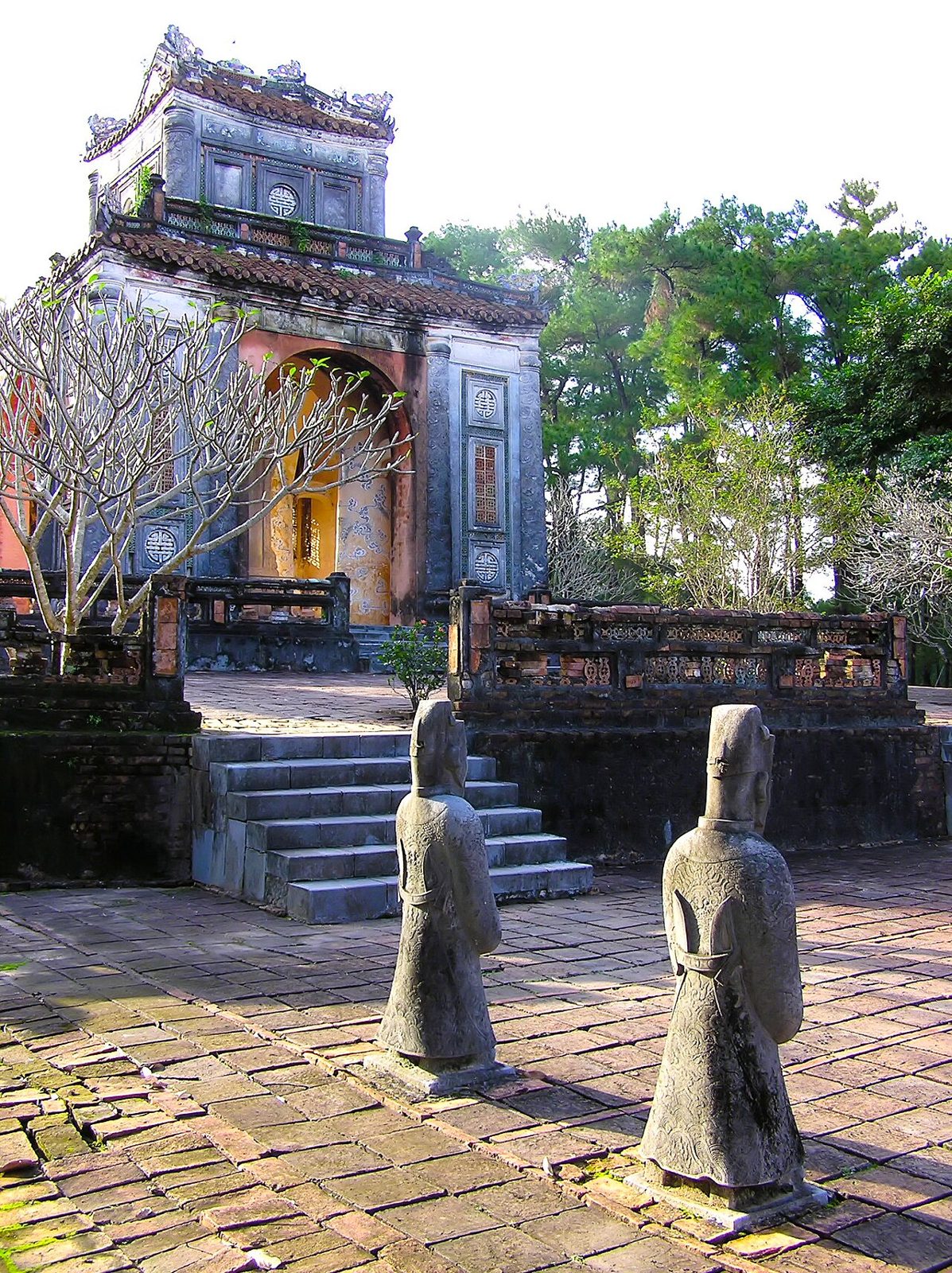
Conceived not merely as an eternal resting place but as a sanctuary from encroaching French colonial rule, the Khiem Tomb was built between 1864 and 1867 by Vietnam's poet-emperor, Tu Duc. Nestled within a pine forest southwest of the Hue Citadel, the complex served as the monarch’s living pleasure-retreat for nearly sixteen years before his death. Visitors wander beneath the shade of frangipani trees to Luu Khiem Lake, where lotus blossoms drift beneath the stilts of the Xung Khiem Pavilion. In this open-air pavilion, the emperor once reclined to fish, drink tea brewed with morning dew, and compose melancholic verse lamenting his childless lineage and the slow unraveling of his empire. Beyond the water lies the devotional core: the dark-lacquered Hoa Khiem Temple, still rich with the scent of aged cedar and incense, housing personal artifacts and ancestral altars. Ascending moss-softened stone terraces, travelers confront the fortress-like Stele Pavilion, sheltering a 20-ton stone tablet hauled 500 kilometers from Thanh Hoa. Inscribed upon its face is Tu Duc’s 4,935-character self-authored epitaph—a remarkably candid admission of administrative failures and personal melancholy. Passing a silent guard of diminutive stone mandarins, horses, and elephants in the Honor Courtyard, the path terminates at the austere, walled burial vault, a deceptively quiet monument that guards the enduring mystery of the emperor's true, hidden grave.
More in Hue
Photo credits (4)
- BluesyPete, CC BY-SA 3.0, via Wikimedia Commons
- Kandukuru Nagarjun, CC BY 2.0, via Wikimedia Commons
- Lưu Ly, Public domain, via Wikimedia Commons
- dronepicr, CC BY 2.0, via Wikimedia Commons