
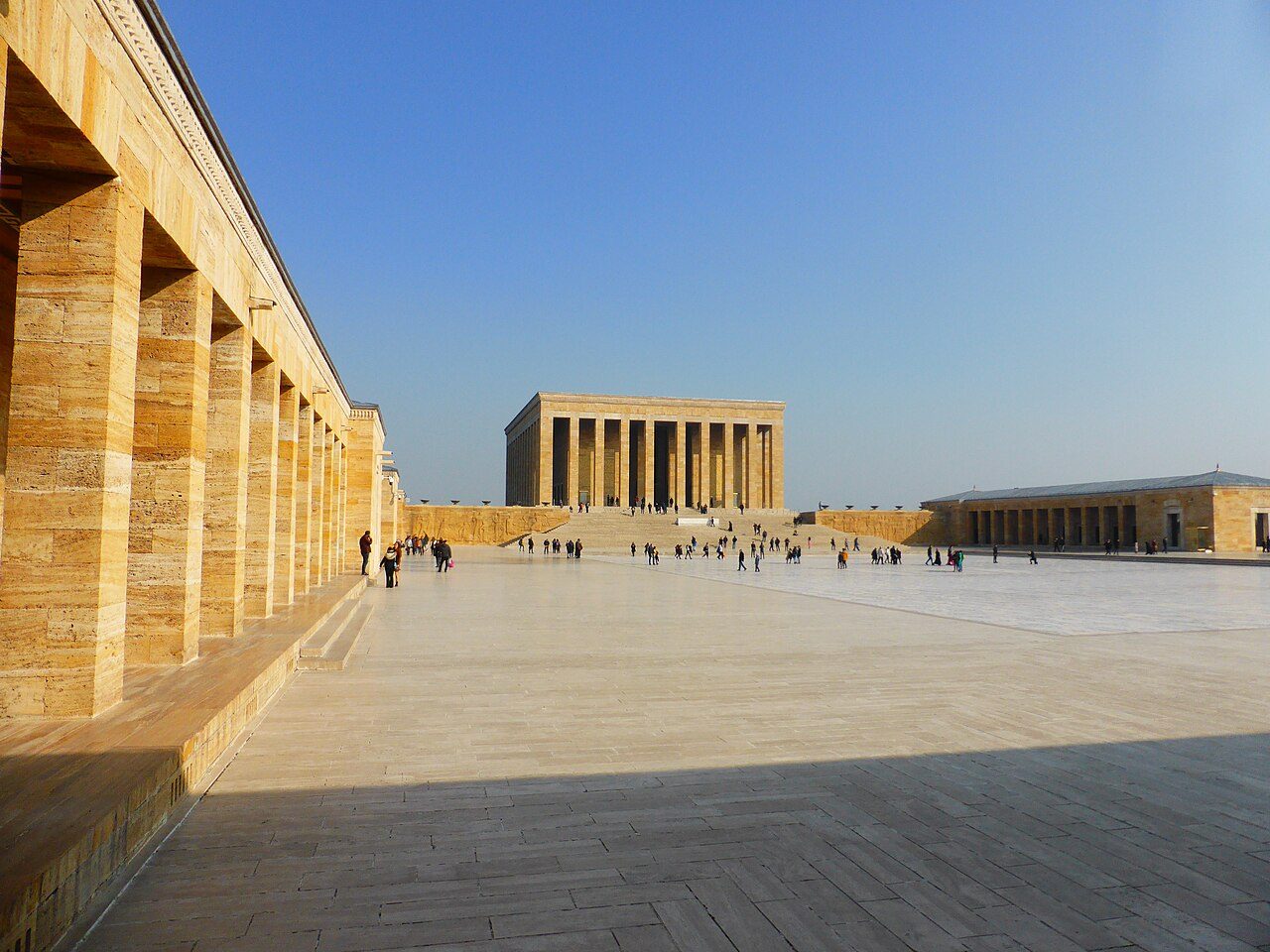
Anitkabir
High atop the Rasattepe hill overlooking Ankara, Anıtkabir commands the Turkish capital with solemn, monolithic authority. Designed by architects Emin Onat and Orhan Arda and completed in 1953 to house the remains of modern Turkey’s founder, Mustafa Kemal Atatürk, the mausoleum serves as the pinnacle of the Second National Architectural Movement. The complex masterfully fuses austere neoclassical monumentality with ancient Anatolian and Seljuk motifs. Visitors begin their approach along the 262-meter-long Road of Lions, a travertine promenade lined by 24 recumbent limestone lions sculpted in archaic Neo-Hittite style. The pavers beneath your feet are deliberately spaced five centimeters apart, enforcing a measured, downward-looking gait that naturally commands quiet reverence before you emerge into the sweeping ceremonial courtyard framed by ten symmetrical, peaked-roof towers. Passing the immaculately frozen sentries of the Turkish Armed Forces, you step into the cavernous Hall of Honor, where soft amber light filters through bronze-latticed colonnades onto polished marble floors quarried from Afyon and Bilecik. Overhead, gilded ceiling mosaics evoke intricate 15th-century Turkish carpet motifs, leading the eye toward the apse where Atatürk’s symbolic 42-ton monolithic sarcophagus rests in absolute stillness before a window facing Ankara Castle. The hushed chamber echoes only with the sharp, synchronized crack of boot-heels during the changing of the guard. Encircling the entire complex is the Peace Park, where more than 50,000 trees gifted from dozens of foreign nations form a dense green perimeter that insulates this monumental sanctum from the surrounding metropolis.
More in Ankara
Photo credits (3)
- Kemal KOZBAEV, CC BY-SA 4.0, via Wikimedia Commons
- Georges Jansoone ( JoJan ), CC BY-SA 3.0, via Wikimedia Commons
- Bernard Gagnon, CC BY-SA 3.0, via Wikimedia Commons