
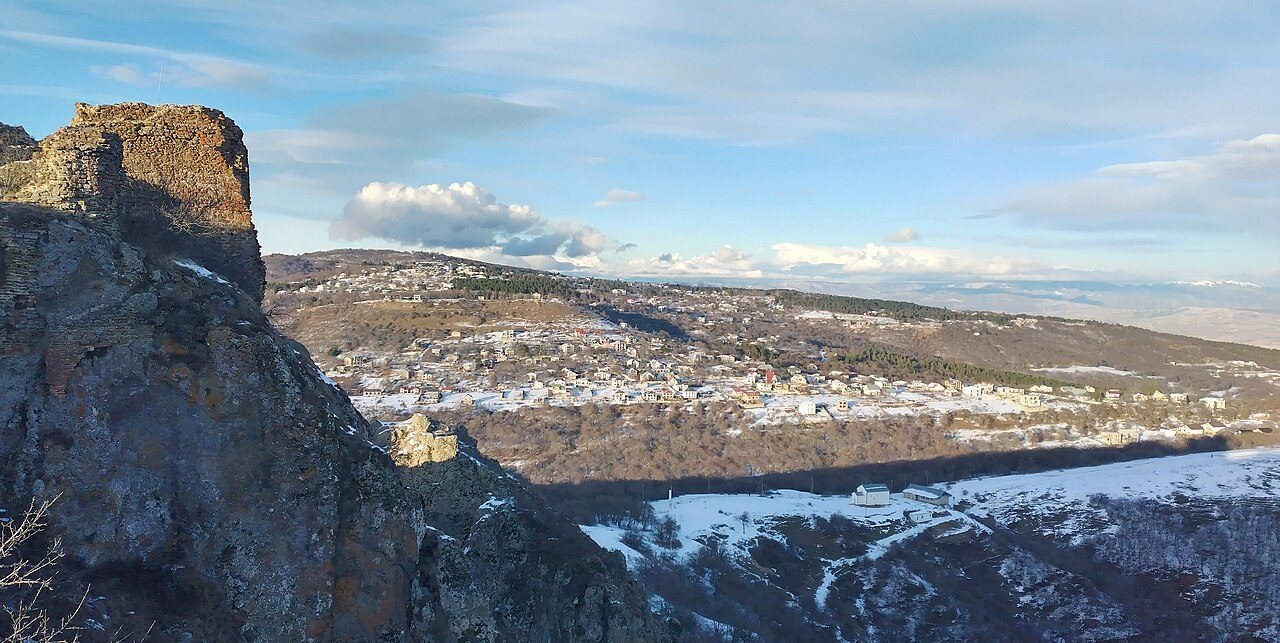
Kojori Fortress
Perched dramatically atop the volcanic tooth of Mount Azeula, the 11th-century stronghold historically known as Agarani commanded the vital southern trade arteries linking medieval Georgia to Armenia and the broader Middle East. Royal chronicles note that King Tamar sought refuge within its high masonry during her final, illness-stricken months in the early 13th century. Centuries later, the site was consecrated in blood during the February 1921 Soviet invasion, when Georgian military cadets (*junkers*) mounted a heroic, ill-fated defense against the 11th Red Army along these very ridges, turning the citadel into a poignant monument of national sovereignty. What survives today is a fractured crown of dark basalt rubble and lime mortar, appearing almost sculpted from the precipitous cliff itself. Visitors traverse a narrow spur and scale steep, open-grate iron stairs anchored directly into sheer stone to reach the upper redoubt. At the summit, buffeted by relentless subalpine winds, you stand amid fragmented watchtowers and collapsed curtain walls with unobstructed panoramic sweeps. To the west, the forested folds of the Trialeti Range ripple outward, while the vast terracotta-and-concrete sprawl of Tbilisi unfurls across the valley floor below, offering an exhilarating sense of isolation suspended high above the capital.
More in Tbilisi

Photo credits (3)
- Yuri Samoylov, CC BY-SA 4.0, via Wikimedia Commons
- Image-Tbilisi_XIXc_05.jpg : Dimitri Ermakov Ermakov._Old_Tbilisi._6.jpg : Dimitri Ermakov Ermakov._Old_Tbilisi._7.jpg : Dimitri Ermakov Tbilisi_XIXc_2.jpg : Un…, Public domain, via Wikimedia Commons
- Vyacheslav Argenberg, CC BY 4.0, via Wikimedia Commons