 New added
Mogren Beach
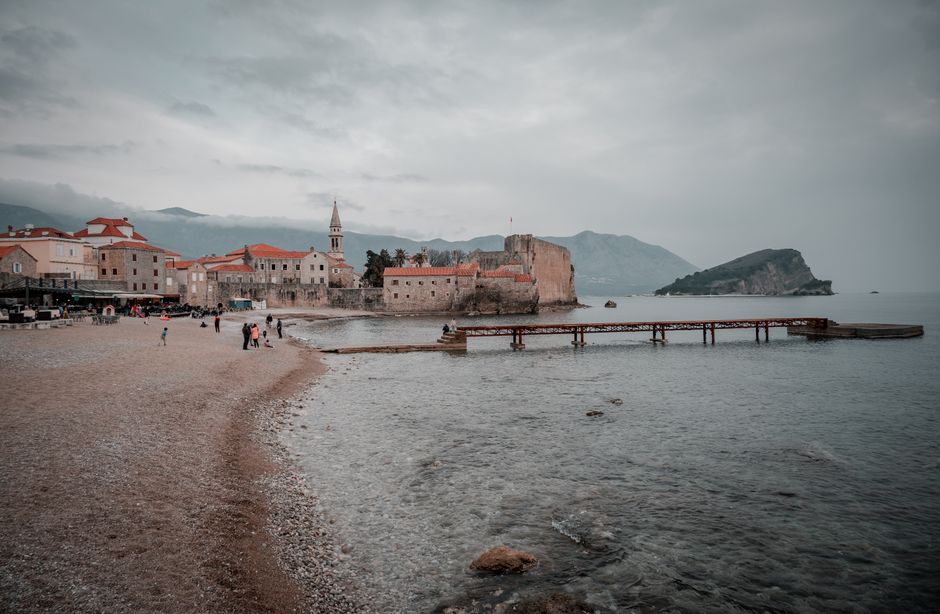
Carved into the foot of Spas Hill just beyond Budva’s medieval ramparts, Mogren Beach draws its name from the 16th-century Spanish mariner Mogrini, the sole survivor of a shipwreck who erected a chapel to Saint Anthony upon its sands. Looming on the ridge directly above, the limestone ruins of the Austro-Hungarian Fort Mogren, constructed in 1860, still survey the coastline. Reaching the secluded shore requires traversing a narrow, wave-splattered concrete path cantilevered against sheer cliffs, passing the iconic bronze silhouette of the Budva Dancer perched atop an offshore boulder. The beach divides into two amber-pebbled crescents—Mogren I and Mogren II—measuring roughly 350 meters combined and separated by a jagged karst spur. Crossing between the two coves involves ducking through a low, wave-washed tunnel chiseled straight through the sedimentary bedrock. Emerging onto Mogren II, visitors encounter towering, ribboned rock strata colonized by fragrant Aleppo pines, which cast sharp afternoon shadows across the cove. Here, the Adriatic shifts from crystalline aquamarine shallows to deep indigo, its cool brine washing over sun-warmed shingles with a hollow rattle that entirely muffles the modern bustle of the nearby resort town.