
 New added
Istiqlal Mosque
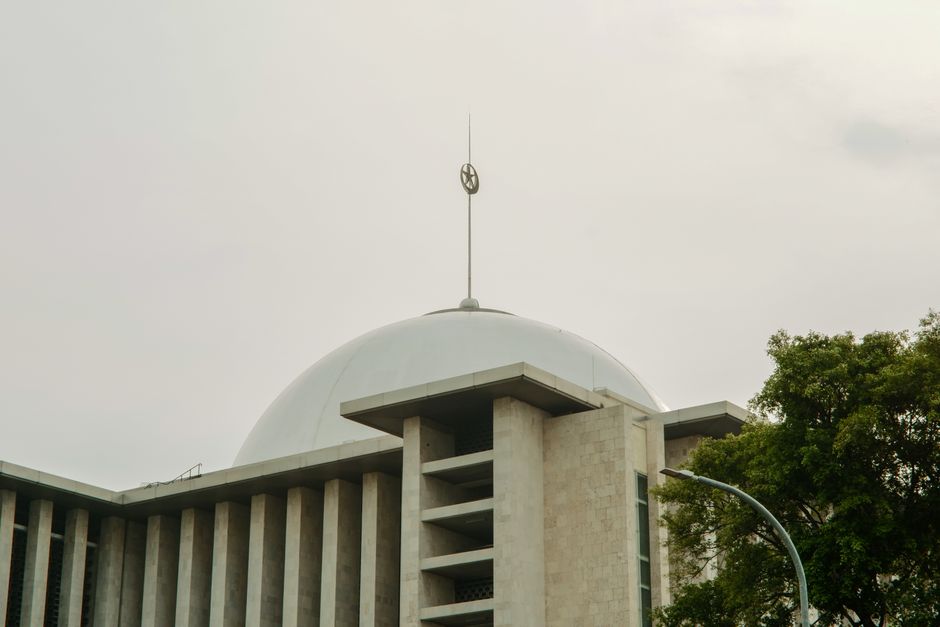
Commissioned by Indonesia’s founding president, Sukarno, to commemorate the nation's sovereignty, Istiqlal Mosque—meaning "Independence" in Arabic—stands as a monumental triumph of Tropical Modernism. Formally inaugurated in 1978, the colossal complex was conceived by Friedrich Silaban, a Christian architect whose winning blueprint boldly reflected the young republic’s ethos of religious tolerance, positioned deliberately across from Jakarta Cathedral. Every architectural calculation doubles as national and spiritual allegory: the gargantuan central stainless-steel dome spans exactly 45 meters to honor the 1945 Proclamation of Independence, anchored within by twelve cylindrical, steel-clad pillars symbolizing the twelfth day of Rabi' al-awwal, the Prophet Muhammad’s birthdate. Stepping barefoot onto the vast expanse of cool Indonesian marble, visitors shed Jakarta’s stifling heat and vehicular roar for an arena of breezy, cavernous stillness. Natural cross-ventilation sweeps across the monumental rectangular prayer hall, where sunlight filters through intricate geometric metal screens, casting shifting Arabesque shadows across the floor. Gazing upward past five tiers of sweeping balconies—built to symbolize both the five pillars of Islam and Indonesia’s national ideology of Pancasila—the sheer volume of the sanctuary reveals itself, capable of sheltering over 200,000 worshippers beneath a gleaming metallic canopy that magnifies the resonant, spine-tingling cadence of the daily call to prayer.