
 New added
Palace of Peace
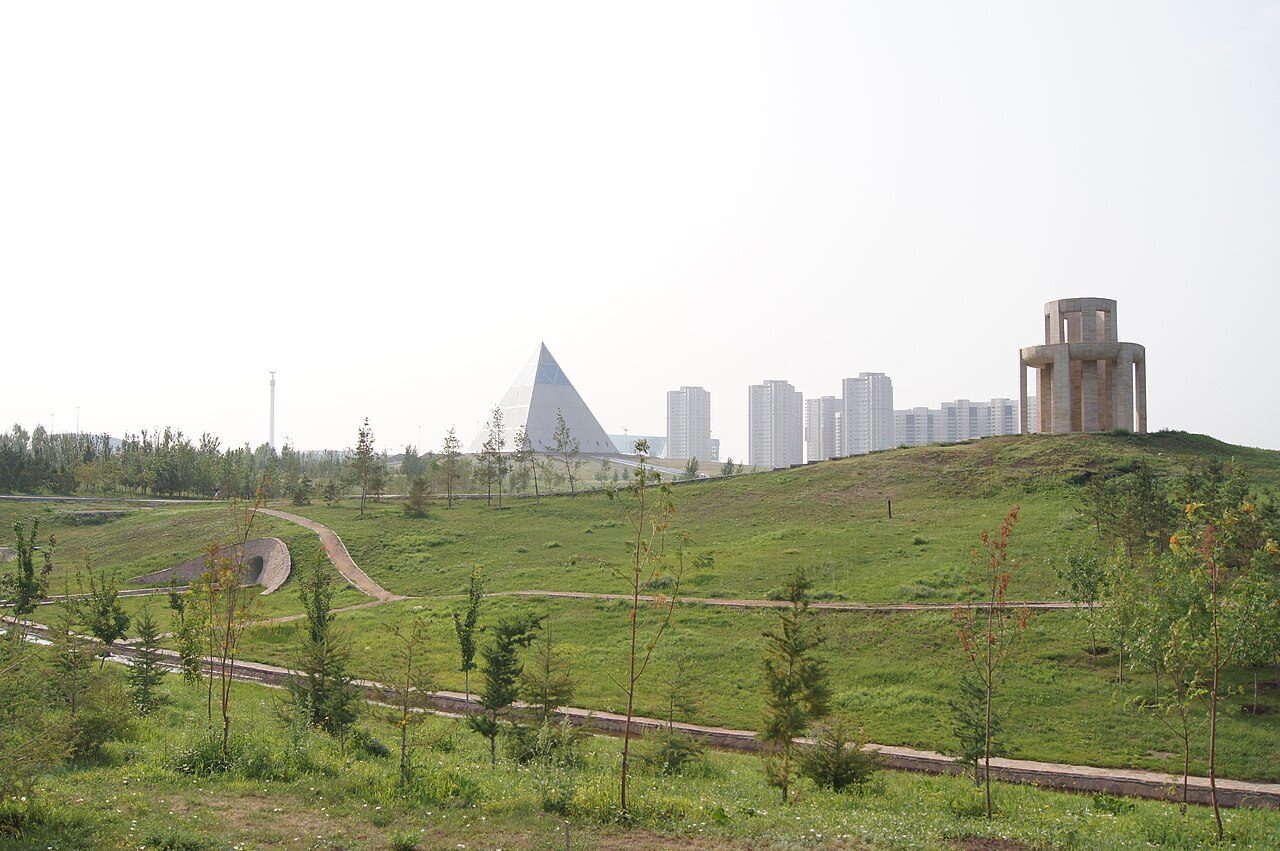
Commissioned to host the triennial Congress of Leaders of World and Traditional Religions, the Palace of Peace and Reconciliation—often called the Pyramid of Peace—opened in 2006 under the direction of British architect Sir Norman Foster. Rising directly from Astana’s flat steppe as a strict equilateral pyramid measuring 62 meters high on a 62-meter base, the structure embodies Kazakhstan's civic ambition. Its lower tiers are clad in pale, geometric granite blocks, while the towering apex dissolves into a translucent beacon of stained glass designed by artist Brian Clarke, intricately patterned with 130 white doves symbolizing the nation’s diverse ethnic groups. Inside, visitors encounter a deliberate architectural journey from terrestrial shadow toward celestial illumination. Entering beneath the earth, travelers first step into a 1,300-seat opera house wrapped in dark timber and burgundy fabric, before ascending into a luminous, five-story atrium flanked by hanging gardens. Climbing the zigzagging stairs or glass-encased diagonal elevators leads to the apex's circular conference hall, known as the "Cradle." Here, sitting beneath the dove-filled glass canopy, visitors stand bathed in shifting patterns of pale yellow and sky-blue light, gazing out through the geometric steel lattice across the sprawling lawns of Presidential Park.
More in Astana
Photo credits (2)
- jtstewart, CC BY-SA 2.0, via Wikimedia Commons
- Ken and Nyetta, CC BY 2.0, via Wikimedia Commons