
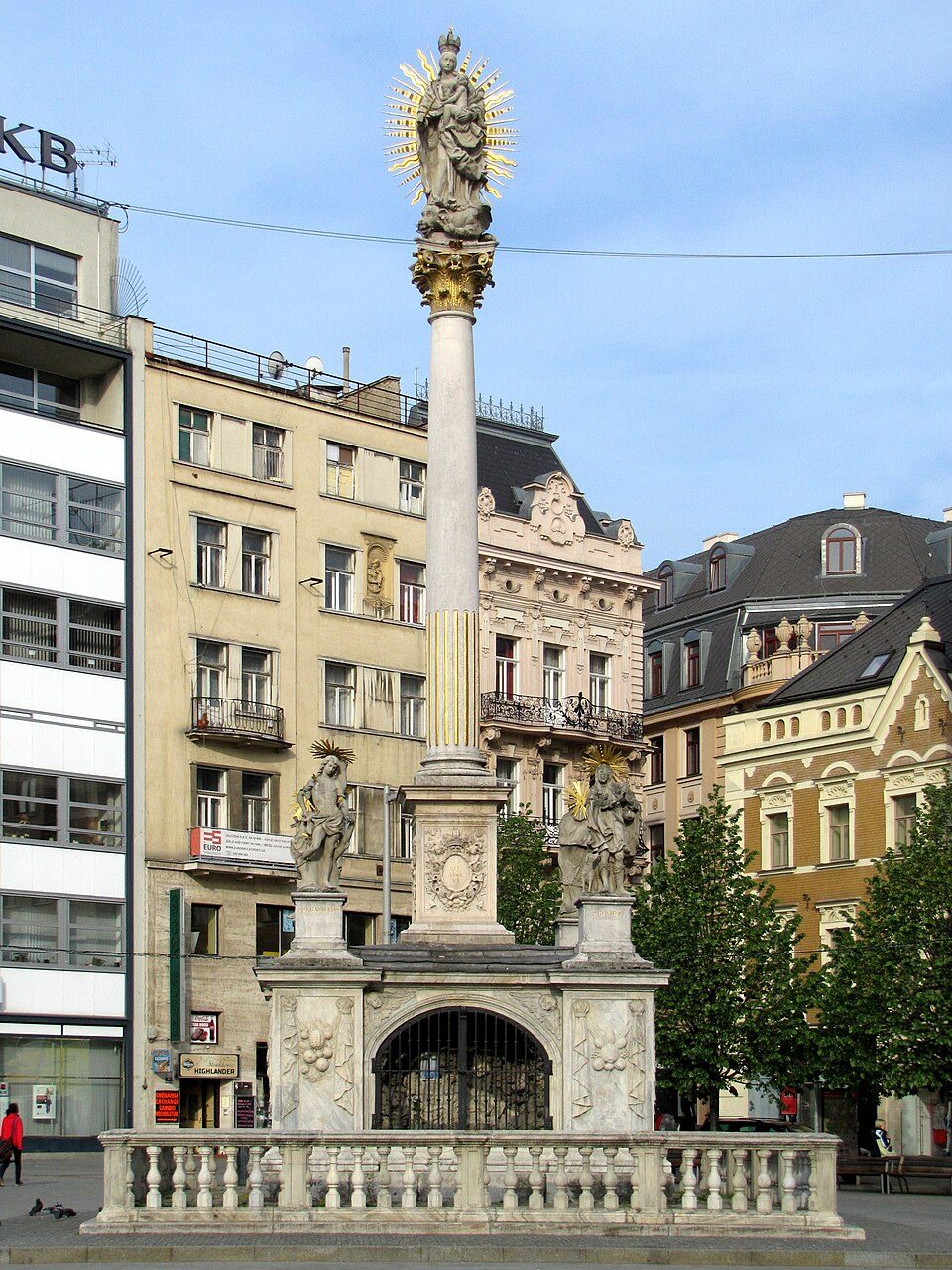
Freedom Square
Originating in the 13th century as the Lower Market (*Dolní trh*), Freedom Square forms an expansive, triangular crossroads of Moravian history. At its center rises the Baroque Plague Column, erected between 1679 and 1689 by architect Jan Křtitel Erna to commemorate the city's survival following the 1645 Swedish siege and devastating epidemics. The perimeter is an architectural montage: the Renaissance sgraffito-adorned House of the Lords of Lipá stands opposite the cast-iron balconies of the 19th-century Klein Palace, while austere Functionalist banks and a bronze fountain etched with poetry by Jan Skácel complete the layered aesthetic. Today, visitors encounter a kinetic urban stage where red-and-cream trams slice through wide flagstones and outdoor cafe tables hum with conversation. The square’s most arresting modern addition is the controversial Brno astronomical clock, a six-meter-tall obelisk of polished black South African granite shaped like an artillery shell. Every morning, crowds encircle this enigmatic monolith. Because local legend recounts how the city tricked the besieging Swedish army by ringing the midday chimes an hour ahead, the clock strikes noon at precisely 11:00 AM. At that moment, internal mechanisms drop a single patterned glass marble through one of four brass-lined apertures, prompting onlookers to press their hands deep into the cold stone slots in hopes of catching the prized keepsake.
More in Brno
Photo credits (4)
- Radek Linner
- Ben Skála, CC BY-SA 4.0, via Wikimedia Commons
- Perituss, CC0, via Wikimedia Commons
- Jorge Franganillo, CC BY 4.0, via Wikimedia Commons