
 New added
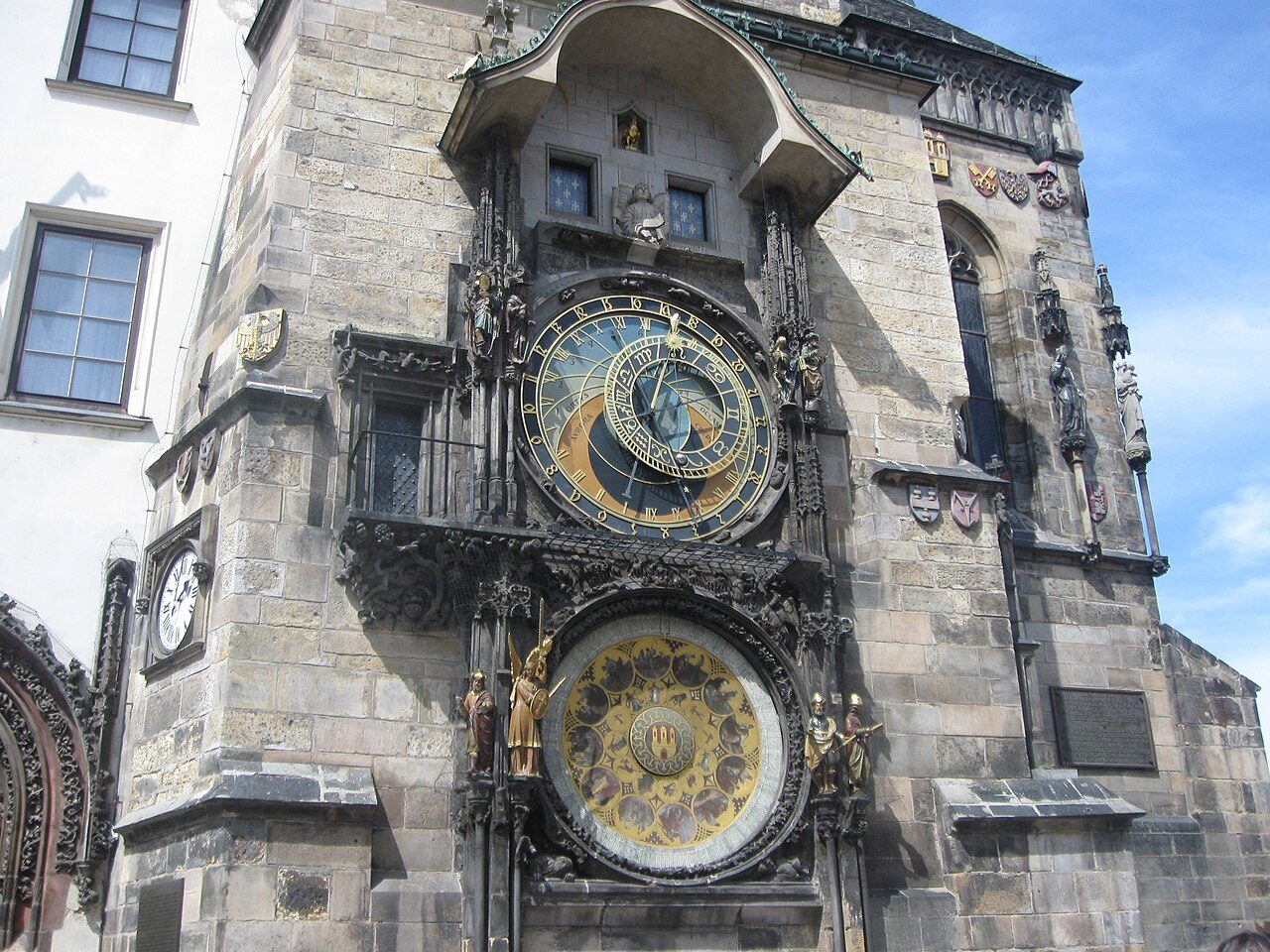
Astronomical Clock
Mounted upon the southern flank of Prague’s Old Town City Hall, the medieval *Orloj* has tracked celestial movement since 1410. Engineered by imperial clockmaker Mikuláš of Kadaň alongside Charles University mathematician Jan Šindel, it endures as the world's oldest operating astronomical clock. The upper dial functions as an intricate astrolabe, depicting a geocentric universe where gilded hands and a mobile zodiac ring sweep across vibrant shades of lapis blue and ochre, measuring Babylonian, Old Czech, and solar time. Beneath this cosmic display hangs an elaborate calendar plate painted by Josef Mánes in 1865, encircled by pointed Gothic arches and watchful stone grotesques carved during the reign of King Wenceslas IV. As the hour approaches, a hushed anticipation settles over the cobblestones of Old Town Square. The performance begins when a skeletal figure of Death tugs a funeral bell cord with bony fingers and upturns an hourglass, flanked by baroque allegories of Vanity peering into a mirror and Greed clutching a moneybag. Above, two blue shutters snap open to reveal the Twelve Apostles sliding past miniature windows in a mechanical rotation. The somber morality play culminates with the piercing crow of a gilded brass rooster and the resonant strike of the heavy iron bell, reminding spectators of mortality before dissolving back into the lively hum of the historic plaza.
More in Prague

Photo credits (5)
- Dwxn, CC BY-SA 4.0, via Wikimedia Commons
- Falk2, CC BY-SA 4.0, via Wikimedia Commons
- 31x05x2024, CC0, via Wikimedia Commons
- ZSimonova, CC BY-SA 4.0, via Wikimedia Commons
- o¬., CC BY 2.0, via Wikimedia Commons