
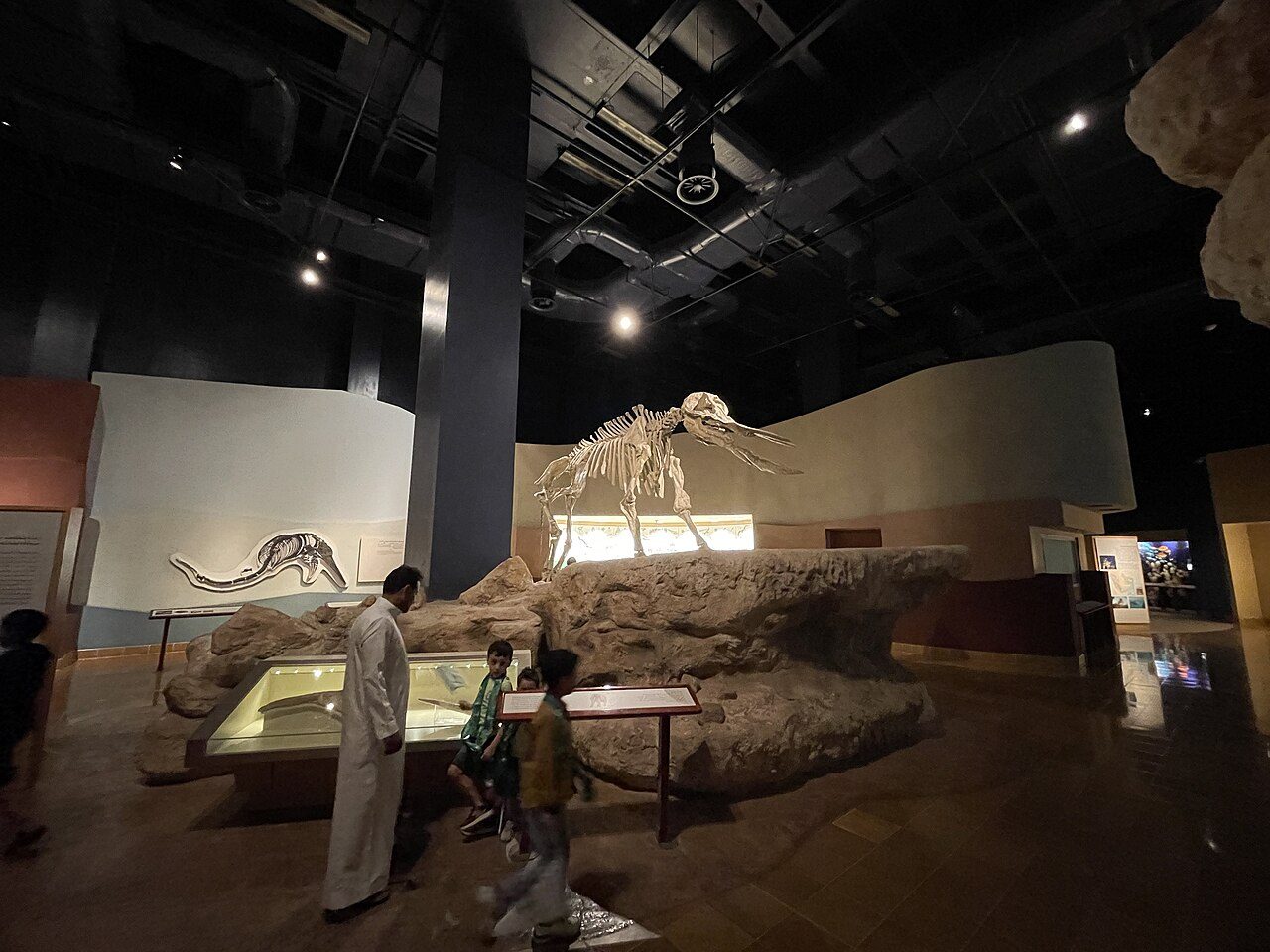
National Museum
Rising from the historic grounds of the King Abdulaziz Historical Center, the National Museum opened in 1999 to commemorate the centennial of the unification of Saudi Arabia. Canadian architect Raymond Moriyama sculpted the modernist edifice to mirror the undulating red dunes of the Rub' al Khali, wrapping the western facade in a sweeping, crescent-shaped wall of local Riyadh limestone. Approaching across sun-baked courtyards framed by desert palms and cooling water features, visitors find the museum’s low-slung, honey-hued pavilions standing in striking geometric contrast to the reconstructed mud-brick bastions of nearby Murabba Palace. Inside, the desert glare yields to the hushed, ambient gloom of eight thematic galleries arranged across two chronological levels. The journey commences in "Man and the Universe," where travelers confront a massive, pitted fragment of the prehistoric Wabar meteorite, unearthed from the Empty Quarter. Moving deeper, the path winds past Neolithic petroglyphs and bronze artifacts into a dramatic chamber housing a full-scale reconstruction of a rock-cut Nabataean tomb facade from Hegra, its carved pilasters glowing under sharp spotlights. Gliding over cool marble walkways, visitors transition into the Islamic era, surrounded by illuminated 8th-century Quranic manuscripts and rare astrolabes that render thousands of years of Arabian statecraft and desert survival immediately tangible.
More in Riyadh
Photo credits (3)
- Gryffindor, CC0, via Wikimedia Commons
- Ammar shaker, Public domain, via Wikimedia Commons
- Geektaker, CC BY 3.0, via Wikimedia Commons