
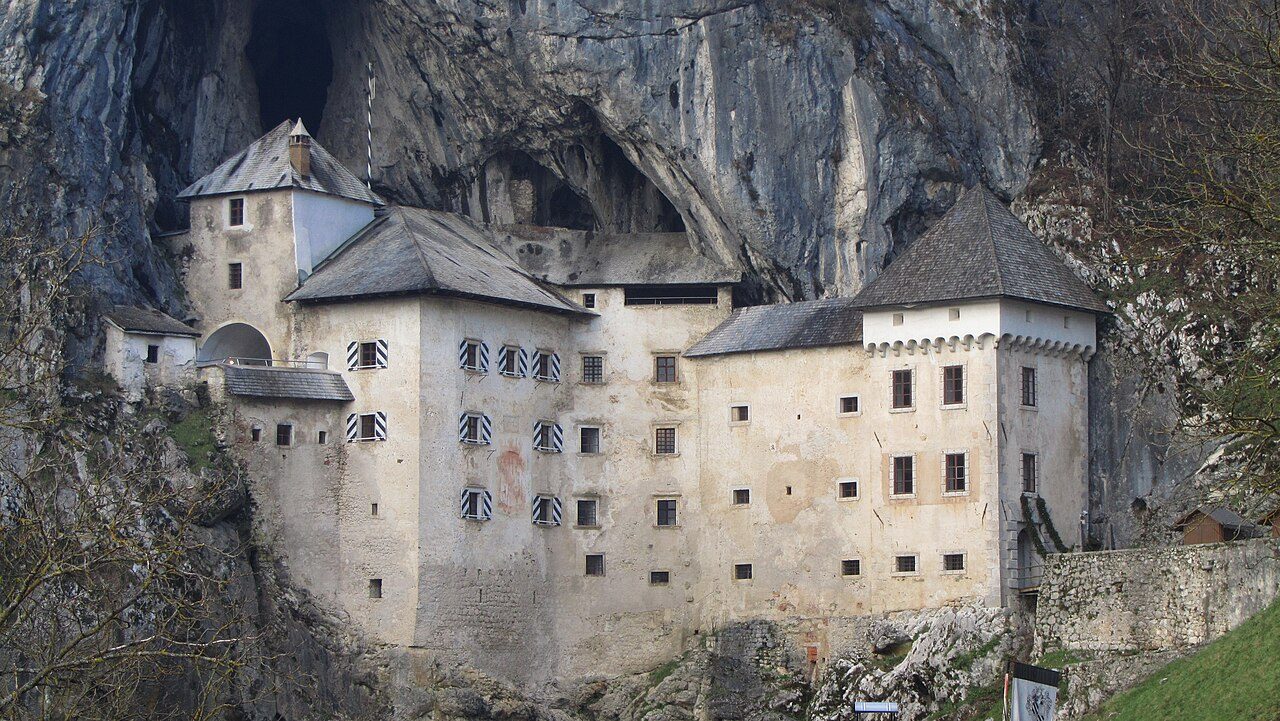
Predjama Castle
Clinging impossibly to the gaping mouth of a cavern halfway up a 123-meter sheer limestone cliff, Predjama Castle stands as a masterwork of medieval defensive ingenuity. Documented as early as 1274, the four-story Renaissance fortress visible today was largely erected in 1570 by Baron Johann Cobenzl. The stronghold’s enduring lore, however, belongs to the 15th-century rebel knight Erasmus of Lueg, who withstood a year-long imperial Habsburg siege by exploiting a secret vertical shaft through the karst caves to smuggle in fresh cherries and provisions. Inside, architecture and geology blur; rough-hewn stalactite-studded cliff walls form the interior boundaries of the armory, residential chambers, and a drafty third-floor torture room equipped with an original rack. Crossing the wooden drawbridge over the Lokva stream, visitors immediately feel the sharp drop in temperature as mountain air yields to the damp, subterranean chill of the cave system. Creaking timber staircases wind past arrow slits framing vertigo-inducing views of the lush valley below, leading through restored banquet halls warmed only by modest stone hearths. At the castle’s highest accessible point, the masonry gives way entirely to the cavernous upper reaches of Erasmus’s Nook, where travelers can listen to the persistent drip of cave water echoing against raw stone, palpably sensing the eerie isolation of this impenetrable rock-bound refuge.
More in Postojna
Photo credits (3)
- Mariposa.que.vuela, CC BY-SA 3.0, via Wikimedia Commons
- Leon Yaakov from Tel Aviv, ISRAEL, CC BY 2.0, via Wikimedia Commons
- Lander at Slovenian Wikipedia, CC BY-SA 3.0, via Wikimedia Commons