
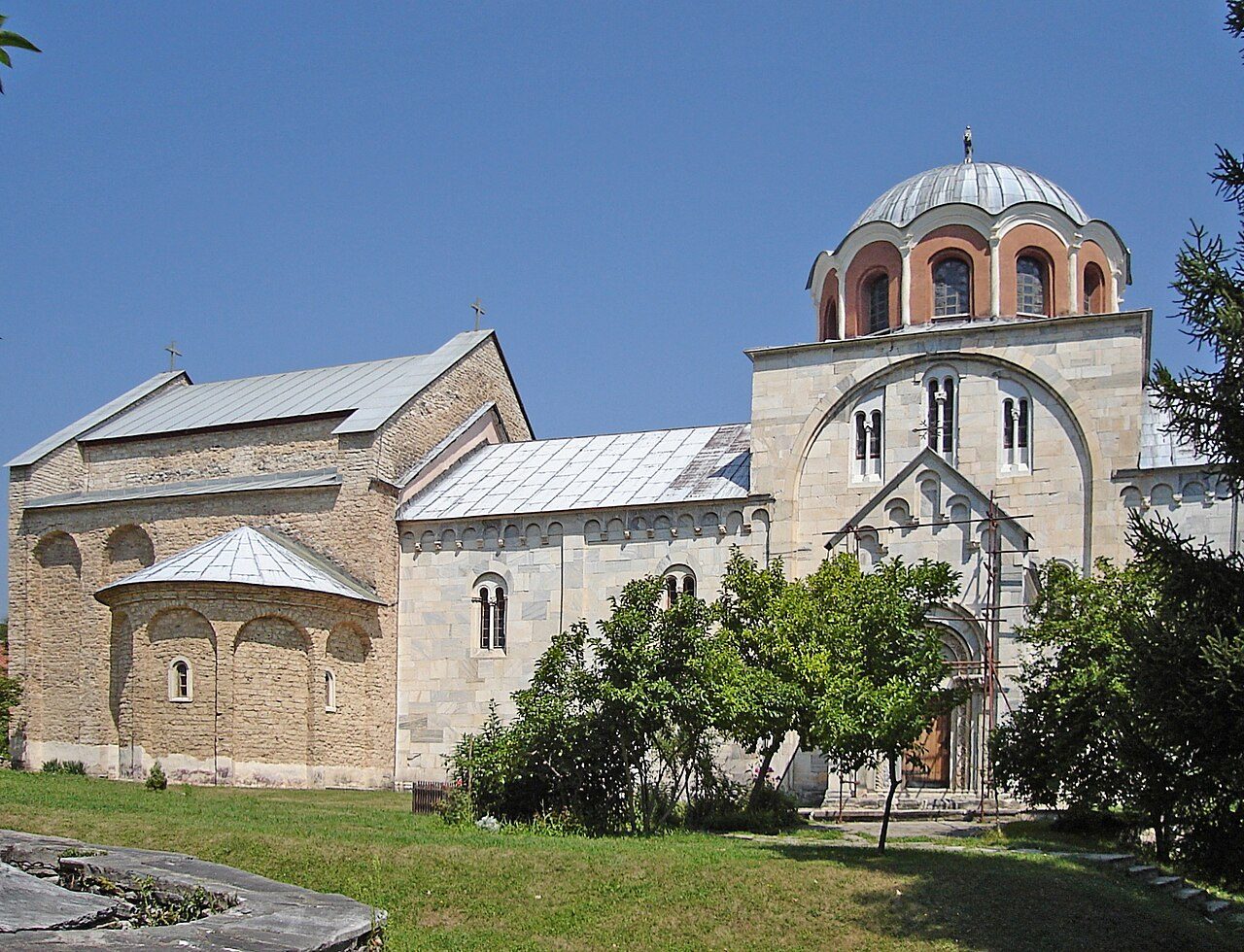
Studenica Monastery
Founded in 1190 by Grand Prince Stefan Nemanja, the founder of the medieval Serbian state, Studenica Monastery rises from a forested river valley south of Kraljevo as an imperial sanctuary and the crown jewel of the Raška architectural school. This fortified complex bridges East and West, fusing Romanesque stonework with Byzantine spatial symmetry. Its centerpiece, the Church of the Virgin, gleams in polished white marble quarried from nearby Mount Radočelo, crowned by an octagonal dome and framed by a magnificent Romanesque portal intricately carved with reliefs of apostles, mythical gryphons, and twisting flora. Enclosed within the defensive curtain walls stands the smaller King’s Church, built by King Milutin in 1314, completing a compound that served as the spiritual and cultural incubator of the Nemanjić dynasty. Stepping into the cool, incense-scented shadows of the Virgin’s Church, travelers are confronted by the foundational masterpieces of 13th-century Byzantine fresco painting. Dominating the western wall is the monumental 1209 *Crucifixion*, set against a luminous backdrop of ground lapis lazuli imported at staggering expense from the Levant; the tragic, humanized expressions of the mourners predate similar Italian proto-Renaissance developments by decades. Outside, the steady rush of the Studenica River and the rustle of walnut trees in the cloister courtyard break the mountain stillness. Walking the worn slate pathways between weathered marble walls and monks' quarters, one feels the secluded weight of eight centuries of preserved Orthodox monastic tradition.
More in Kraljevo
Photo credits (2)
- Cornelius Bechtler, CC BY-SA 3.0, via Wikimedia Commons
- Djina, CC BY-SA 3.0, via Wikimedia Commons