

Tayrona National Park
Where the jungle-clad foothills of the Sierra Nevada de Santa Marta plunge into the Caribbean, the ancestral territory of the pre-Columbian Tairona civilization has been preserved as a national park since 1964. Centuries before Spanish conquistador Rodrigo de Bastidas anchored in nearby bays in 1525, indigenous builders engineered dry-stone terraces, retaining walls, and circular dwellings deep in the maritime forest, leaving behind sacred enclaves like Pueblito Chairama. Today, the park encompasses 15,000 hectares of marine and terrestrial ecosystems fiercely protected and spiritually stewarded by the Tairona’s direct descendants—the indigenous Kogui, Wiwa, Arhuaco, and Kankuamo peoples—who still conduct sacred equilibrium rituals along these ancestral coastlines. Trekking through the dense, humid canopy along slick stone paths, travelers navigate a cacophony of screeching red howler monkeys and darting blue morpho butterflies before the foliage suddenly yields to the blinding white arc of Cabo San Juan del Guía. Colossal, weathered granite boulders, smoothed by centuries of surf, rise like prehistoric sculptures out of churning turquoise shallows. At the center of the promontory, a steep wooden staircase leads up to a two-story, palm-thatched gazebo balanced precariously atop a sea-battered rock, where visitors can gaze down upon twin crescent coves, inhaling the salt spray and listening to the rhythmic crash of the open sea against ancient stone.
More in Santa Marta
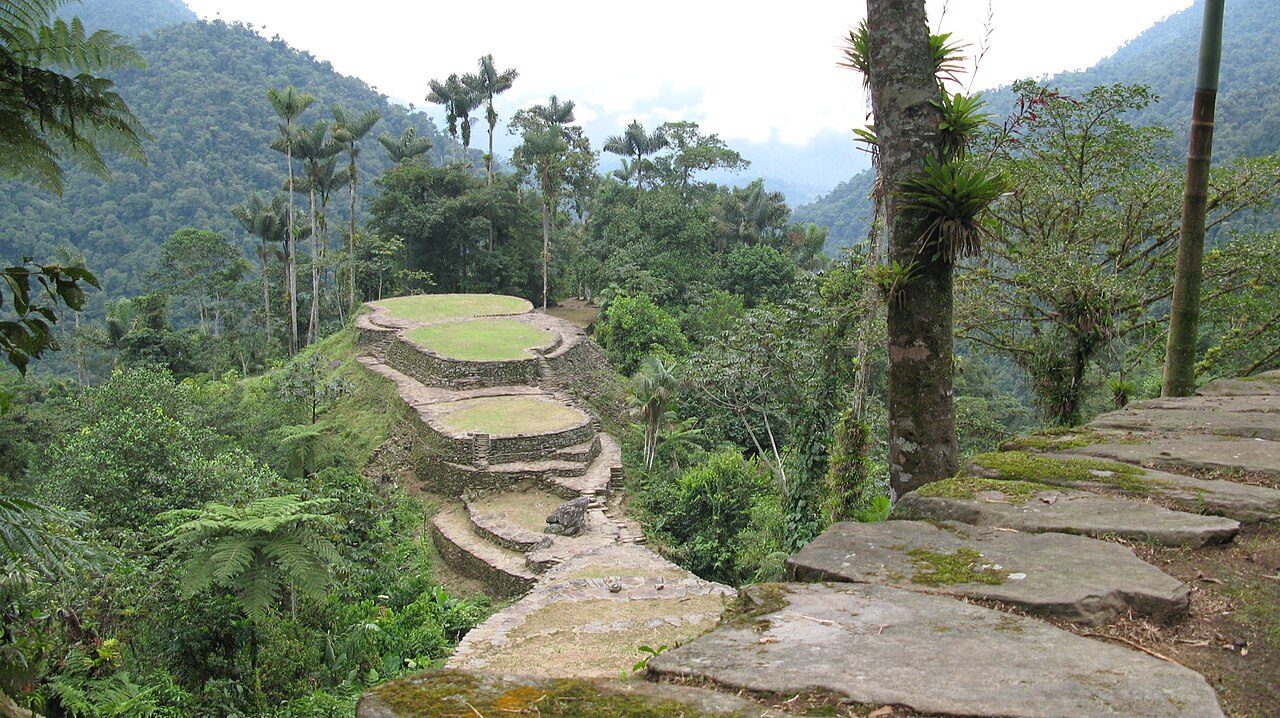
Photo credits (1)
- Gavin Rough from Waterloo, Canada, CC BY 2.0, via Wikimedia Commons