
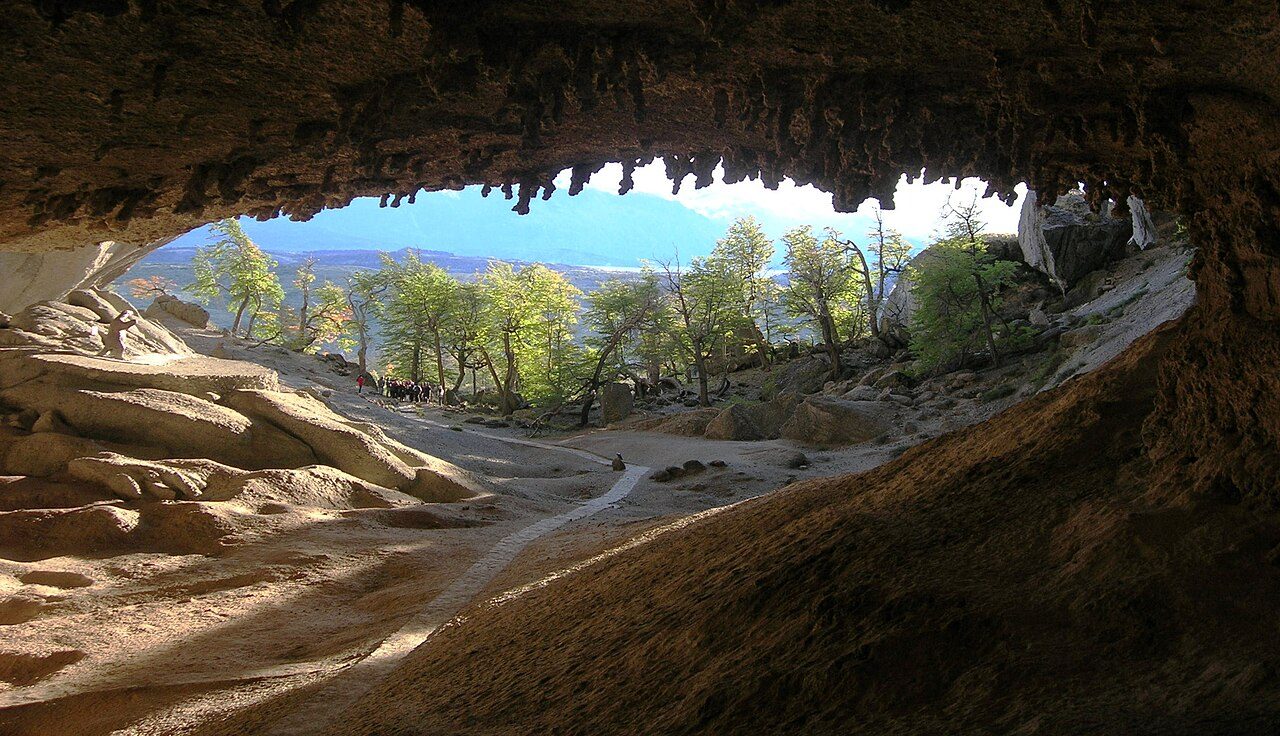
Cueva del Milodon
In 1895, German pioneer Hermann Eberhard ventured into this colossal natural amphitheater and unearthed petrified skin, bone, and dung belonging to the *Mylodon darwinii*, an extinct, three-meter-tall giant ground sloth from the late Pleistocene. Hollowed out by the wave action of a glacial lake tens of thousands of years ago, the primary cavern plunges 200 meters into conglomerate bedrock, supported by a sweeping natural vault that rises 30 meters overhead. Archaeologists later identified ash strata, charcoal hearths, and stone tools alongside megafaunal bones, confirming that early Paleo-Indian hunters utilized this subterranean sanctuary as early as 11,000 years ago. Crossing beneath the jagged rock overhang, visitors encounter an immediate drop in temperature and the damp, earthy scent of ancient sediment sheltered from the Patagonian winds. Sunlight angles through the massive threshold, raking across pitted limestone walls and mineral-streaked crevices before fading into twilight. Deeper along the wooden boardwalk, a life-sized, fiberglass replica of the clawed Mylodon rears up in a defensive posture, offering an arresting sense of scale against the cavernous interior. Turning back toward the entrance, the massive silhouette of the cave mouth perfectly frames the distant, windswept lenga forests and the snow-dusted ridges of the Cerro Benítez.
More in Puerto Natales
Photo credits (2)
- Remi Jouan, CC BY-SA 3.0, via Wikimedia Commons
- LBM1948, CC BY-SA 4.0, via Wikimedia Commons