
Meeting of Waters
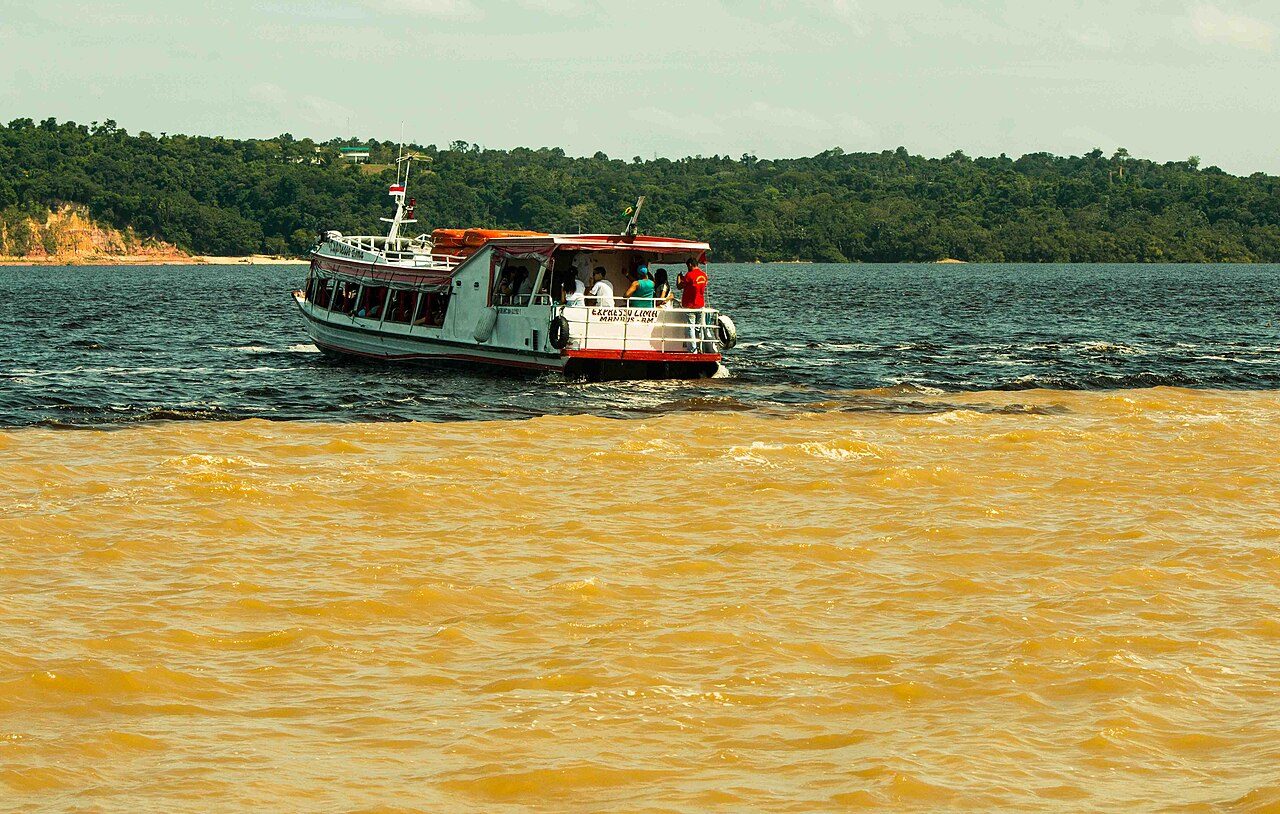
Just east of Manaus, two hydrological giants collide without yielding: the ink-dark Rio Negro and the pale, sandy-ochre Rio Solimões. First charted by European eyes during Francisco de Orellana’s fateful 1542 descent of the Amazon basin, and officially recognized by Brazil’s National Institute of Historic and Artistic Heritage (IPHAN) in 2010, this phenomenon sees two massive rivers run side-by-side for over six kilometers without blending. The stark dichotomy is an act of physics: the sediment-choked Solimões rushes at nearly six kilometers per hour, dense and cool at 22°C, while the tannin-stained Negro drifts languidly at two kilometers per hour, its acidic, tea-colored water warmed by the equatorial sun to roughly 28°C. Skimming across this liquid frontier aboard a wooden riverboat, you encounter a line of demarcation so sharp it appears etched with a blade. Leaning over the gunwale to submerge your hands across the seam reveals an immediate, tactile shock—one palm registers the tepid warmth of the dark current while the other plunges into the cool, clay-thick rush of the pale stream. The air shifts abruptly between damp mineral silt and the sweet, decaying vegetation of flooded jungles. Watch closely where the contrasting currents roil against one another, and you will often catch the pink, glinting arc of a *boto cor-de-rosa* breaching the surface to hunt disoriented fish trapped in the hydraulic divide.
More in Manaus
Photo credits (2)
- Ana Claudia Jatahy - MTUR, CC0, via Wikimedia Commons
- Karine Hermes, CC BY-SA 4.0, via Wikimedia Commons