
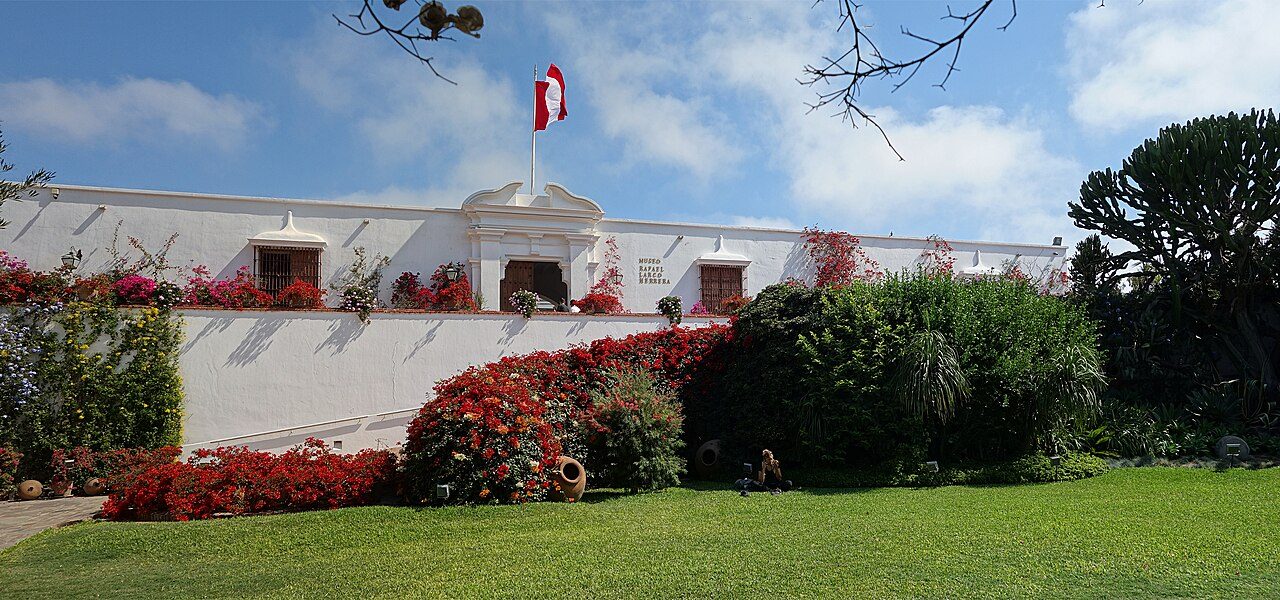
Larco Museum
Perched atop a seventh-century pre-Columbian pyramid in Lima’s Pueblo Libre district, the Larco Museum occupies an eighteenth-century viceregal mansion smothered in cascading magenta bougainvillea and subtropical palms. Founded in 1926 by pioneering archaeologist Rafael Larco Hoyle, the estate safeguards over five thousand years of ancient Peruvian history behind gleaming whitewashed walls and dark timber balconies. Visitors pass from sun-drenched colonial courtyards into climate-controlled galleries glowing with the artistry of the Cupisnique, Chimú, Nazca, and Moche civilizations, encountering hammered gold funerary masks, intricate turquoise-inlaid earflares, and feathered Paracas textiles preserved across millennia. Beyond the formal exhibition halls, travelers descend into the museum’s rare open-access storerooms, an overwhelming archive where floor-to-ceiling glass cabinets house roughly thirty thousand cataloged ceramic vessels, their stirrup spouts catching the dim vault lighting. A separate, shaded garden pavilion leads to the celebrated Erotic Pottery Gallery, where Mochica vessels frankly depict ritual intercourse, underworld deities, and fertility ceremonies with striking anatomical precision. Mingling the scent of blooming jasmine with the earthy antiquity of clay, the sensory transit through the grounds bridges Spanish viceregal architecture and the profound spiritual cosmology of the pre-Columbian Andes.
More in Lima
Photo credits (4)
- Velvet, CC BY-SA 4.0, via Wikimedia Commons
- Mira4espina78y, CC BY-SA 3.0, via Wikimedia Commons
- Alexey Komarov, CC BY-SA 4.0, via Wikimedia Commons
- Diego Delso, CC BY-SA 4.0, via Wikimedia Commons