
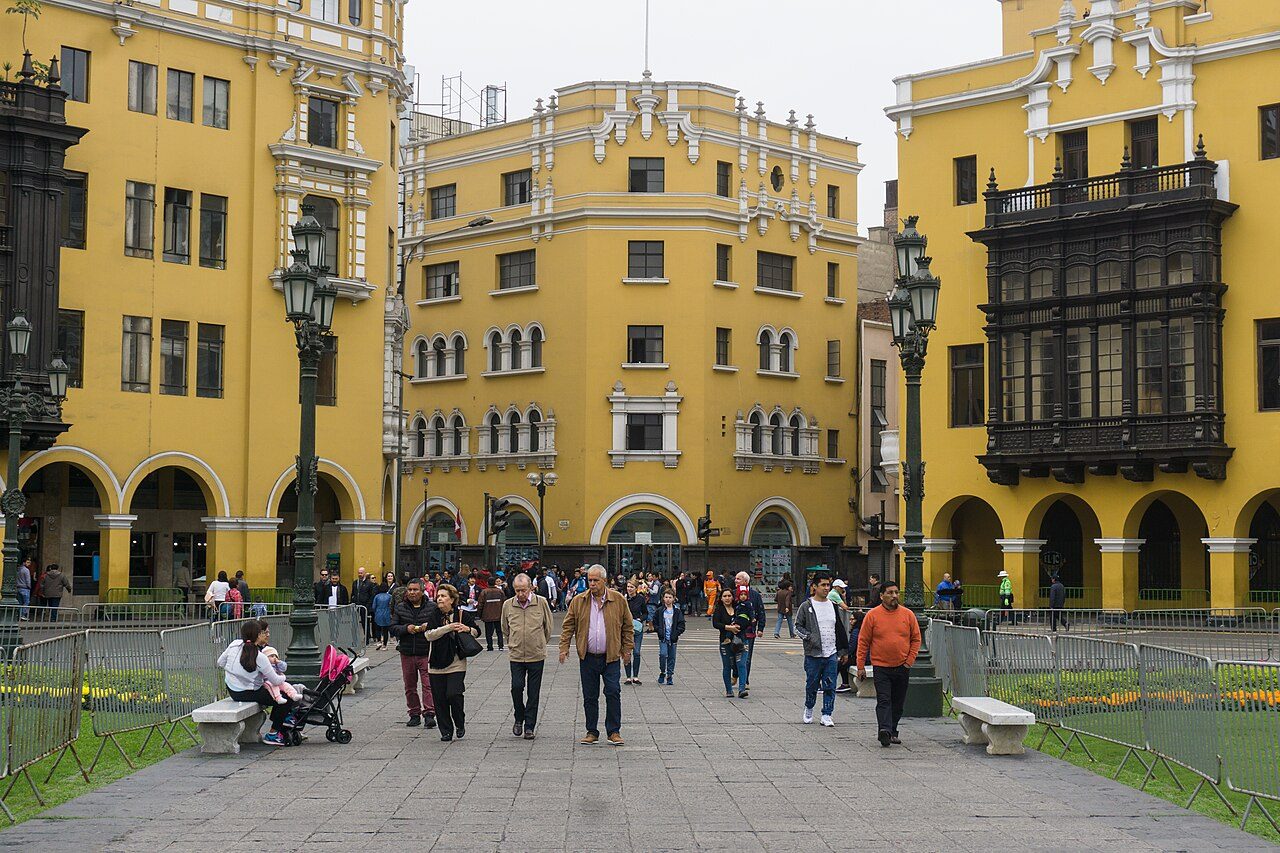
Plaza Mayor of Lima
Conquistador Francisco Pizarro laid out this colossal square on January 18, 1535, declaring it the heart of his "City of the Kings." Centered on a tiered bronze fountain cast in 1651 and crowned with the trumpeting angel of Fame, the plaza has witnessed centuries of upheaval, from the solemn executions of the Spanish Inquisition to General José de San Martín’s 1821 proclamation of Peruvian independence. Surrounding the perimeter, grandiose architecture commands the skyline: the twin Neoclassical towers of the 17th-century Cathedral of Lima anchor the eastern flank, while the sun-drenched, mustard-yellow facades of the Municipal Palace and Club de la Unión display magnificent baroque balconies carved from dark cedar, their intricate Moorish-style latticework designed to let cloistered colonial women view the street unseen. Standing upon the polished flagstones, travelers encounter a sensory theater where centuries of Limeño statecraft and street life collide beneath the coastal desert’s overcast *garúa* haze. At noon, the wrought-iron gates of the neo-baroque Government Palace rattle open as the presidential guard, the Hussars of Junín, execute a synchronized changing of the guard punctuated by bugle calls, glittering sabers, and high-stepping marching bands. Under the shaded arches of the Portal de Botoneros, the scent of fresh sweet *picarones* fried in bubbling oil drifts past strolling locals, while cool breezes off the nearby Rímac River sweep across the open stone expanse, offering a rare pause inside South America's bustling metropolis.
More in Lima
Photo credits (4)
- Alexey Komarov, CC BY-SA 4.0, via Wikimedia Commons
- Mira4espina78y, CC BY-SA 3.0, via Wikimedia Commons
- Velvet, CC BY-SA 4.0, via Wikimedia Commons
- Diego Delso, CC BY-SA 4.0, via Wikimedia Commons