
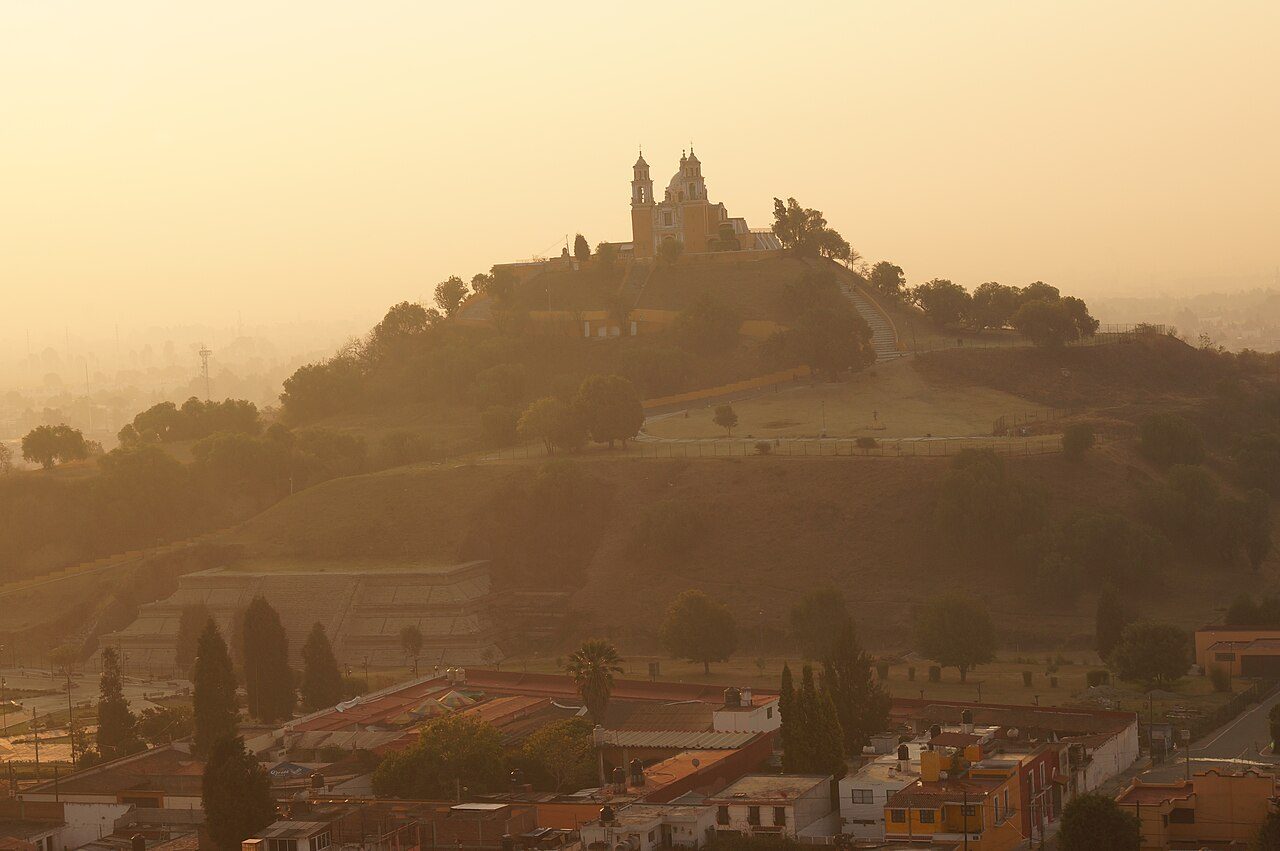
Great Pyramid of Cholula
Crowned by the canary-yellow facade and neoclassical bell towers of the 16th-century *Santuario de Nuestra Señora de los Remedios*, this colossal, grass-blanketed mound conceals *Tlachihualtepetl*—the largest pyramid base on Earth by volume. Begun around the 3rd century BCE and dedicated to the feathered serpent deity Quetzalcoatl, the ceremonial complex grew across a millennium through six overlapping construction phases, accumulating an astounding 4.45-million-cubic-meter footprint. By the time Hernán Cortés orchestrated the brutal Cholula massacre in 1519, centuries of neglect had cloaked the sacred adobe acropolis in brush, leading the Spanish to mistake it for a natural hill before crowning its summit with an imposing Catholic outpost in 1594. Exploring the site begins in the subterranean labyrinth, where visitors thread narrow, claustrophobic tunnels illuminated by soft amber lighting. The air here turns crisp and damp, smelling of ancient clay, revealing cross-sections of original Talud-Tablero staircases and nearby access to the celebrated *Mural of the Drinkers* (*Mural de los Bebedores*), an energetic 110-person pre-Columbian fresco depicting a ritual pulque feast. Surfacing into the radiant highland sun, travelers tackle the spiraling stone footpath to the summit. From the church courtyard, decorated in Puebla’s signature glazed Talavera tiles, the panoramic view delivers an arresting juxtaposition: vibrant colonial rooftops sprawl in the valley below, directly framed by the smoking, snow-dusted crater of the Popocatépetl volcano.
More in Puebla
Photo credits (2)
- Lievanomx, CC BY-SA 3.0, via Wikimedia Commons
- Diego Delso, CC BY-SA 3.0, via Wikimedia Commons