
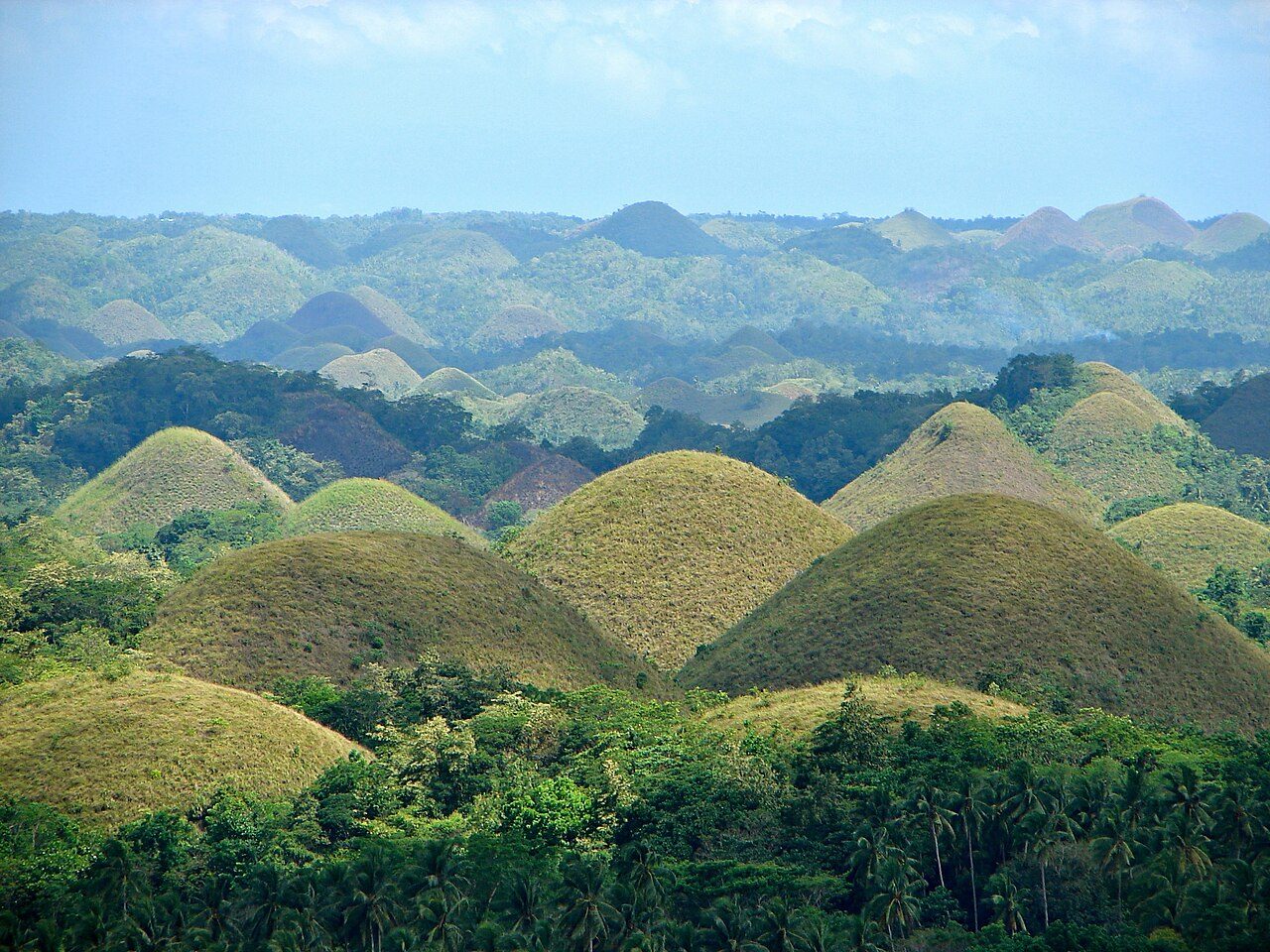
Chocolate Hills
Rising across fifty square kilometers of Bohol’s interior northeast of Tagbilaran, at least 1,776 symmetrical, conical karst mounds punctuate the landscape. Composed of Pliocene marine limestone derived from coral reefs and oceanic sediments, these uplifted domes—designated as the Philippines' third National Geological Monument on June 18, 1988—feature nearly uniform slopes soaring between 30 and 120 meters high. While local folklore attributes the formation to the dried tears of the heartbroken giant Arogo grieving his lost mortal love, Aloya, the hills owe their famed culinary moniker to seasonal botany. When the dry season parches the native *Imperata cylindrica* grass between February and May, the lush green terrain cures into a deep, cocoa-brown carpet stretching toward the horizon. Reaching the observation terrace in Carmen requires climbing 214 stone steps, rewarding visitors with a breeze-swept, 360-degree vantage over an undulating, almost alien topography. At dawn, thick swathes of white fog cling to the valleys between the limestone mounds, gradually dissolving as the tropical sun illuminates the textured, honeycombed slopes. Travelers standing on the deck gaze out over an unbroken ocean of earth mounds uninterrupted by modern architecture, feeling the vast, ancient scale of a submerged seabed thrust into the atmosphere by millennia of tectonic upheaval and sculpted by perpetual rainfall.
More in Tagbilaran

Photo credits (2)
- P199, CC BY-SA 3.0, via Wikimedia Commons
- P199, CC BY-SA 3.0, via Wikimedia Commons