
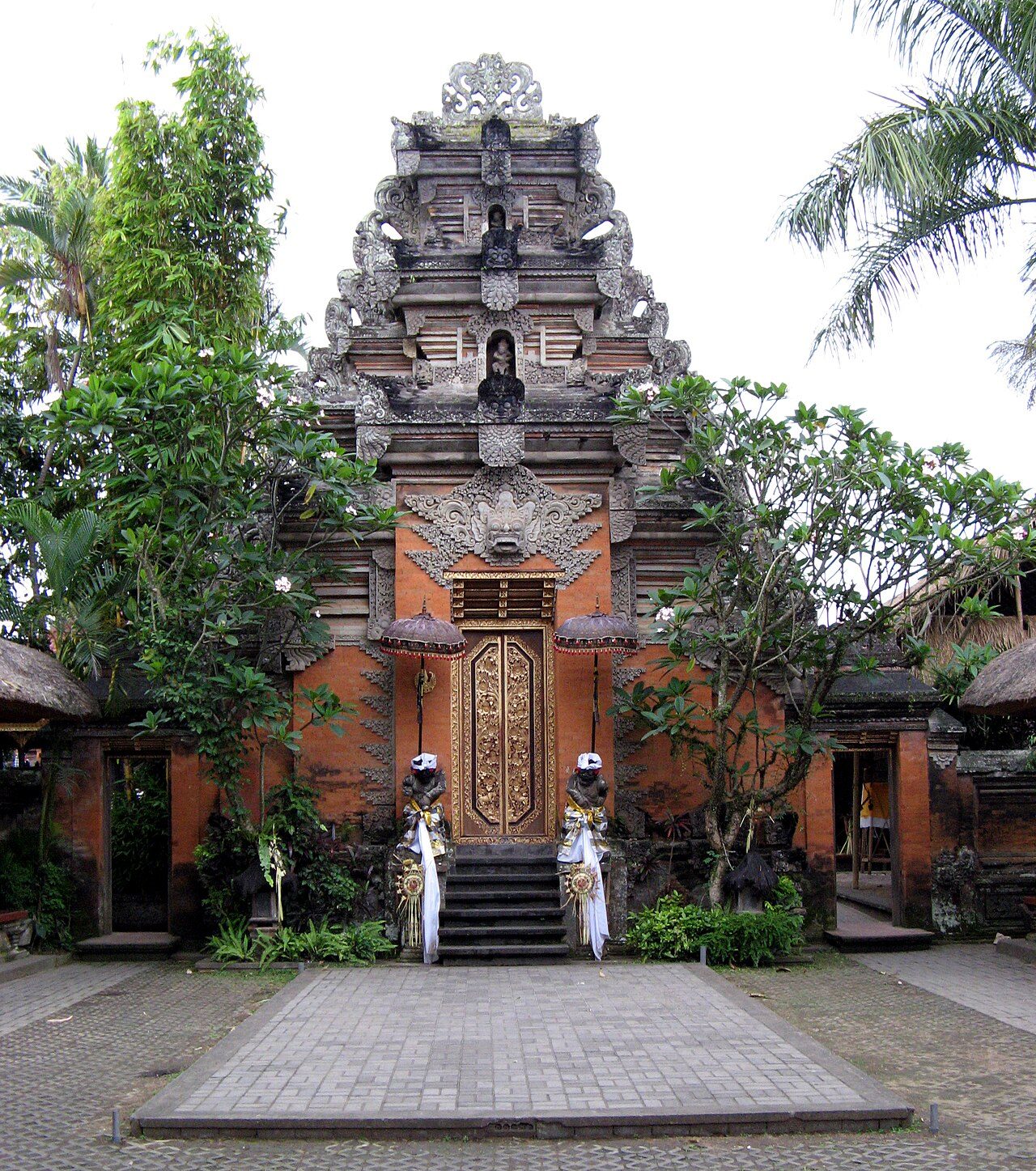
Ubud Palace
Commissioned in the early 19th century under the reign of Ida Tjokorda Putu Kandel and painstakingly restored after the catastrophic 1917 earthquake, Puri Saren Agung stands as the historic seat of Ubud’s royal Sukawati dynasty. Designed according to classical Balinese spatial principles, the compound organizes its walled enclosures along a cosmic axis, separating ancestral shrines from communal gathering pavilions. Weathered red-brick courtyards are pierced by towering *kori agung* stone gateways, where fierce, toothy *dvarapala* guardian statues flank the thresholds. Intricate relief carvings sculpted from charcoal-gray *paras* volcanic tuff cover the masonry with scenes from the Mahabharata, crowned by gilded teak pillars and tiered thatched roofs that shelter royal heirlooms. Stepping off the roaring junction of Jalan Raya Ubud into the palace’s shaded entryways, the modern town's chaos instantly yields to an atmosphere of cloistered reverence. Visitors traverse moss-dappled flagstones beneath sprawling banyan branches, enveloped in the fragrant haze of burning sandalwood and fresh frangipani blossoms left in palm-leaf *canang sari* offerings. As dusk falls, oil lamps illuminate the central courtyard for traditional performances, where the percussive shimmer of a live bronze gamelan ensemble reverberates against the stonework, accompanying Legong dancers whose golden headdresses and razor-sharp, darting eye movements animate centuries of courtly Balinese tradition.
More in Bali
Photo credits (2)
- Michael Gunther, CC BY-SA 4.0, via Wikimedia Commons
- Chainwit., CC BY 4.0, via Wikimedia Commons