
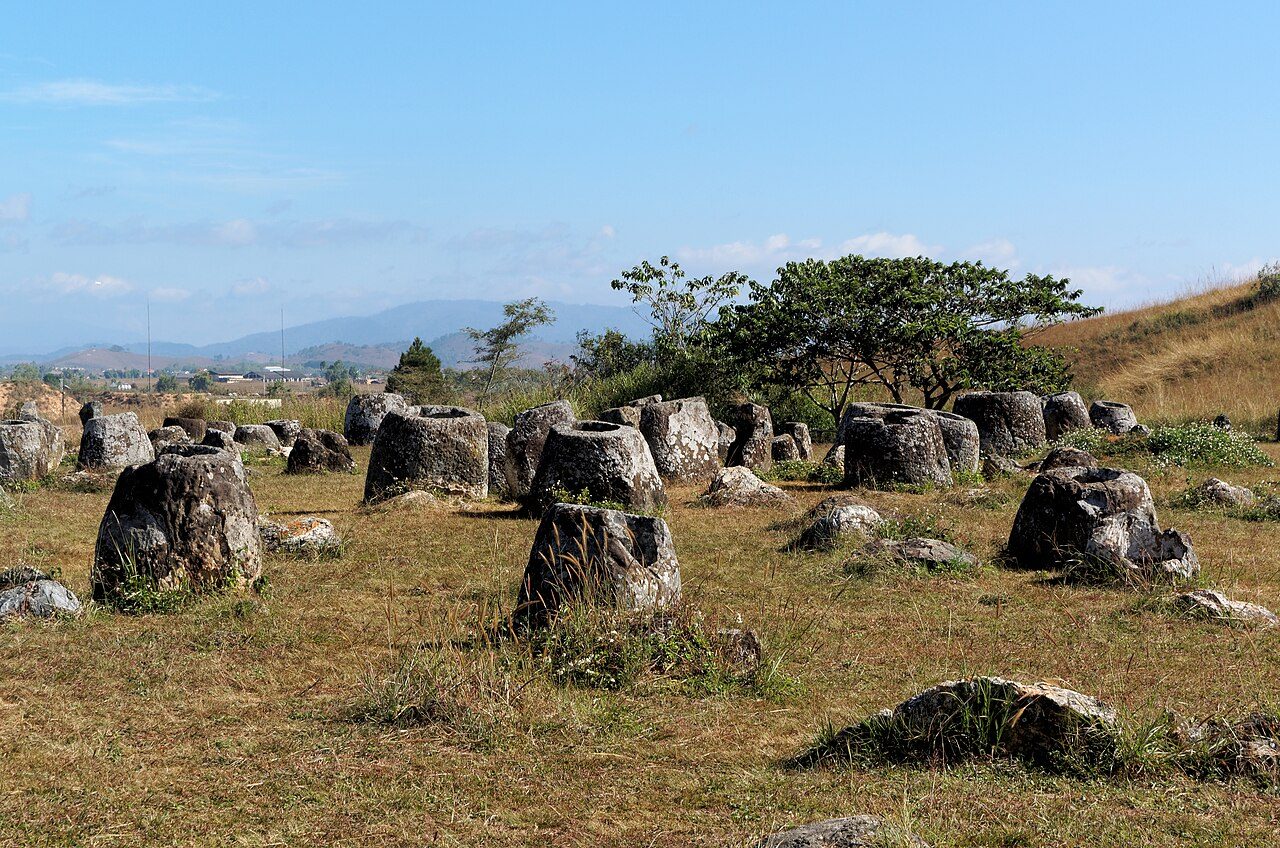
Plain of Jars
Scattered across the windswept plateaus of Xieng Khouang outside Phonsavan, thousands of megalithic stone vessels emerge like ancient sentinels from the ridgelines. Dating from Southeast Asia's Iron Age (roughly 500 BCE to 500 CE), these relics were first systematically surveyed in the 1930s by French archaeologist Madeleine Colani, who excavated human remains, glass beads, and bronze adornments that tied the urns to sophisticated prehistoric mortuary rituals. Chiseled primarily from local sandstone, granite, and conglomerate rock, the hollowed cylinders vary from modest knee-high vessels to colossal specimens exceeding three meters in height and fourteen tons in weight, with rare examples retaining carved disc-lids depicting frog motifs or stylized human figures. Standing at Site 1 (Thong Hai Hin), travelers confront a landscape caught between ancient mystery and modern tragedy. Narrow walking corridors—strictly bounded by red-and-white concrete markers laid by the Mines Advisory Group—steer visitors safely around unexploded ordnance and gaping bomb craters left behind by the U.S. Secret War of the 1960s and 70s. The air over the rolling savanna is cool and quiet, punctuated only by cattle bells and the sound of wind whistling across hollow stone rims. Towering over the grass stands *King Cheuang’s Jar*, an immense megalith legendarily attributed to a mythical victory feast, anchoring an encounter that feels both profoundly sacred and starkly haunting.